Wind Classification, Bracing and Tie-Downs for Exposed and Coastal Sites
$99.00 GST
On an exposed coastal site, the wind class on your drawings can be the most expensive line on the sheet. Copy it from a job down the street and every bracing wall, tie-down and window is selected for the wrong load, while salt air quietly decides how long each connector lasts.
This one hour CPD course is for building designers, architects, building surveyors, licensed builders and structural engineers. Four short modules, two case studies and a ten question quiz, with your certificate saved to your dashboard.
Description
Wind classification for an exposed or coastal house is a site decision made once and used by every trade, so it has to be right before anything is sized. By the end of this course, you will be able to apply the AS 4055 method to classify a non-cyclonic house site, evaluate when AS 4055 and the Housing Provisions stop applying, analyse the bracing and tie-down load path under AS 1684, and apply the coastal corrosion provisions and document every decision.
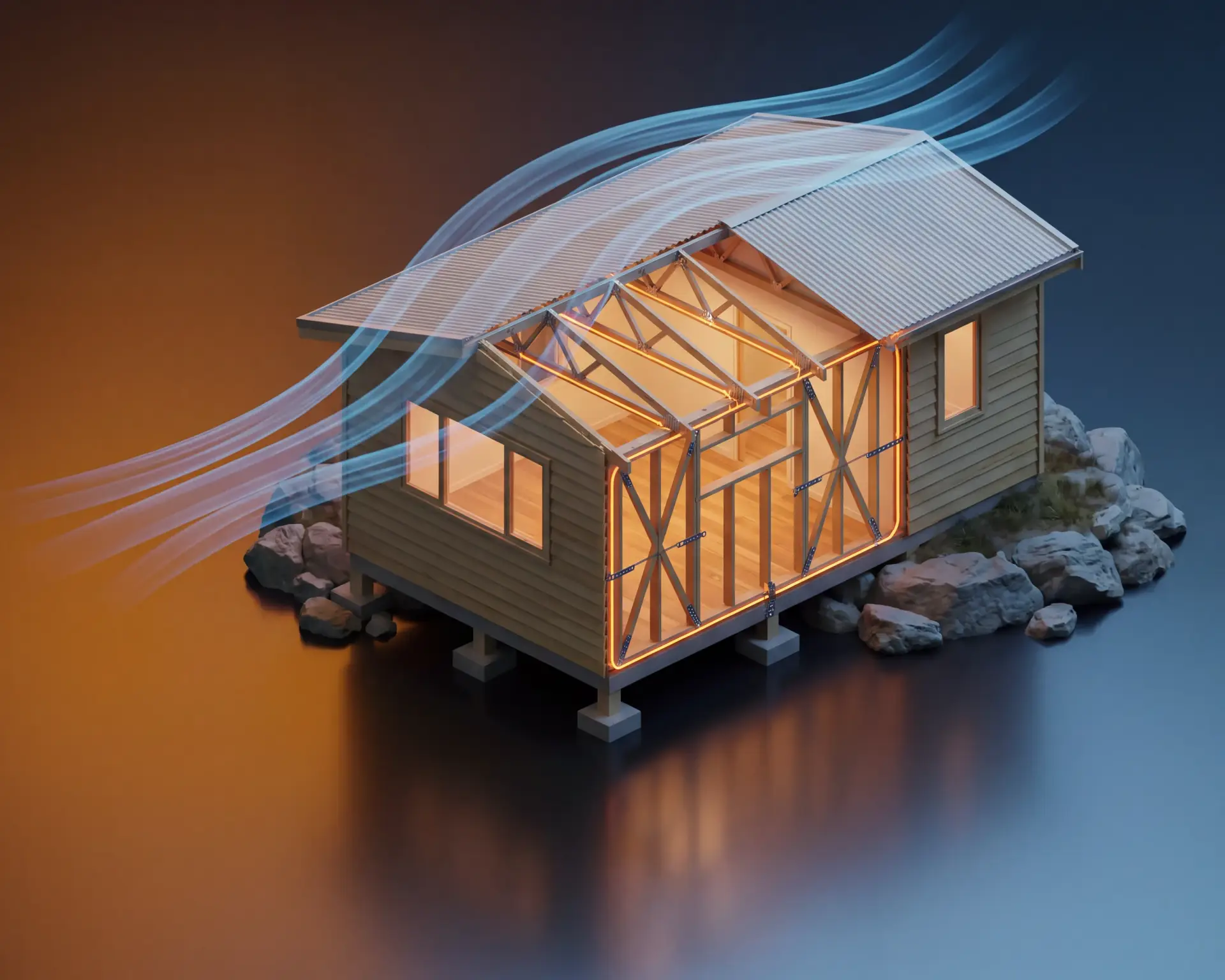
The course reads the four site inputs, wind region, terrain category, topographic class and shielding, into a single wind class, with the Tasmanian position stated. It then tests the house against the geometric limits of AS 4055 and the N3 line, above which much of the Housing Provisions acceptable construction stops and the referenced standards or an engineer take over. It follows bracing and tie-down as one continuous chain from the roof to the footing, including glazed walls, raking ceilings and wide masonry openings, and finishes with the corrosion environments set by distance to breaking surf and sheltered water, from roof sheeting and fixings to wall ties, lintels, steel and decks.
Two case studies put that into practice: an east coast headland house classified from the township below, and a beachfront roof specified as if it were inland.
This CPD reflects NCC 2022 Amendment 2, NCC 2025, the ABCB Housing Provisions and the Tasmanian Building Act 2016 and Building Regulations 2016 as published in November 2026. Confirm the edition, the wind classification and the structural design for each project with your building surveyor and, where required, a structural engineer. It is general professional education, not structural engineering advice.