

Course Content
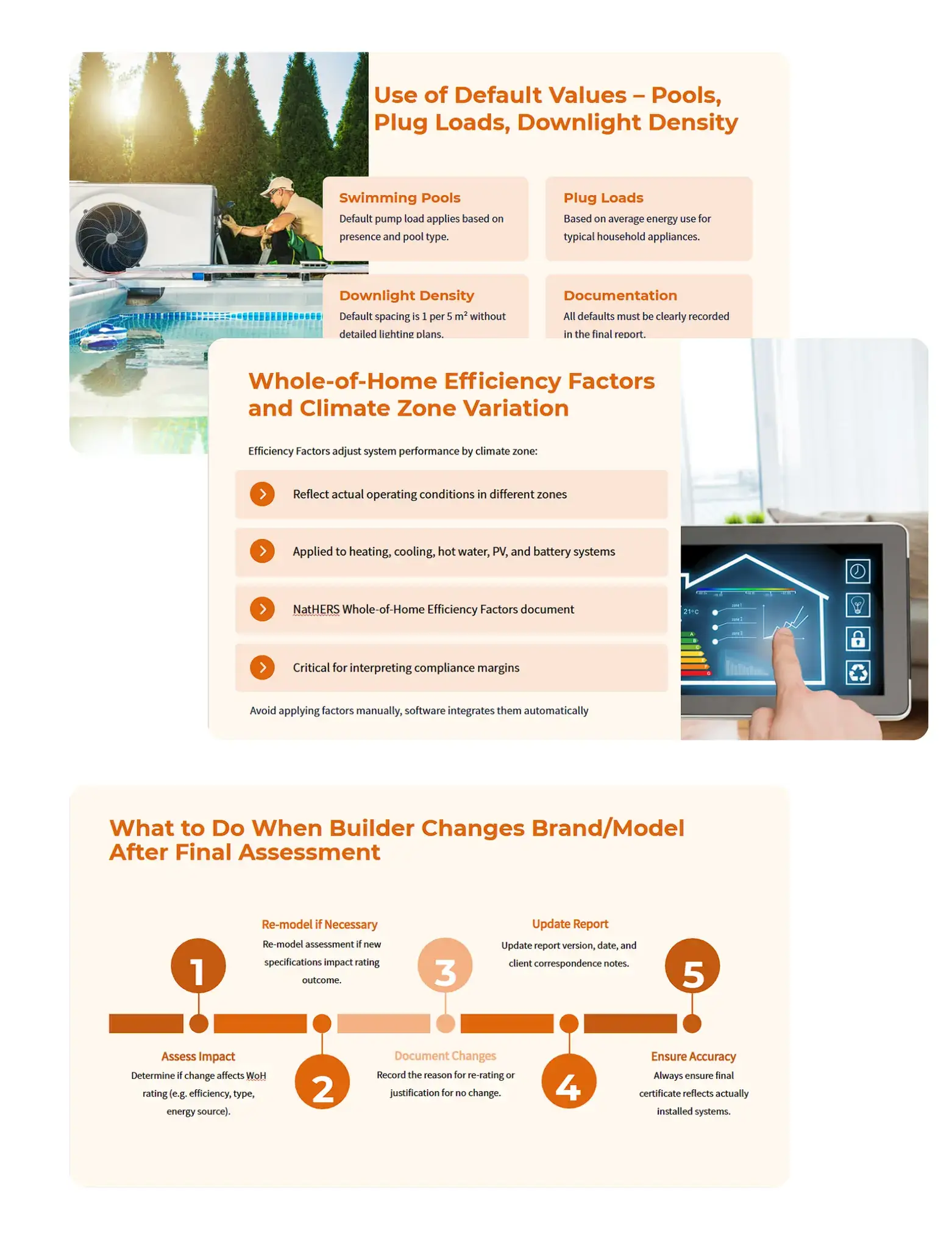
By the end of this session, you’ll understand the expanded scope of Whole-of-Home (WoH) assessments, which go beyond thermal performance to include heating, cooling, hot water systems, solar PV, battery storage, and plug loads. You’ll know how to apply default values and document assumptions in line with Section 12 of the NatHERS Technical Note to ensure compliance. The session will help you identify when a re-rating is required due to design or appliance changes and how to respond appropriately. You’ll also gain the practical skills needed to model fixed appliances accurately using NatHERS-accredited software. Ultimately, you’ll leave with greater confidence to deliver assessments that are compliant, traceable, and audit-ready.
Learning Outcomes
This ensures that CPD efforts align with professional regulatory requirements.
This CPD provides general guidance on professional responsibilities and documentation practices. It does not constitute legal advice or replace project-specific contractual or statutory obligations.
Compliance and Accreditation
|
Framework/Body |
Relevant Sections |
Focus Areas |
|
National Construction Code (NCC 2022) |
Volume Two, Section 13.6; ABCB Housing Provisions Part 13.6; J3D14 |
Whole-of-Home assessment scope, performance standards, default assumptions, software compliance using Chenath 3.22/3.23 |
|
NatHERS Protocols |
Technical Note Section 12; Software Protocols; Defaults and Re-rating Guidance |
Modelling heating, cooling, PV, batteries, plug loads; use of defaults; documentation and data retention; triggers for re-rating |
|
ABSA CPD Competency Area |
Professional Knowledge & Application; Reporting & Communication |
Application of new assessment tools, documenting assumptions, assessing compliance pathways, communicating changes with builders |
|
Building Designers |
NCC compliance understanding; fixed appliance modelling; appliance substitution protocols |
Modelling system performance; understanding compliance impacts of product selection and default usage |
|
NSCA 2021 (Architects) |
PC20, PC21, PC28, PC31, PC33 |
Regulatory alignment; sustainable design; environmental performance metrics; documentation and lifecycle carbon considerations |
|
Engineers Australia (Stage 2) |
Technical Proficiency; Practical Application of Engineering |
Simulation accuracy, system energy load evaluation, modelling for compliance, appliance lifecycle analysis |
|
Licensed Builders (State CPD) |
NSW Code of Conduct Clause 16 (CPD); Re-rating triggers; As-built system variation handling |
Changes requiring reassessment; builder communications; certifier readiness |
|
Building Surveyors |
NCC 2022 Part 13.6; Verification and Certification Standards |
Verifying modelling inputs, assessing assumption legitimacy, checking compliance of fixed systems |
This session is designed for

Energy Assessors

Architects

Building Designers

Builders

Building Surveyors
What’s Included
This course covers the practical application of the updated NatHERS Whole-of-Home (WoH) requirements under NCC 2022 for energy assessors. It explores the expanded assessment scope, which now includes not only the thermal envelope but also fixed appliances such as heating and cooling systems, hot water units, solar PV, battery storage, and plug loads. You’ll learn how to apply default values and document assumptions correctly, when and how to conduct a re-rating, and how to model systems using tools powered by the Chenath 3.22 and 3.23 engines. The course also covers regulatory alignment with ABCB Housing Provisions, proper data retention, and effective communication protocols with builders and designers to ensure compliance throughout a project’s lifecycle. In short, it provides assessors with the skills, tools, and knowledge needed to deliver accurate, audit-ready, and NCC-compliant Whole-of-Home energy assessments.
Why Take This CPD Session?

Ensure compliance with NCC 2022 by mastering the expanded scope of Whole-of-Home assessments under NatHERS, including fixed appliances and plug loads.
Avoid costly errors and rework by learning when re-rating is required and how to document assumptions and defaults in line with Section 12 of the NatHERS Technical Note.
Enhance your practical skills in modelling appliances and interpreting software outputs using accredited NatHERS tools powered by the Chenath engine.
Professional development is an investment in career growth and regulatory compliance. Take the next step today.