

Course Content
By the end of this course, you will be able to read a NatHERS specification that exists but says too little, and turn its words into defensible modelling inputs. A specification line is sorted first into prescriptive, performance or reference, so that a confident sentence about complying with the NCC is never mistaken for a number. Insulation, construction and colour descriptions are converted into the value the engine reads, with the point where a default or a request takes over made explicit. Glazing schedules that say double glazed and nothing else are worked through the Technical Note’s window rules, including the three conditions for substituting a custom window. Or equivalent is given a test rather than a generous reading, and the request and certificate note that keep each input defensible are written from the input backwards.
Learning Outcomes
This ensures that CPD efforts align with professional regulatory requirements.
This CPD provides general guidance on professional responsibilities and documentation practices. It does not constitute legal advice or replace project-specific contractual or statutory obligations.
Compliance and Accreditation
|
Framework/Body |
Relevant Sections |
Focus Areas |
|
NatHERS Technical Note (version 20241023; Chenath 3.22 and 3.23; NCC 2022 requirements) and NatHERS Assessor Handbook |
Section 2 design documentation (2.5); section 3 data entry, consistency, clarification and defaults (3.3 to 3.9); section 6 void formers (6.4); section 7 wall colour and insulation (7.1 to 7.4); section 8 windows, default and custom libraries, substitution conditions, openability, obscure glass, frame colour, restrictors (8.2 to 8.13, Table 5); section 9 roof colour (9.1, 9.2); section 10 screens (10.8); section 11 thermal bridging, steel frame defaults, thermal breaks (11.1 to 11.8, Tables 8 and 9); section 12 Whole of Home appliance evidence and re-rating triggers (12.5, 12.9, 12.26); section 13 stamping and additional notes (13.1, 13.2); section 14 colour definitions |
Primary framework. Reading a thin specification as evidence: the evidence standard for a non-default input, the currency of R-values, reflective layers and colour, the window substitution conditions, or equivalent, the request and the certificate note |
|
ABSA and AAO Protocol CPD categories |
Category a (understanding the NatHERS Technical Note and Assessor Handbook); category d (ways to improve building envelope thermal performance) |
Formal technical CPD point; software-safe (no tool operation, no product names) |
|
National Construction Code (NCC 2022 and NCC 2025; edition by jurisdiction) |
Volume Two H6D2 and Specification 42 (S42C2 to S42C4): the energy rating pathway and the Housing Provisions clauses it calls up; ABCB Housing Provisions Part 13.2: 13.2.2 insulation installation, 13.2.3(2), (5), (7) and (10) roofs, 13.2.5(3) to (5) walls, 13.2.6(4) to (6) slab edge insulation; Part 13.4 building sealing; Part 13.7 services |
What a reference line (to comply with the NCC) commits the builder to under the rating pathway, without giving the assessor a value; elemental absorptance caps as the reason a specification says light coloured roof; labelled versus total R-values |
|
Australian Standards |
AS/NZS 4859.1 (materials for the thermal insulation of buildings: labelled, declared R-values); AS/NZS 4859.2 (total R-value calculation); AFRC protocol for whole window U-value and SHGC (WERS and WERSlink libraries) |
The currency of an R-value and a window rating; why European ratings and centre of glass figures are not inputs |
|
Building Designers (state licensing CPD, for example QBCC and BDAA) |
Documentation and specification practice; NCC energy efficiency provisions for Class 1 buildings |
What a NatHERS-ready specification carries; the request the assessor will send back |
|
NSCA 2021 (Architects) |
PC12, PC33, PC37, PC45, PC55, PC56 |
LO1 to PC12: how building codes and standards apply across practice, including the rating pathway’s construction clauses. LO2 to PC33 and PC45: integrating thermal systems and selecting materials, finishes and components on performance evidence. LO3 to PC37: producing accurate and complete documentation that can be modelled and constructed. LO4 to PC55 and PC56: document control, revision status and the approval of substitutions during construction |
|
Building Surveyors and certifiers (AIBS CPD; state registration) |
Assessment of documentation against the NatHERS certificate and its additional notes; frame stage inspection of insulation, thermal breaks and installed window products |
Testing the built house against the substitution range on the certificate |
This session is designed for

NatHERS Energy Assessors

Building Designers

Architects

Building Surveyors

Builders and Estimators
What’s Included
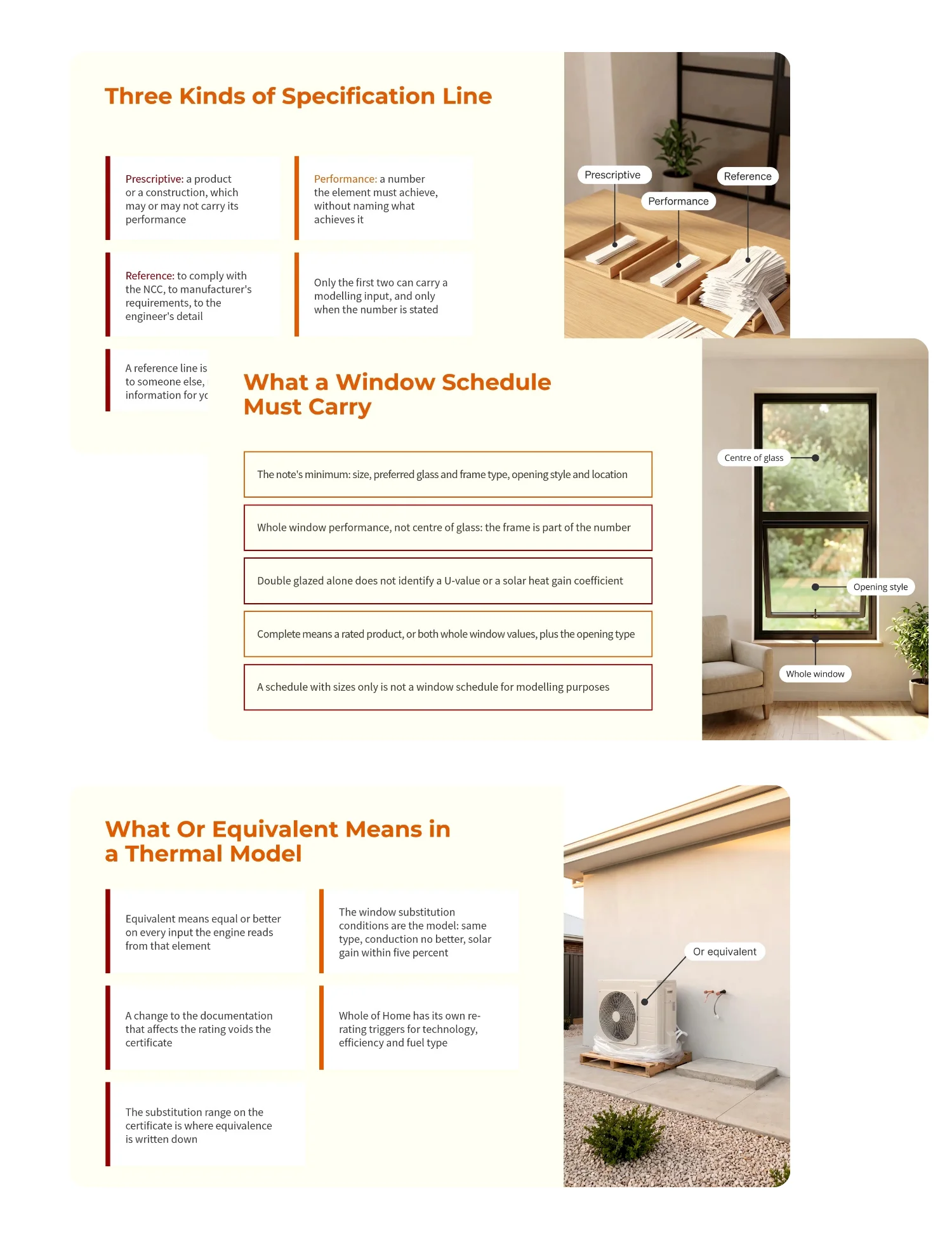
This course examines the specification that exists but does not say enough: the generic insulation line, the window schedule that reads double glazed throughout, the roof described only as light coloured, and the product name followed by or equivalent. It sorts every line into what it proves and what it only promises, then applies the NatHERS Technical Note’s evidence standard to each non-default input. The currency of an R-value, the three numbers a reflective layer needs, the chart value behind a colour word and the whole window figures behind a glazing line are each traced to the point where a default or a request takes over. Substitution is treated as a test written on the certificate, using the Technical Note’s window conditions as the template for every other element. Two case studies, a volume builder’s standard specification and an architect’s performance specification, apply the same reading to a full set of documents.
Why Take This CPD Session?

Learn to sort a specification into prescriptive, performance and reference lines, so a confident sentence about complying with the NCC is never entered as a number.
Convert insulation, colour and glazing descriptions into the values the engine reads, and know exactly where the words run out and a default or a request takes over.
Build the habit of writing the ranked request and the certificate note that settle a substitution at frame stage, tested on a volume builder’s specification and an architect’s performance specification.
Professional development is an investment in career growth and regulatory compliance. Take the next step today.