

Course Content
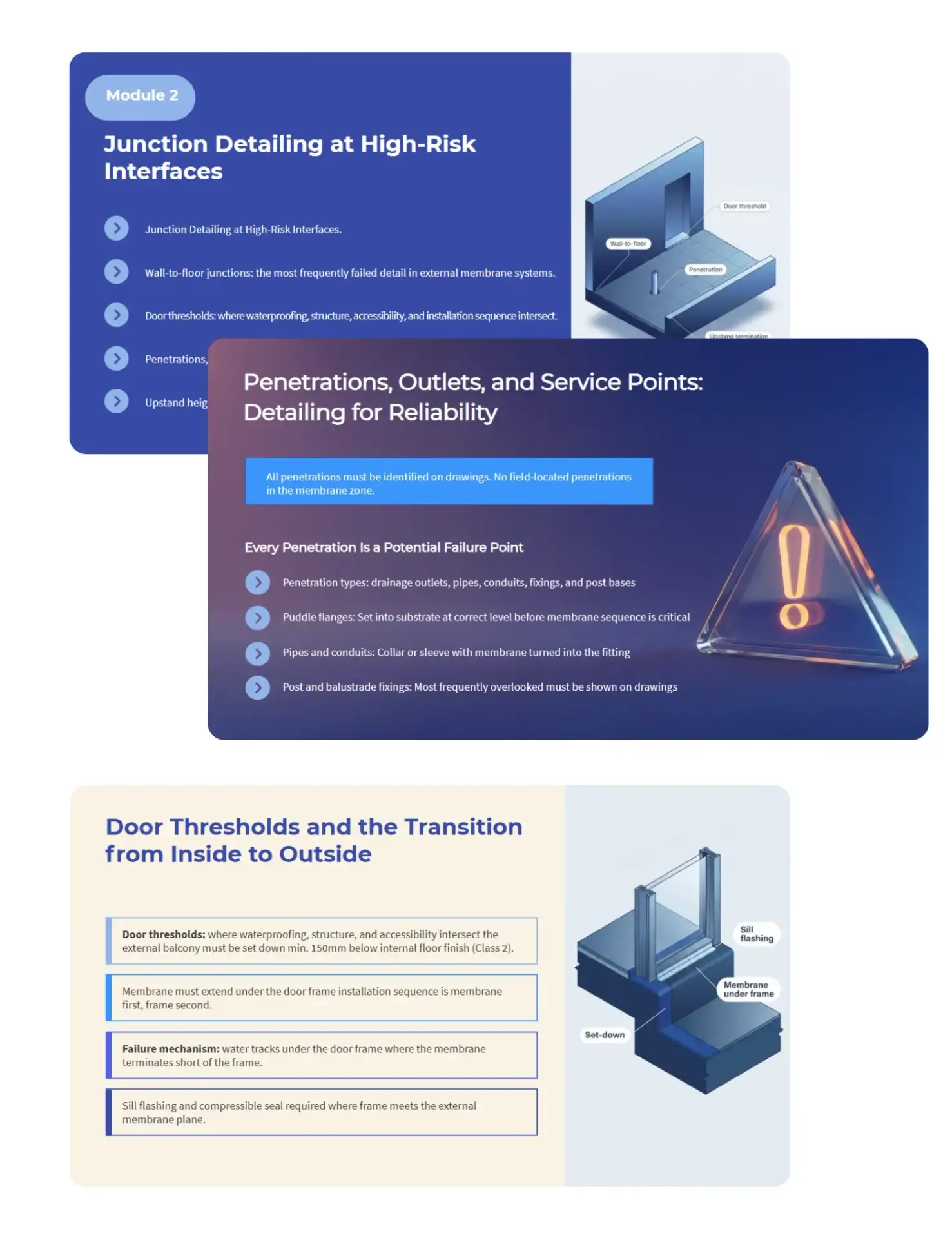
By the end of this course, participants will be able to analyse the key failure modes that cause waterproofing breakdown in balconies and podiums and link them to compliance requirements. They will be able to design and detail high risk junctions such as wall to floor connections, thresholds, and penetrations with greater accuracy. Participants will understand how to apply appropriate falls and drainage strategies that go beyond minimum code requirements to improve real world performance. They will also be able to select and specify membrane systems based on substrate conditions and structural movement. Finally, they will be equipped to produce clear documentation and specifications that reduce ambiguity, support compliance, and protect against design liability.
Learning Outcomes
This ensures that CPD efforts align with professional regulatory requirements.
This CPD provides general guidance on professional responsibilities and documentation practices. It does not constitute legal advice or replace project-specific contractual or statutory obligations.
Compliance and Accreditation
|
Framework/Body |
Relevant Sections |
Focus Areas |
|
National Construction Code (NCC 2022) |
Volume One & Two – Waterproofing Performance Requirements; External moisture management; Class 1 & Class 2 provisions |
Compliance with waterproofing performance requirements; prevention of water ingress; balcony and podium design obligations; falls, drainage, and threshold detailing |
|
ABSA CPD Competency Area |
Building Physics; Moisture Management; Construction Detailing |
Moisture control strategies; membrane performance; substrate conditions; risk mitigation in external wet areas |
|
Building Designers |
Design Documentation; Construction Detailing; Compliance |
Balcony and podium detailing; junction resolution; specification clarity; coordination with construction outcomes |
|
NSCA 2021 (Architects) |
PC12, PC33, PC39, PC45, PC46 |
PC12 (regulatory requirements and building codes): The course is strongly anchored in NCC 2022 and Australian Standards (AS 3740, AS 4654), requiring understanding and application of compliance frameworks for waterproofing design. |
|
Engineers Australia (Stage 2) |
Element 2 (Engineering Application Ability); Element 3 (Professional and Personal Attributes) |
Structural movement considerations; coordination with structural design; performance-based solutions; interdisciplinary collaboration |
|
Licensed Builders (State CPD) |
Construction Practices; Waterproofing Installation Standards; QA Processes |
Buildability of details; installation sequencing; substrate preparation; inspection and sign-off processes |
|
Building Surveyors |
Compliance Assessment; Certification; Performance Solutions |
Verification of NCC compliance; assessment of DTS vs Performance Solutions; inspection of waterproofing systems |
|
Urban Planners & Landscape Architects |
Site Planning; External Works Integration; Drainage Coordination |
Podium drainage coordination; integration of landscape elements with waterproofing systems; surface water management |
This session is designed for

Architects

Building Designers

Builders

Building Surveyors

Structural Engineers
What’s Included
This course examines why balconies and podiums are the most failure prone waterproofing areas in buildings and how these risks develop over time. It explores the interaction between substrate condition, structural movement, and environmental exposure in driving membrane failure. The course also investigates how design decisions around detailing, drainage, and sequencing directly influence long term performance. In addition, it reviews the regulatory framework and standards that govern waterproofing compliance in Australia. Finally, it looks at how gaps in documentation and specification translate into real world defects and liability.
Why Take This CPD Session?

Reduce the risk of costly waterproofing failures by making better design and specification decisions early in the project.
Strengthen your understanding of compliance requirements and detailing practices for high risk balcony and podium conditions.
Protect your professional position with clearer documentation, better coordination, and defensible specifications.
Professional development is an investment in career growth and regulatory compliance. Take the next step today.