

Course Content
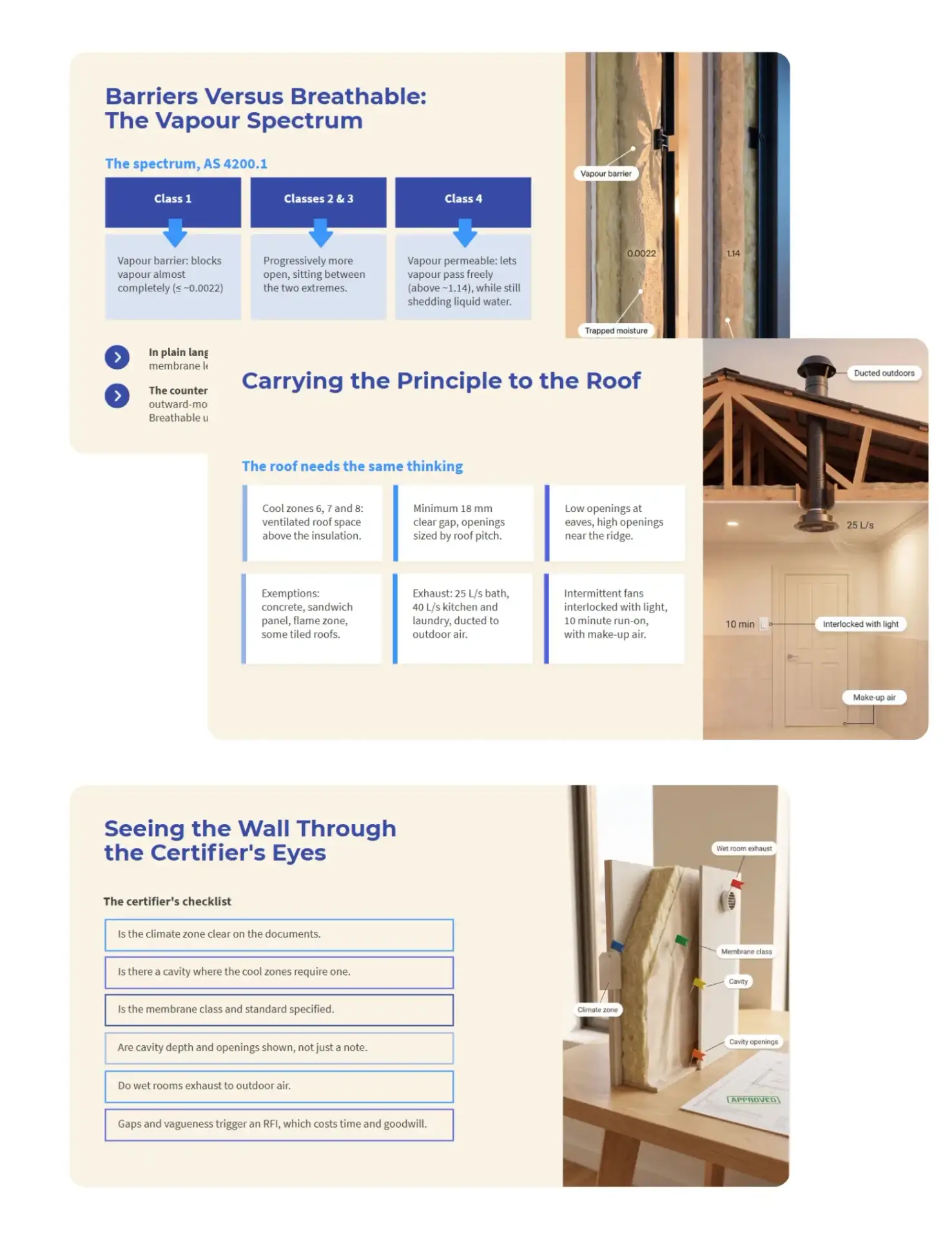
By the end of this course, you will understand how condensation forms within residential wall and roof assemblies and how NCC 2025 addresses condensation risks through compliant design practices. You will be able to determine the appropriate use of drained and ventilated cavities, select the correct building membrane for different climate zones, and coordinate these elements into an effective wall system. You will also gain the confidence to document condensation management requirements clearly on drawings and specifications, helping achieve smoother approvals and more durable, healthier residential buildings. In addition, you will be able to identify common design and documentation errors that can lead to moisture related failures, mould growth, and costly rectification work. You will leave with practical knowledge that can be applied immediately to residential projects, improving both compliance outcomes and long term building performance.
Learning Outcomes
This ensures that CPD efforts align with professional regulatory requirements.
This CPD provides general guidance on professional responsibilities and documentation practices. It does not constitute legal advice or replace project-specific contractual or statutory obligations.
Compliance and Accreditation
|
Framework/Body |
Relevant Sections |
Focus Areas |
|
National Construction Code (NCC 2025 & NCC 2022) |
NCC 2025 Volume Two Performance Requirement H4P7; Housing Provisions Part 10.8; transitional application of NCC 2022 |
Condensation management, drained and ventilated cavities, climate zone requirements, membrane selection, roof and wet area ventilation, compliance documentation, residential detailing and certification. |
|
NatHERS Protocols |
Relationship between energy efficiency and condensation management |
Interaction between airtightness, insulation and moisture movement. Understanding that improved thermal performance increases condensation risk and requires appropriate moisture management. |
|
ABSA CPD Competency Areas |
Building physics, thermal performance, moisture management, residential construction |
Building envelope performance, condensation risk assessment, climate-responsive detailing, compliance with NCC housing provisions. |
|
Building Designers |
Residential design documentation, NCC Volume Two compliance, specification writing |
Wall and roof detailing, membrane specification, cavity design, documentation for approvals, coordination with builders and certifiers, risk management. |
|
NSCA 2021 (Architects) |
PC12, PC28, PC33, PC45, PC46 |
PC12 is directly applicable because the course focuses on understanding and applying NCC 2025 condensation provisions, building codes, standards, and compliance requirements. PC28 is highly relevant as the course explains building science principles including moisture movement, dew point, vapour diffusion, thermal behaviour, and condensation risk which underpin sound conceptual design decisions. PC33 aligns with the integration of sustainable environmental systems, particularly the coordination of membranes, ventilation, insulation, and moisture management to improve building performance. PC45 is appropriate because the course addresses quality and performance standards for wall assemblies, membranes, ventilation cavities, and compliance with NCC performance requirements. PC46 is strongly supported through the learning objective requiring participants to correctly document condensation compliance on drawings and specifications to achieve first-time certifier approval. |
|
Licensed Builders (State CPD) |
Construction compliance, building envelope installation, NCC compliance |
Correct installation of membranes, cavity construction, sequencing, quality assurance, preventing defects and reducing rectification risk. |
|
Building Surveyors |
Assessment against NCC Volume Two and Housing Provisions |
Reviewing compliance documentation, verification of membrane classes, cavity detailing, ventilation provisions and certification requirements. |
This session is designed for

Building Designers

Architects

Building Surveyors

Residential Builders

Energy Assessors
What’s Included
This course examines the science of moisture movement within residential building envelopes and the design principles that help prevent condensation related defects. It explores the NCC 2025 requirements for wall and roof assemblies, including the role of ventilated cavities, building membranes, and climate specific design decisions. The course also investigates how proper detailing and documentation contribute to successful certification and long term building durability. Using practical examples and real project scenarios, it demonstrates how thoughtful condensation management can improve building performance and occupant health.
Why Take This CPD Session?

Understand the latest NCC 2025 condensation requirements and apply them confidently to residential projects.
Learn practical strategies to reduce moisture related defects, mould growth, and costly remediation.
Improve your design documentation and specification skills to support smoother approvals and better building performance.
Professional development is an investment in career growth and regulatory compliance. Take the next step today.