

Course Content
By the end of the course, participants will understand how to design and manage a smooth transition of leadership or ownership within an architectural studio, with clarity around both strategic and practical steps. They will have a solid grasp of the financial, legal, and cultural factors that influence successful succession, including valuation methods, formal agreements, governance structures, and the protection of intellectual property. Participants will also understand how to maintain business continuity during periods of change by safeguarding project knowledge, digital assets, client relationships, and compliance obligations. They will be familiar with different ownership pathways such as partnerships, equity-sharing models, and employee share schemes, and how these options shape long-term stability. Most importantly, they will be able to develop a clear, actionable succession roadmap that strengthens leadership capability, preserves studio identity, and reduces risk across the practice.
Learning Outcomes
This ensures that CPD efforts align with professional regulatory requirements.
This advanced CPD course provides architects and studio leaders with a structured approach to preparing their practice for future leadership transitions and long-term resilience. It explains strategic options for ownership or leadership change while covering key financial, legal, and cultural considerations that influence smooth and compliant transitions. Participants learn how to maintain business continuity, safeguard digital and intellectual assets, and uphold regulatory obligations during periods of disruption. The course also explores modern ownership pathways such as internal promotion, equity-sharing models, and employee participation. By the end, attendees are equipped with practical tools to build a clear succession roadmap that protects their studio’s identity, stability, and long-term value.
Compliance and Accreditation
|
Framework/Body |
Relevant Sections |
Focus Areas |
|
National Construction Code (NCC 2022) |
Section A – Governing Requirements; Part A5 – Documentation of Performance Solutions |
Emphasises responsibility and continuity of licensed practitioners for in-progress projects and NCC compliance during leadership transitions. |
|
ABSA CPD Competency Area |
Section 4 – Business Operations & Professional Development |
Aligns with business continuity, legal responsibilities, IP handling, and strategic planning within certified practice frameworks. |
|
Building Designers |
BDAA – Business Continuity & Practice Management Streams |
Addresses studio succession, ownership transfer, IP control, and cultural alignment with practice management responsibilities for sole and team-based designers. |
|
NSCA 2021 (Architects) |
PC1, PC2, PC5, PC15, PC16 |
Covers legal frameworks, risk mitigation, business planning, quality assurance, IP rights, cultural continuity, and governance strategies for architectural practice. |
|
Urban Planners & Landscape Architects |
Planning Institute of Australia Ethics & Governance |
Overlaps in leadership transition, cultural values, and professional responsibility. However, technical content is architectural in focus. |
This session is designed for

Architects

Studio Directors

Practice Managers

Succession Advisors

Interior Architects
What’s Included
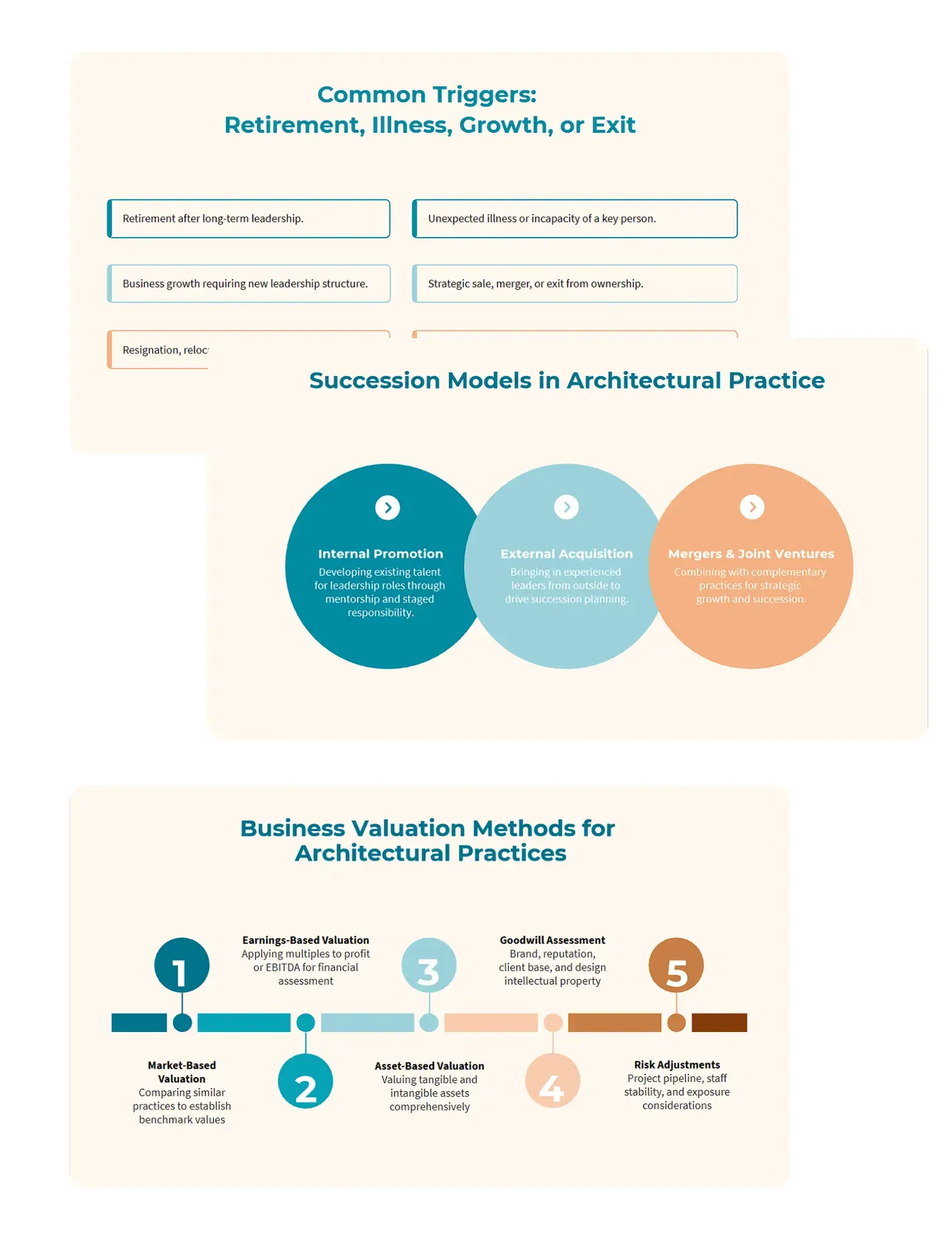
This course covers the full spectrum of succession planning and future-proofing for architectural studios, including how to prepare for leadership or ownership transitions and the common triggers that make planning essential. It explores financial and legal frameworks such as valuation methods, equity transfer structures, governance systems, and intellectual property protection. The course also addresses cultural continuity, helping studios preserve their design ethos, client relationships, and internal identity during change. Participants learn how to maintain business continuity by documenting workflows, managing digital assets, protecting compliance obligations, and reducing key-person risk. Finally, the course examines ownership pathways such as partnerships, ESOPs, and cooperative models, supported by real case studies from Australian practices.
Why Take This CPD Session?

Equips you with practical, compliant strategies to protect your studio from disruption, legal risk, and loss of value during leadership or ownership transitions.
Provides clear, real-world guidance on financial, legal, cultural, and operational elements that studios often overlook until it is too late.
Helps you strengthen long-term resilience by establishing future leaders, safeguarding digital assets, and ensuring continuity for clients and projects.
Professional development is an investment in career growth and regulatory compliance. Take the next step today.