

Course Content
By the end of this course, you will understand how to interpret existing home energy assessments and turn them into practical retrofit strategies that homeowners can confidently act on. You will learn how to diagnose building performance issues, evaluate retrofit options using cost, savings, payback periods and available incentives, and create structured retrofit roadmaps that prioritise improvements in the most effective sequence. You will also gain the skills to communicate recommendations clearly, align retrofit plans with homeowner goals and budgets, manage expectations realistically, and develop long term advisory relationships that deliver both improved building performance and measurable value for homeowners
Learning Outcomes
This ensures that CPD efforts align with professional regulatory requirements.
This CPD provides general guidance on professional responsibilities and documentation practices. It does not constitute legal advice or replace project-specific contractual or statutory obligations.
Compliance and Accreditation
|
Framework/Body |
Relevant Sections |
Focus Areas |
|
National Construction Code (NCC 2022 & NCC 2025) |
Volume Two – Existing buildings, energy efficiency principles, renovation considerations, interaction with energy efficiency upgrades |
Application of energy-efficiency principles during alterations and renovations, understanding retrofit opportunities, sequencing upgrades, relationship between existing-home improvements and current NCC performance expectations. |
|
NatHERS Protocols (Existing Homes) |
Existing Homes In-Home Assessment Protocols, assessor methodology, rating interpretation, homeowner reporting |
Transition from Residential Efficiency Scorecard to NatHERS Existing Homes, interpreting ratings, understanding assessment limitations, converting ratings into practical retrofit advice, maintaining currency with evolving accreditation pathways. |
|
ABSA CPD Competency Areas |
Existing home assessment, advisory services, retrofit planning, client communication |
Building performance assessment, retrofit prioritisation, energy-efficiency recommendations, economic analysis, communication of recommendations, professional advice based on current incentive programs. |
|
Building Designers |
Sustainable design, building performance, renovation design, client advisory services |
Diagnosing existing-home performance, retrofit sequencing, integrating energy upgrades into renovation projects, advising clients on cost-effective improvements and long-term building performance. |
|
NSCA 2021 (Architects) |
PC20, PC21, PC28, PC31, PC33 |
PC20 is relevant because the course teaches participants to assess retrofit options against budgets, costs, rebates, ROI and homeowner objectives. PC21 applies through the emphasis on cost planning, value management, CAPEX/OPEX analysis, payback periods and sequencing retrofit investments. PC28 is strongly aligned as the course requires participants to apply building science, thermal performance, building fabric, insulation, glazing and energy efficiency principles when diagnosing existing homes and developing retrofit strategies. PC31 is directly applicable because the course focuses on improving environmental sustainability by reducing operational energy demand, improving building performance and integrating lifecycle thinking into retrofit decision-making. PC33 is appropriate as participants evaluate and recommend sustainable environmental systems—including thermal performance improvements, efficient services, electrification and solar—in an integrated retrofit roadmap rather than as isolated upgrades. |
|
Engineers Australia (Stage 2 Competencies) |
PE2 Technical Proficiency, PE3 Professional & Personal Attributes |
Building performance analysis, energy efficiency principles, risk-informed recommendations, lifecycle cost evaluation, stakeholder communication, ethical professional advice. |
|
Licensed Builders (State CPD) |
Energy-efficiency upgrades, renovation sequencing, construction best practice |
Practical implementation of retrofit measures, sequencing works, understanding insulation, draught sealing, services upgrades and coordination of staged renovation works. |
|
Building Surveyors |
Existing building compliance, renovation assessment, regulatory interpretation |
Understanding retrofit works that may trigger approvals, interaction between voluntary energy upgrades and regulatory requirements, advising on compliance implications of renovation work. |
This session is designed for

Architects

Building Designers

Home Energy Assessors

Building Surveyors

Licensed Builders
What’s Included
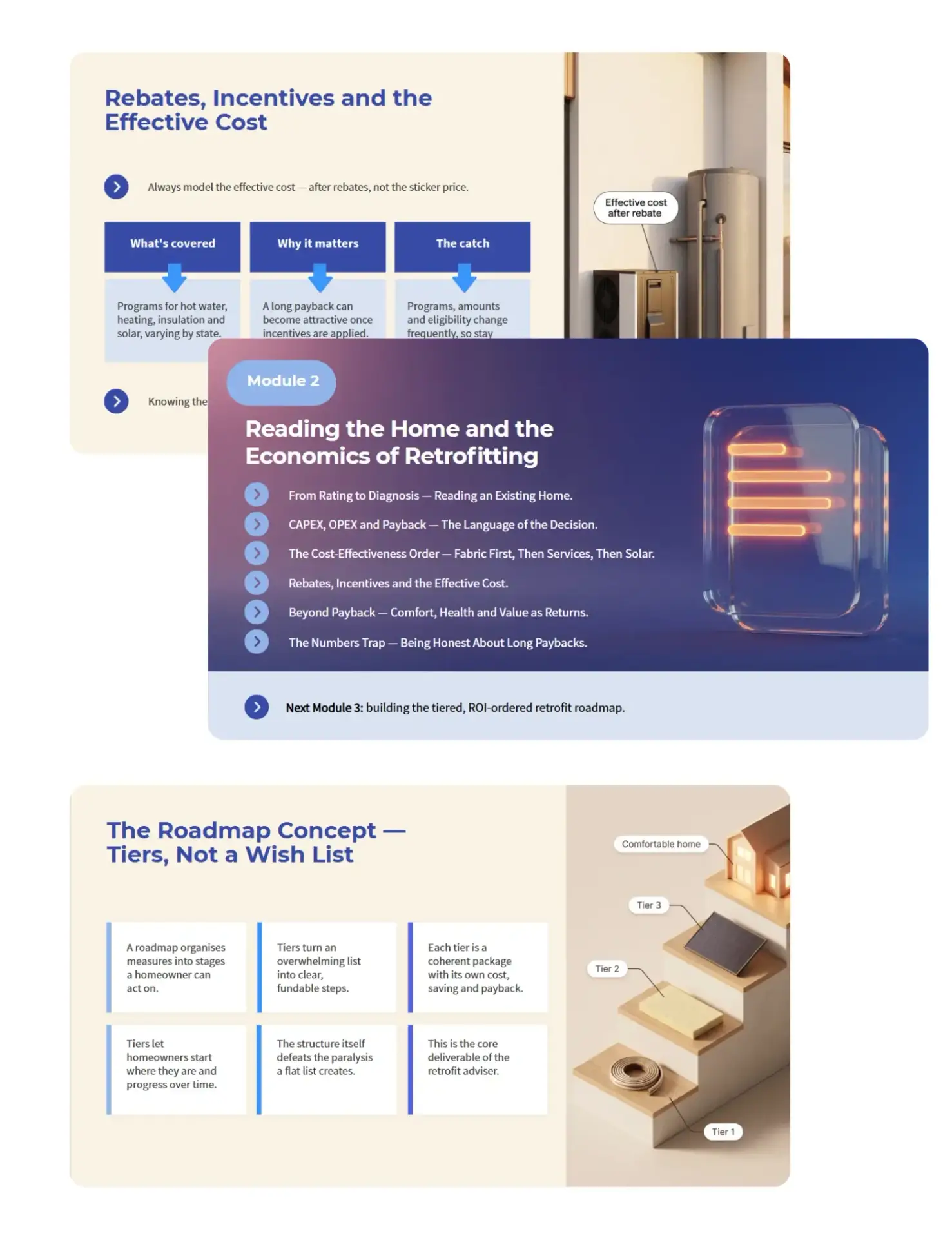
As energy rating programs for existing homes transition from the Residential Efficiency Scorecard to NatHERS for Existing Homes, the demand for practical, outcome-focused retrofit advice is growing rapidly. This course explores how to move beyond simply producing an energy rating by interpreting existing-home assessments, identifying the underlying causes of poor performance, and prioritising retrofit measures based on cost-effectiveness, comfort and long-term value. It examines how to evaluate retrofit options using CAPEX, OPEX, payback periods, rebates and incentives, while developing staged Retrofit Roadmaps that homeowners can realistically implement over time. The course also covers effective communication strategies, helping you present recommendations in a clear, homeowner-friendly format, tailor advice to different budgets and life stages, manage expectations honestly, and build long-term advisory relationships that deliver ongoing value for both clients and your practice.
Why Take This CPD Session?

Learn how to turn existing-home energy ratings into practical, staged retrofit plans that homeowners can confidently implement.
Develop the skills to evaluate retrofit measures using costs, payback, rebates and long-term value to deliver trusted, evidence-based advice.
Position yourself to capitalise on the growing retrofit market by offering a high-value advisory service that goes beyond energy assessments.
Professional development is an investment in career growth and regulatory compliance. Take the next step today.