

Course Content
By the end of this course, you will be able to explain why a design practice ends up competing on price and what a year of discounting really costs it. Value is defined from the client’s side, as the outcome they get rather than the tasks you perform, so the course shows you how to name your genuine differentiators and back them with proof. A first meeting spent listening, a proposal that opens with the client’s goals and reaches the fee last, and a number stated without apology then turn that value into work won at full fee. Options and anchoring let the client choose how to work with you instead of deciding whether to. When the too-expensive objection, the cheaper rival quote or the third kitchen move arrives, you will have a calm, scope-based answer that holds the fee.
Learning Outcomes
This ensures that CPD efforts align with professional regulatory requirements.
This CPD provides general guidance on professional responsibilities and documentation practices. It does not constitute legal advice or replace project-specific contractual or statutory obligations.
Compliance and Accreditation
|
Framework/Body |
Relevant Sections |
Focus Areas |
|
NSCA 2021 (Architects) |
PC5, PC6, PC7, PC19 |
LO2 and LO3 to PC5: the essential elements of a client architect agreement, including alternatives for partial services, applied through tiered options (design and approval; design, approval and documentation; contract administration) described by scope and outcome. LO4 to PC6: reporting and varying the scope of services, applied to scope creep, naming a variation early and calmly, offering more for more and keeping a variation log. LO3 and LO4 to PC7: clear and consistent communication with clients, applied to the first meeting, the proposal walked through in person, the fee stated without apology and the reply to the too-expensive objection. LO1 and LO3 to PC19: identifying, analysing and evaluating client project requirements and objectives, applied to the discovery questions on goals, fears and what a good outcome looks like, and to qualifying an enquiry on budget, priorities and timeframe. |
|
Architect registration boards (state and territory CPD requirements) |
Formal CPD in the practice management competency area: client engagement and agreements, scope of services, communication with clients, fee proposals and variations |
Structured learning with an assessment on client engagement, value proposition, proposal structure, fee presentation, options and anchoring, objection handling, scope definition and variations. Practice management education, not financial or legal advice. |
|
Building Designers (BDAA CPD and state licensing, for example QBCC and the Building Practitioners Board) |
Business and practice management CPD: client engagement, fee proposals, scope definition and variations, professional communication |
Defining design value as client outcomes; finding differentiators; structuring a value-based proposal; presenting the fee; handling the cheaper quote; billing variations instead of absorbing them; qualifying enquiries and knowing when to walk away. |
|
National Construction Code (NCC 2022 and NCC 2025, edition by jurisdiction) |
One general reference only: the staged adoption of NCC 2025 across the states and territories (slide 14, The Cost of the Cheap or Wrong Designer). No NCC provision is taught. |
Knowing which edition of the Code applies to a client’s project is presented as part of the value a competent designer offers and a cheap one may not, because documents prepared to the wrong edition must be reworked before approval. |
This session is designed for

Architects

Building Designers

Interior Designers

Landscape Architects

Practice Managers
What’s Included
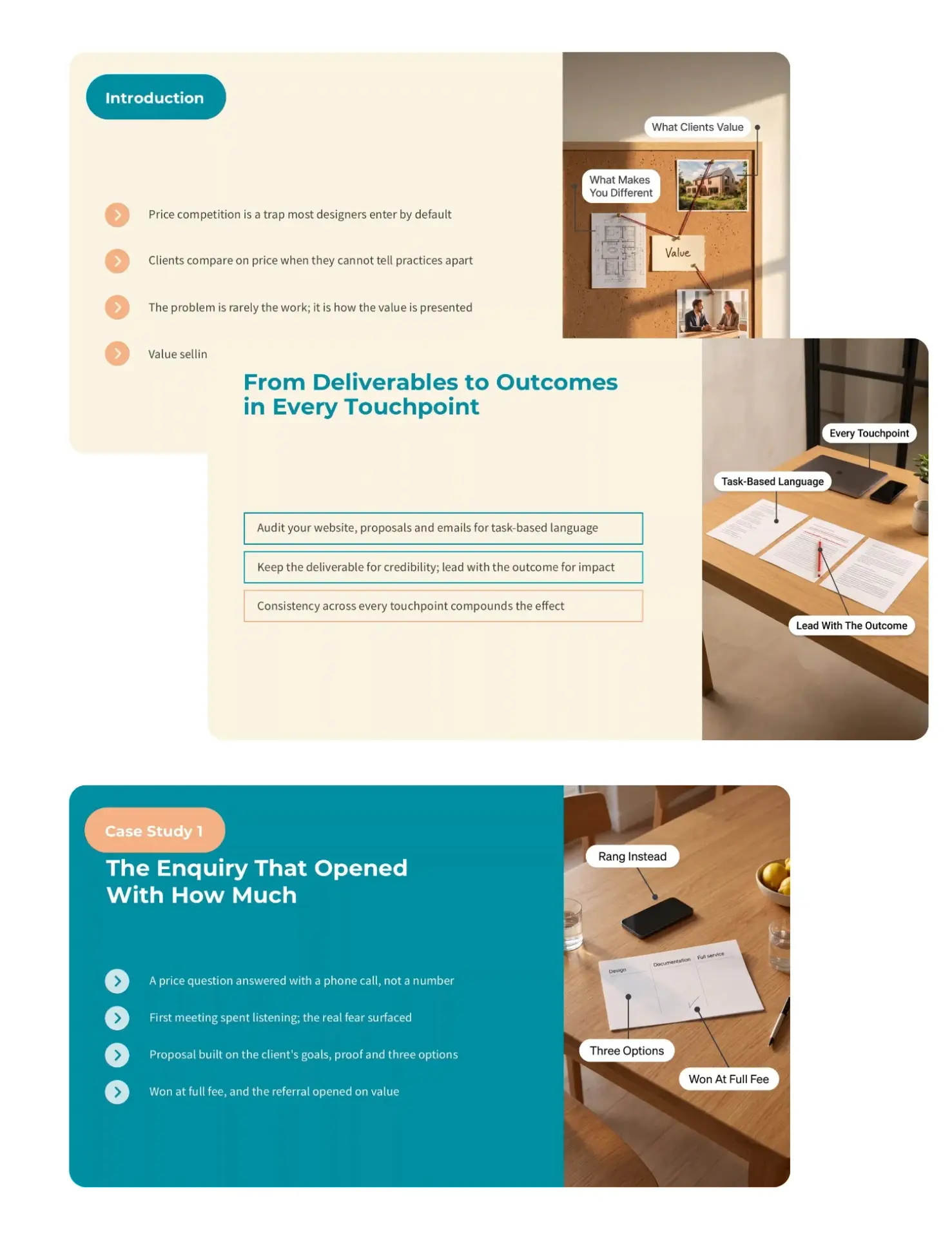
This course examines why price becomes the only thing a client can compare when three practices look the same on paper, and what that race to the bottom costs in margin, client quality and the principal’s own energy. Value is treated as what the client gets rather than what the designer does, with the differentiators, the cost of the cheap or wrong designer, the value proposition and the proof that makes it believable. The first meeting, the proposal, the fee conversation and tiered options are worked through as the order for presenting design value so that the number lands last. Objections, scope creep, qualifying and walking away cover holding the position once the pressure comes. Two case studies follow an enquiry that opened with how much and a discount that cost a year.
Why Take This CPD Session?

Understand why a discount removes profit and never hours, and run the arithmetic on your own fees so that a number you have seen is harder to give away than a percentage you have only felt.
Learn to define your value from the client’s side, name differentiators that are specific and hard to copy, and present them in the order that makes the fee land last.
Build the habits that hold a fee under pressure, from a curious reply to the cheaper quote to a written scope with billed variations, supported by two case studies of an enquiry that opened with how much and a discount that cost a year.
Professional development is an investment in career growth and regulatory compliance. Take the next step today.