

Course Content
By the end of this course, you will be able to interpret the practical implications of Victoria’s lead free plumbing provisions for residential design practice and understand how compliance responsibilities are shared across the design, construction, and certification process. You will be able to review product evidence with confidence, recognise where documentation vulnerabilities commonly occur, and understand how compliance issues can progress from specification through to procurement, installation, and certification. You will also gain practical techniques for improving document quality, reducing project risk, and creating more robust and defensible specifications for residential projects.
Learning Outcomes
This ensures that CPD efforts align with professional regulatory requirements.
This CPD provides general guidance on professional responsibilities and documentation practices. It does not constitute legal advice or replace project-specific contractual or statutory obligations.
Compliance and Accreditation
|
Framework/Body |
Relevant Sections |
Focus Areas |
|
National Construction Code (NCC 2025 / NCC 2022 Transition Context) |
NCC 2025 Plumbing Provisions; Victorian implementation from 1 May 2026; VIC A5G4 evidence requirements; WaterMark certification requirements |
Lead-free plumbing products; specification compliance; drinking-water product requirements; documentation obligations; product verification; compliance risk management |
|
ABSA CPD Competency Area |
Regulatory requirements; building compliance; technical assessment; evidence of suitability |
Understanding plumbing product compliance, specification verification, NCC interpretation, risk identification and compliance documentation |
|
Building Designers |
NCC compliance; construction documentation; specification development; product selection and verification |
Preparing compliant schedules and specifications; managing document risk; product selection processes; quality assurance in residential documentation |
|
NSCA 2021 (Architects) |
PC1, PC12, PC16, PC45, PC47 |
PC1 (Regulatory Requirements and Obligations): The course focuses on the NCC 2025 lead-free plumbing requirements operative in Victoria from 1 May 2026 and the designer’s responsibility to understand and comply with evolving regulatory obligations affecting architectural documentation. PC12 (Building Codes, Standards and Technical Requirements): A core learning outcome is analysing VIC A5G4, AS/NZS 4020, WaterMark certification requirements, and determining whether specified plumbing products comply with current code and technical standards. PC16 (Risk Management and Mitigation): The course is fundamentally a risk-management exercise, identifying how non-compliant plumbing specifications can expose designers to compliance risks and outlining verification and specification practices to mitigate those risks. PC45 (Quality and Performance Standards): Participants learn how to verify product performance requirements, assess evidence of compliance, and ensure specified products meet the required lead-free and WaterMark performance standards. PC47 (Accurate Documents): The course directly addresses how schedules, specifications, prime cost items and issued documentation can become non-compliant, and provides procedures for maintaining accurate and compliant construction documentation. |
|
Engineers Australia (Stage 2) |
Risk management; regulatory compliance; technical judgement; professional accountability |
Evaluation of compliance evidence; verification of product suitability; specification control; quality assurance processes |
|
Licensed Builders (State CPD) |
NCC compliance; construction documentation; product compliance obligations; contract administration |
Compliant product selection; interpreting documentation; managing substitutions; identifying non-compliant specifications |
|
Building Surveyors |
Evidence of suitability; NCC compliance assessment; certification processes; WaterMark verification |
Assessment of compliant documentation; verification of specified products; certification and inspection pathways |
This session is designed for

Architects

Building Designers

Licensed Builders

Building Surveyors

Plumbing Consultants
What’s Included
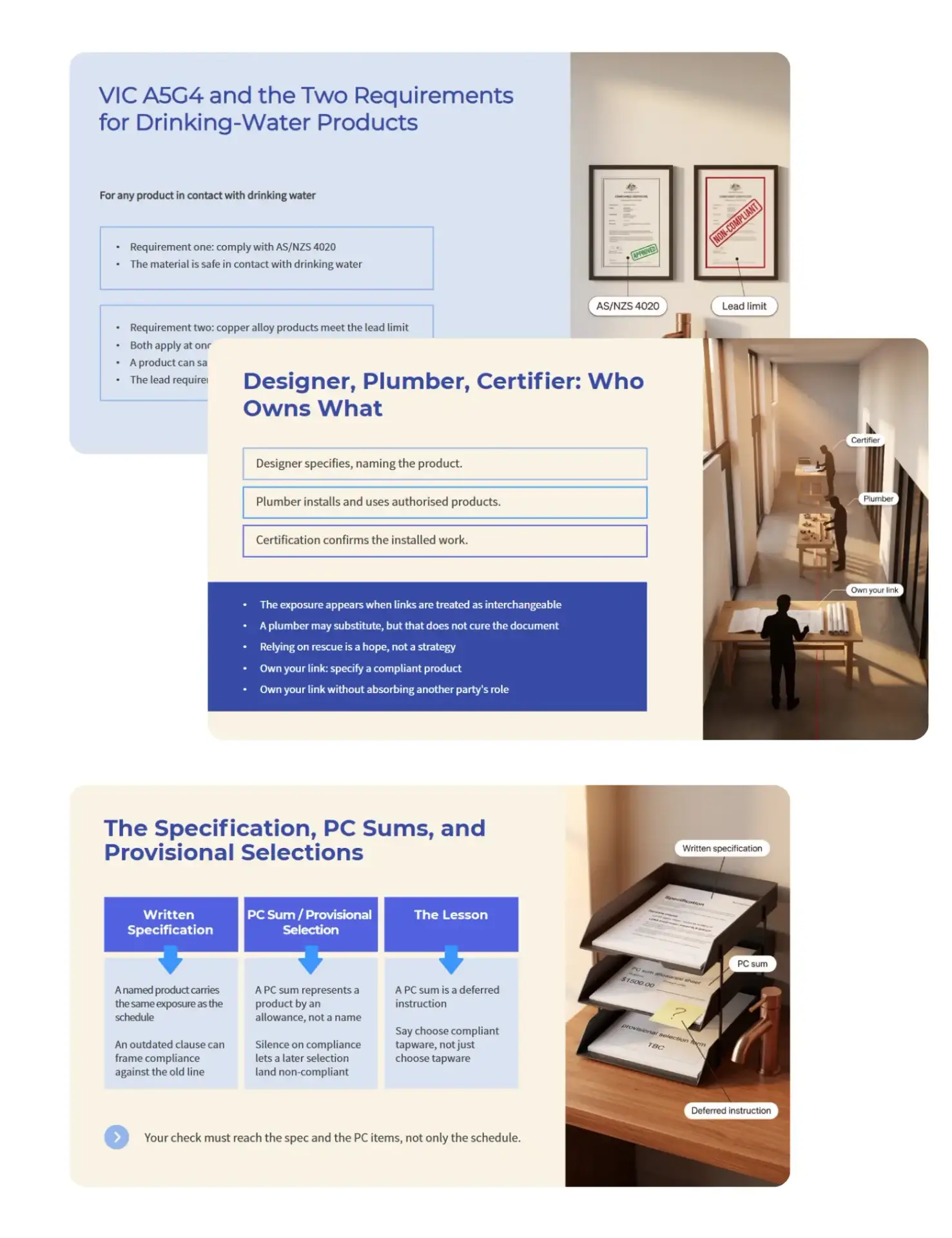
This course examines the regulatory changes introduced by the NCC 2025 lead free plumbing requirements in Victoria and their impact on residential documentation. It explores the relationship between product selection, compliance obligations, and documentation accuracy, while reviewing the certification and evidence pathways used to demonstrate product suitability for drinking water applications. The course also investigates how compliance issues can arise during procurement, installation, inspection, certification, and product substitution processes, and analyses real world residential scenarios to highlight practical risk management strategies that support accurate, compliant, and defensible project documentation.
Why Take This CPD Session?

Understand how the NCC 2025 lead free plumbing requirements can affect the compliance of residential design documentation in Victoria.
Learn how to identify and avoid specification risks that can lead to costly rework, delays, and certification issues.
Gain practical strategies for selecting, verifying, and documenting compliant plumbing products with confidence.
Professional development is an investment in career growth and regulatory compliance. Take the next step today.