

Course Content
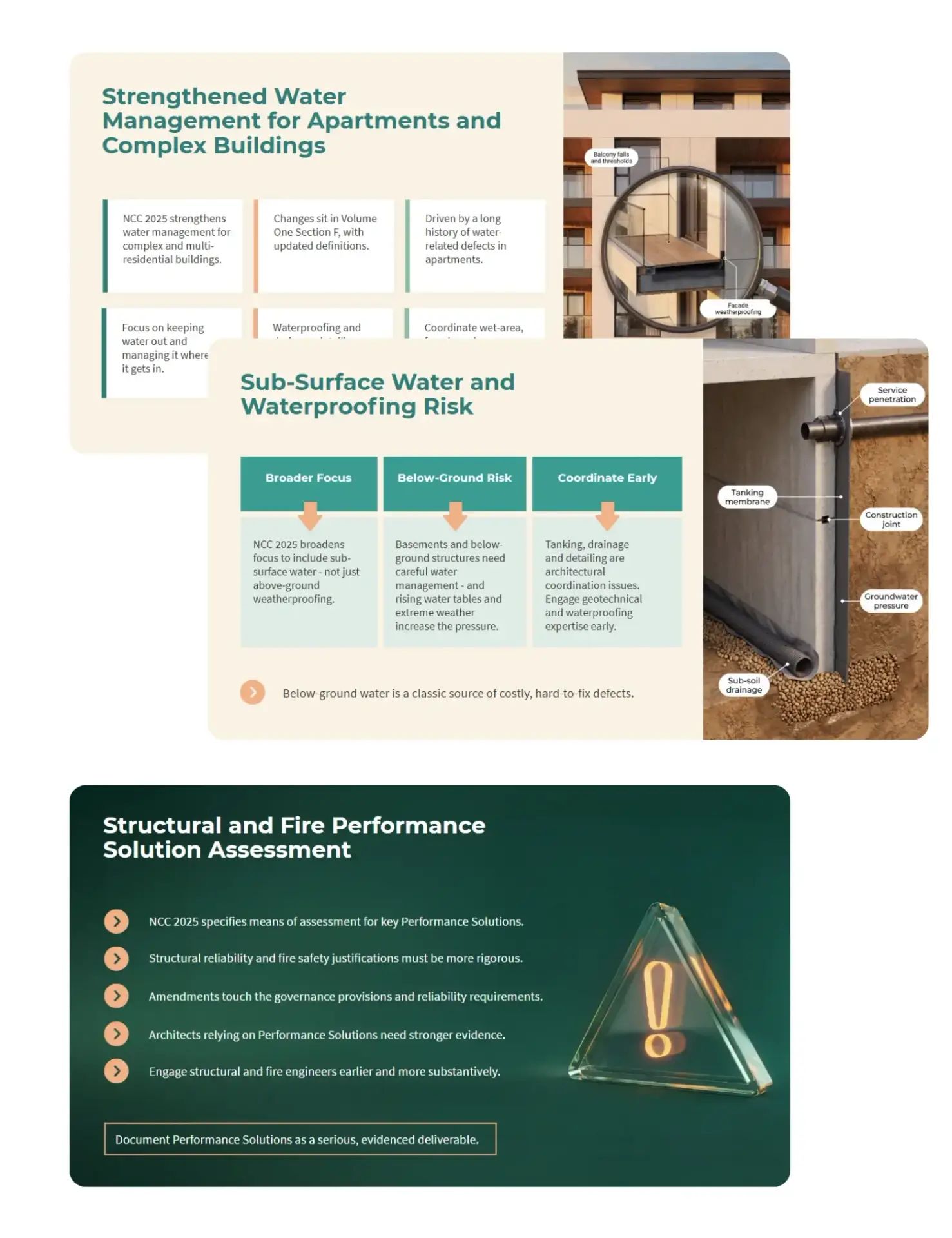
By the end of this course you will understand which NCC 2025 changes apply to your work and how to triage any project by building class to identify the relevant provisions early. You will understand how the commercial energy step change works, including the roughly halved energy budget, the new cap on greenhouse gas emissions, the mandatory on site solar requirement for Class 3 and Class 5 to 9 buildings, and why the penalty on gas makes all electric design the easier path. You will understand where the strengthened water management and tightened carpark fire safety provisions bite, from apartment and sub surface waterproofing risk to the new sprinkler requirements for larger open deck carparks and car stackers. Finally, you will understand the remaining changes, including the optional all gender facilities pathway, condensation management, Performance Solution assessment, and accessibility, along with the staggered adoption timeline and how to prepare your practice for it.
Learning Outcomes
This ensures that CPD efforts align with professional regulatory requirements.
This CPD provides general guidance on professional responsibilities and documentation practices. It does not constitute legal advice or replace project-specific contractual or statutory obligations.
Compliance and Accreditation
|
Framework/Body |
Relevant Sections |
Focus Areas |
|
National Construction Code (NCC 2025 / NCC 2022 transition) |
Volume One; Section J (Commercial Energy); Performance Solutions; Fire Safety; Water Management; Accessibility; Sanitary Facilities; Condensation; Building Classification |
Commercial energy provisions, mandatory solar PV, greenhouse gas emissions, electrification, water management, carpark fire safety, Performance Solutions, accessibility, staggered adoption, compliance across Class 2–9 buildings |
|
NSCA 2021 (Architects) |
PC12, PC20, PC31, PC33, PC45 |
PC12 The course is fundamentally about interpreting and applying the National Construction Code (NCC 2025), including building code requirements, fire safety, accessibility, planning implications and statutory compliance. This directly aligns with PC12 (building codes, standards and planning controls). |
|
Building Designers |
NCC Volume One compliance; commercial documentation; energy efficiency; waterproofing; accessibility |
Commercial and mixed-use design, regulatory compliance, multidisciplinary coordination |
|
Licensed Builders (State CPD) |
Commercial construction compliance; fire safety; waterproofing; energy requirements; solar installation coordination |
Understanding new construction obligations, sequencing, compliance, and contractor coordination |
|
Building Surveyors |
Building approval, Performance Solutions, fire safety, accessibility, Section J compliance |
Assessment of NCC 2025 compliance, certification, documentation review, approval pathways |
|
Engineers Australia (Stage 2) |
Building services integration; structural/fire Performance Solutions; energy systems |
Energy modelling, electrification, PV integration, structural and fire engineering collaboration, multidisciplinary coordination |
|
Urban Planners & Landscape Architects |
Limited relevance – planning implications of commercial development and sustainability |
Understanding NCC transition, sustainability implications, coordination with architectural teams |
This session is designed for

Architects

Architectural Designers

Commercial Building Designers

Building Surveyors

Building Certifiers
What’s Included
This course examines where NCC 2025 concentrates its heaviest changes across the Class 2 to Class 9 commercial and apartment buildings that make up most architectural work. It examines the commercial energy step change, including the reduced energy budget, the new cap on greenhouse gas emissions, mandatory on site solar, and the compliance penalty on gas, alongside the strengthened water management and tightened carpark fire safety provisions. It also examines the remaining significant changes, including all gender facilities, condensation management, Performance Solution assessment, and accessibility, together with the staggered adoption timeline and how to prepare a practice for it.
Why Take This CPD Session?

Gain a clear understanding of the key NCC 2025 changes affecting commercial and apartment buildings, including energy performance, solar requirements, water management, fire safety, and accessibility.
Learn how to apply the new energy and emissions requirements to your projects, helping you design compliant, efficient, and future-ready buildings.
Prepare your practice for the NCC 2025 transition by understanding adoption timelines, reducing compliance risks, and improving coordination with consultants from the earliest design stages.
Professional development is an investment in career growth and regulatory compliance. Take the next step today.