

Course Content
By the end of this course, you will be able to accurately identify and apply the correct NatHERS climate zone for any property across Australia. You will know how to justify alternative zone selections when postcode data is missing, conflicting, or unclear. You’ll understand which default values in assessment software are influenced by climate zone selection, including insulation, flooring, and ventilation. You’ll also be equipped to validate location data using mapping tools, satellite imagery, and LGA boundaries to avoid audit issues. Most importantly, you will be confident in documenting and defending your zone decisions to ensure compliance with NatHERS and NCC requirements.
Learning Outcomes
This ensures that CPD efforts align with professional regulatory requirements.
This CPD provides general guidance on professional responsibilities and documentation practices. It does not constitute legal advice or replace project-specific contractual or statutory obligations.
Compliance and Accreditation
|
Framework/Body |
Relevant Sections |
Focus Areas |
|
National Construction Code (NCC 2022) |
NCC Vol 2, Part 13.7.1 (Energy Efficiency) |
Thermal performance compliance for Class 1 buildings; zone-specific energy modelling; consistency with Whole-of-Home requirements. |
|
NatHERS Protocols |
Climate zone mapping, default values assignment, validation and audit processes |
Appropriate use of mapped zones, managing edge cases, justification documentation, and default assumptions for thermal simulation. |
|
ABSA CPD Competency Area |
Technical Knowledge & Application; Professional Responsibility |
Accurate climate zone selection; alignment with NatHERS defaults; mitigating audit risks; software tool proficiency. |
|
Building Designers |
National competency framework: Design & Documentation; Compliance |
Selecting accurate zones; evaluating postcode conflicts; integrating mapping tools; enhancing report defensibility. |
|
NSCA 2021 (Architects) |
PC12, PC20, PC31, PC33, PC45 |
Environmental sustainability, statutory planning compliance, site analysis, energy efficiency decisions, audit defensibility. |
|
Engineers Australia (Stage 2) |
Element 4: Design; Element 6: Professional and Personal Conduct |
Ensuring accuracy in location data for simulations; ethical data handling in design compliance. |
|
Licensed Builders (State CPD) |
NSW, VIC CPD requirements on sustainability and NCC energy provisions |
Awareness of climate zone relevance in construction detailing; understanding how incorrect zoning affects compliance. |
|
Building Surveyors |
NCC compliance verification; energy report checks |
Cross-verifying climate zones in submitted assessments; interpreting default assumptions and their compliance implications. |
This session is designed for

Energy Assessors

Architects

Building Designers

Builders

Building Surveyors
What’s Included
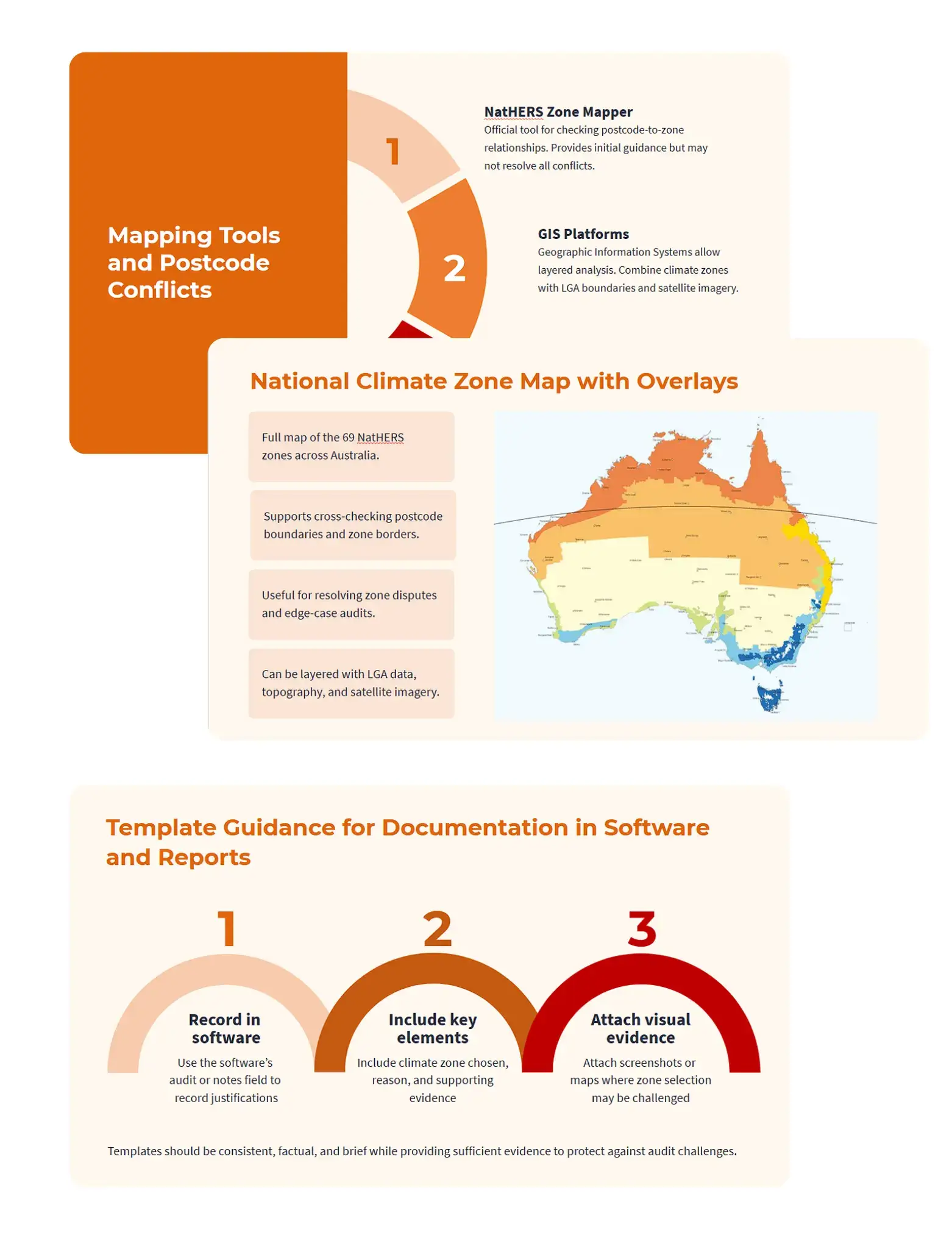
This course covers the structure and application of the 69 NatHERS climate zones used in energy assessments across Australia. It explains how to handle postcode conflicts, unmapped locations, and zone selection in edge cases such as new subdivisions or island towns. The course details how climate zone choices affect software defaults for insulation, flooring, and energy loads. It also provides practical tools and strategies for validating site locations using mapping platforms, weather station data, and LGA boundaries. Finally, it offers guidance on documenting zone justifications clearly to ensure audit readiness and compliance with NCC and NatHERS requirements.
Why Take This CPD Session?

Gain practical skills to confidently navigate complex or unclear NatHERS climate zone scenarios and avoid costly compliance errors.
Improve the accuracy and defensibility of your energy assessments by mastering zone-related defaults and documentation techniques.
Strengthen your professional credibility and reduce audit risk through clear, transparent zone justification practices.
Professional development is an investment in career growth and regulatory compliance. Take the next step today.