

Course Content
By the end of this course, participants will understand the environmental impacts of traditional cement-based concrete and the need for sustainable alternatives. They will be able to compare emerging low-carbon technologies, such as geopolymer and carbon-capturing concrete, and navigate compliance pathways under NCC 2022 and relevant Australian Standards. Participants will also gain practical strategies for selecting, implementing, and assessing low-carbon concrete in real-world construction projects.
Learning Outcomes
This ensures that CPD efforts align with professional regulatory requirements.
This CPD provides general guidance on professional responsibilities and documentation practices. It does not constitute legal advice or replace project-specific contractual or statutory obligations.
Compliance and Accreditation
|
Framework/Body |
Relevant Sections |
Focus Areas |
|
National Construction Code (NCC 2022) |
Volume 1 & 2; |
Supports performance-based approval of alternative concretes; compliance with structural and durability standards |
|
NatHERS Protocols |
Whole-of-Home Material Carbon Metrics (future pathway) |
May support embodied carbon documentation in design-stage LCA for high-performance housing |
|
ABSA CPD Competency Area |
Section 3.5 – Material Impact in Sustainability; |
Relevance for thermal assessors considering lifecycle material impact and environmental product declarations (EPDs) |
|
Building Designers |
BDAA CPD – Sustainable Materials, Concrete Specification, Construction Detailing |
Supports selection of geopolymer, SCMs, and recycled aggregates; understanding Performance Solution pathways |
|
NSCA 2021 (Architects) |
PC10, PC12, PC33, PC45, PC46 |
Aligns with low-carbon material specification, compliance documentation, lifecycle performance, and sustainable procurement |
|
Engineers Australia (Stage 2) |
Materials Engineering; |
Applies to mix testing, fire performance, and compliance with AS 3600 for structural applications of low-carbon mixes |
|
Licensed Builders (State CPD) |
Low-Carbon Materials in Construction; |
Relevant for installation best practices, handling geopolymer and SCM mixes, and verifying construction compliance |
|
Building Surveyors |
NCC Part A5; |
Supports compliance checking of Performance Solutions, mix validation, and documentation review |
|
Urban Planners & Landscape Architects |
Precinct-Scale Carbon Policy; |
Applicable in green infrastructure projects using recycled aggregates and public realm sustainable materials |
This session is designed for

Engineers

Architects

Builders

Building Designers

Sustainability Consultants
What’s Included
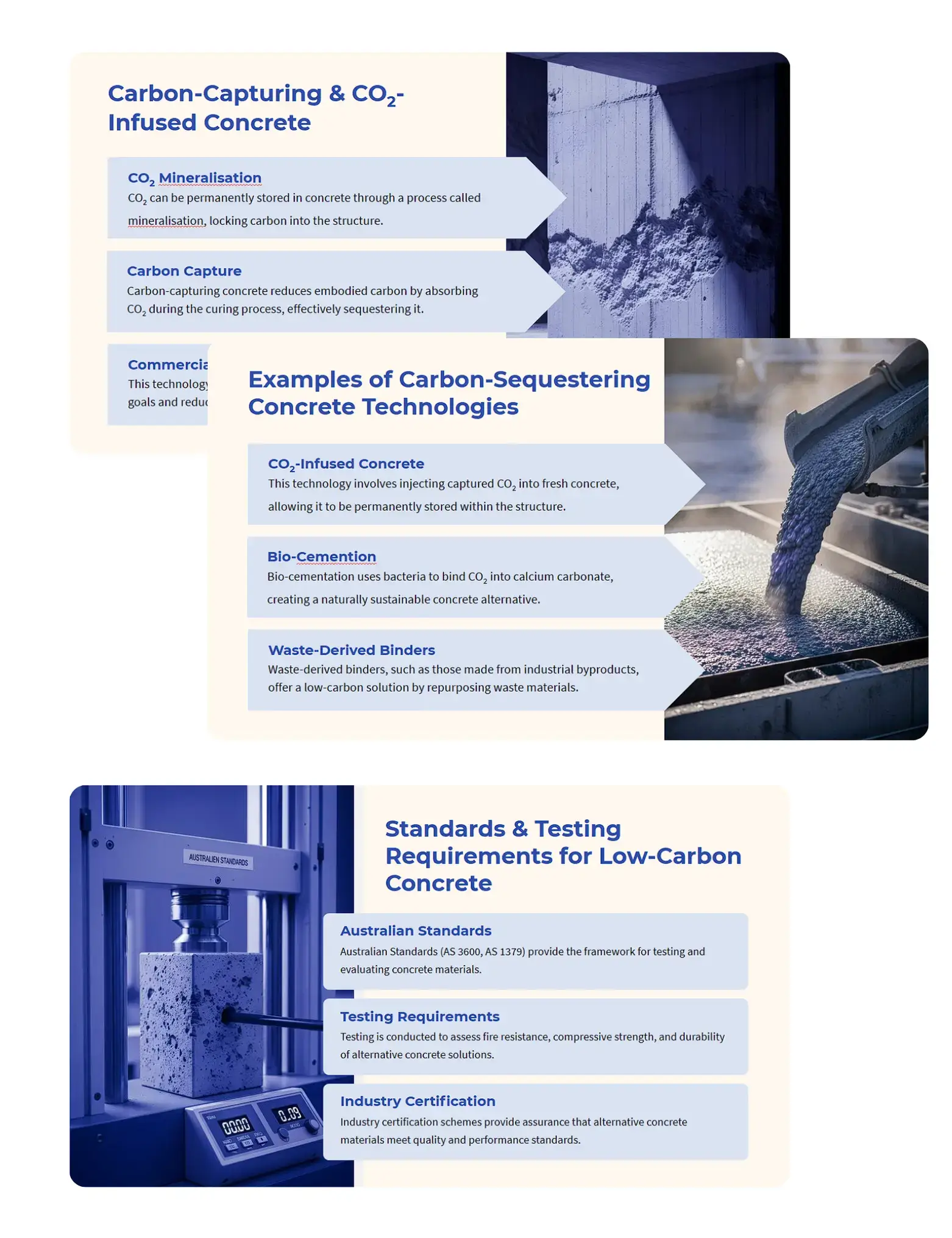
This course covers innovative low-carbon concrete technologies such as geopolymer and carbon-capturing concrete, emphasizing their environmental benefits and structural performance. It provides detailed guidance on navigating Australia’s National Construction Code (NCC 2022) compliance pathways, including Deemed-to-Satisfy and Performance Solutions. Participants learn practical strategies for selecting, designing, and implementing low-carbon concrete in real-world projects, supported by case studies and performance-based testing. The course also explores emerging trends like AI-optimized mix designs and 3D-printed concrete, preparing professionals for sustainable construction futures.
Why Take This CPD Session?

This CPD session is essential for professionals looking to integrate low-carbon concrete solutions into their projects while ensuring compliance with NCC 2022 and Australian standards.
It provides practical insights, case studies, and technical guidance on using geopolymer, CO₂-infused, and recycled aggregate concretes to reduce embodied carbon without compromising performance.
By attending, you’ll gain expert knowledge on material selection, regulatory pathways, and future trends, equipping you to lead sustainable construction initiatives.
Professional development is an investment in career growth and regulatory compliance. Take the next step today.