

Course Content
By the end of this course, you will understand how lighting influences energy performance in Whole-of-Home assessments. You’ll be able to accurately extract lighting details from architectural drawings and input them into NatHERS tools using either defaults or verified manufacturer data. You will also know how to document modelling decisions clearly to meet audit requirements. Ultimately, you’ll be equipped to model lighting confidently and compliantly in line with NCC and NatHERS standards.
Learning Outcomes
This ensures that CPD efforts align with professional regulatory requirements.
This CPD provides general guidance on professional responsibilities and documentation practices. It does not constitute legal advice or replace project-specific contractual or statutory obligations.
Compliance and Accreditation
|
Framework/Body |
Relevant Sections |
Focus Areas |
|
National Construction Code (NCC 2022) |
Volume Two Section H6; J3D14 (Volume One) |
Energy efficiency requirements for lighting in Class 1 and Class 2 dwellings; default downlight density; inclusion of lighting in Whole-of-Home energy assessments |
|
NatHERS Protocols |
Technical Note v20241023; Whole-of-Home Efficiency Factors |
Lighting defaults (e.g., 9W LED), modelling rules for control types, default downlight densities, documentation standards for audit-readiness |
|
ABSA CPD Competency Area |
Section 3: Energy Modelling Accuracy; Section 4: Technical Documentation |
Accurate interpretation and translation of lighting layouts into NatHERS tools; use of defaults vs. manufacturer data; documentation for audit compliance |
|
Building Designers |
CPD Areas: Energy Compliance, Drafting & Design Interpretation |
Interpreting architectural lighting plans, understanding implications of luminaire selection, and inputting compliant data into software |
|
NSCA 2021 (Architects) |
PC28, PC31, PC33, PC45, PC47 |
Environmental systems integration (lighting), interpreting technical documentation, compliance with building codes, and sustainability implications |
|
Engineers Australia (Stage 2) |
Technical Proficiency; Safety, Standards and Codes |
Understanding and applying lighting system specifications; regulatory compliance in energy modelling |
|
Licensed Builders (State CPD) |
NSW and VIC CPD themes: Building Code compliance; Energy Efficiency |
Ensuring that lighting design is compliant with NCC and contributes to passing WoH energy assessments |
|
Building Surveyors |
NCC Interpretation and Verification Methods |
Reviewing lighting data for energy compliance; understanding downlight density assumptions; verifying input data during assessment and certification |
This session is designed for

Energy Assessors

Building Surveyors

Building Designers

Builders

Architects
What’s Included
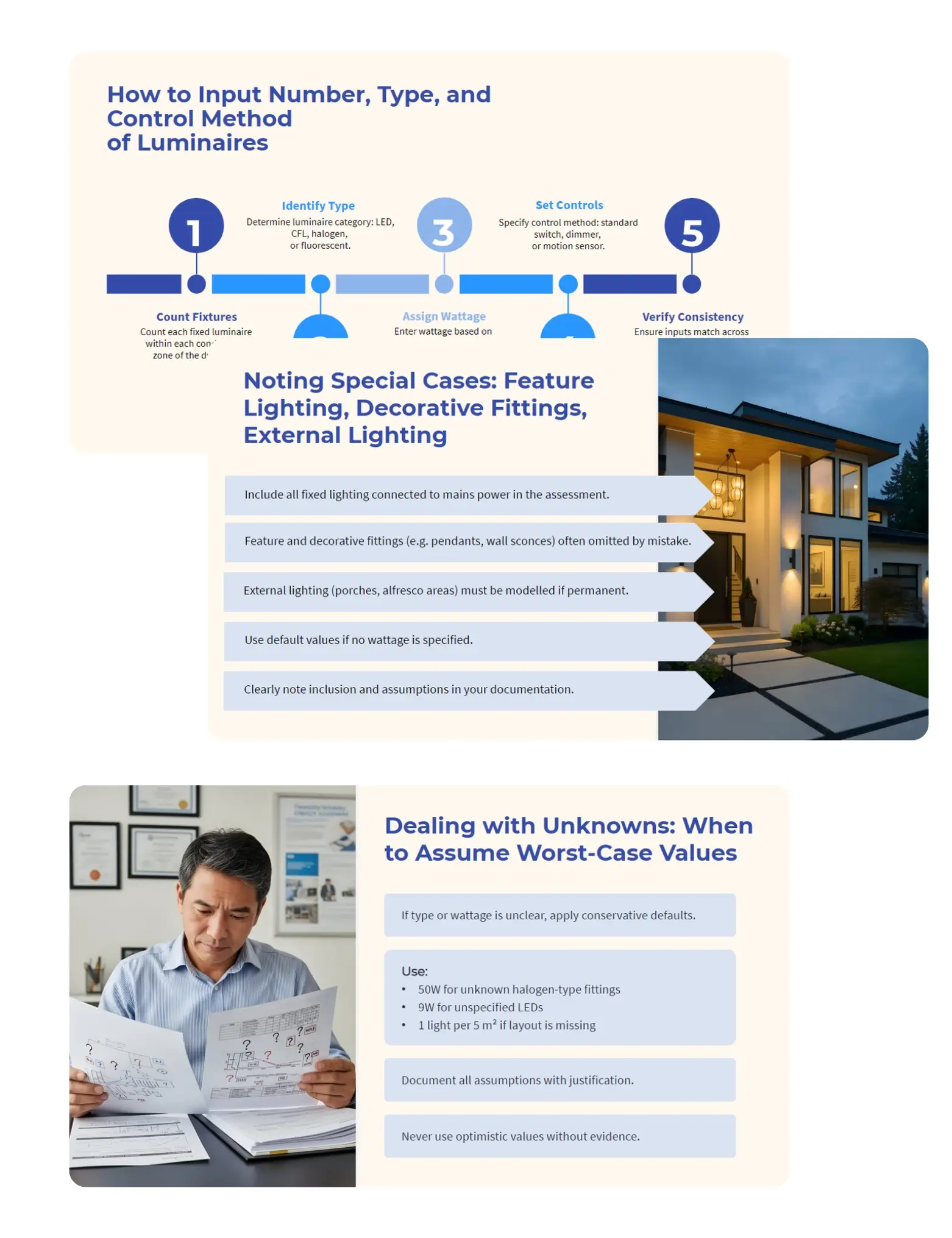
This course covers the role of lighting in Whole-of-Home energy assessments and its impact on compliance with NatHERS and the NCC. It guides participants through the process of extracting accurate lighting data from architectural drawings, including luminaire types, control methods, and mounting styles. The course also explains how to input lighting data into NatHERS tools using default values or verified specifications. Finally, it provides best practices for documentation and audit readiness to ensure transparent and compliant modelling.
Why Take This CPD Session?

Enhance your ability to model lighting accurately and compliantly within Whole-of-Home energy assessments.
Reduce the risk of audit failures by learning how to document lighting assumptions and use defaults correctly.
Stay up to date with NatHERS and NCC requirements, gaining practical skills you can apply immediately in your assessments.
Professional development is an investment in career growth and regulatory compliance. Take the next step today.