

Course Content
By the end of the course, participants will be able to analyse NatHERS outputs to identify renovation opportunities, reading beyond the star rating to interpret load profiles, elemental performance tables and zone-level data as diagnostic tools for decision-making.
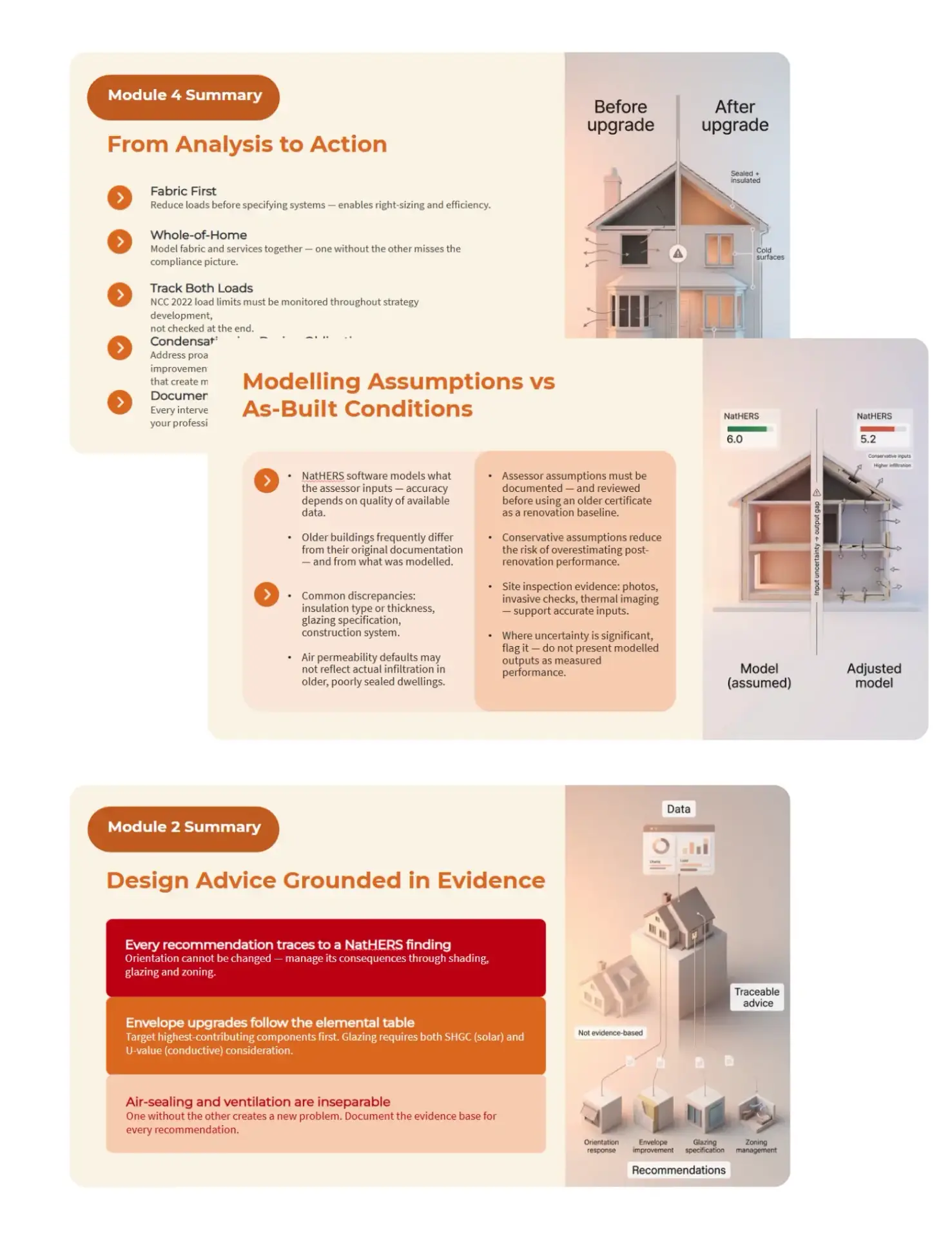
They will be able to translate thermal performance data into evidence-based design advice, connecting specific modelling findings to constructible interventions across orientation response, envelope improvement, glazing specification and zoning management. Participants will also be able to evaluate existing building limitations that affect thermal upgrade feasibility, including construction constraints in pre-2000 dwellings, heritage and structural restrictions, access limitations, and the reliability of modelling assumptions where documentation is incomplete. Finally, they will be able to develop retrofit strategies informed by NatHERS modelling and aligned with NCC 2022 compliance requirements, including the fabric-first sequencing principle, Whole-of-Home service integration, condensation risk management, and staged upgrade planning where full improvement is not immediately achievable.
Learning Outcomes
This ensures that CPD efforts align with professional regulatory requirements.
This CPD provides general guidance on professional responsibilities and documentation practices. It does not constitute legal advice or replace project-specific contractual or statutory obligations.
Compliance and Accreditation
|
Framework/Body |
Relevant Sections |
Focus Areas |
|
National Construction Code (NCC 2022) |
Volume Two – Energy Efficiency (Part 3.12); NatHERS DTS pathway; Heating & Cooling Load Limits; Whole-of-Home provisions |
Application to alterations and additions; compliance with star ratings and load limits; Whole-of-Home integration; jurisdictional variations |
|
NatHERS Protocols |
NatHERS Technical Note; Certificate outputs; Climate files; Software accreditation |
Interpretation of certificates; heating/cooling load analysis; zone diagnostics; modelling assumptions vs as-built conditions |
|
ABSA CPD Competency Area |
Thermal Performance; NatHERS Assessment; Existing Dwelling Modelling; Whole-of-Home |
Translating outputs into design advice; retrofit strategy development; aligning modelling with compliance |
|
Building Designers |
Design Documentation; Energy Efficiency Compliance; Renovation & Alterations |
Envelope upgrades; glazing and shading; applying thermal data in design decisions |
|
NSCA 2021 (Architects) |
PC20, PC28, PC31, PC33, PC45 |
PC20 — Research: analysing NatHERS outputs to identify renovation opportunities and thermal performance insights. |
|
Engineers Australia (Stage 2) |
Element 2; Element 3 |
Thermal performance analysis; system integration; evidence-based problem solving |
|
Licensed Builders (State CPD) |
Energy Efficiency Requirements; NCC compliance; Renovation practices |
Implementation of insulation, glazing, sealing; constructability of retrofit strategies |
|
Building Surveyors |
NCC compliance assessment; Certification; Alterations & Additions |
Verification of NatHERS compliance; load limit assessment; regulatory interpretation |
This session is designed for

Architects

Building Designers

Energy Assessors

Building Surveyors

Residential Builders
What’s Included
This course examines how NatHERS assessment reports should be read and applied in residential renovation projects, where existing building constraints and older construction methods make compliance more demanding than in new construction. It examines the full content of the NatHERS certificate and how each section, from load profiles to elemental tables and assessor assumptions, informs design decision-making under NCC 2022. The course also examines how thermal performance findings translate into specific design advice across orientation, envelope, glazing and zoning, and how the NCC 2022 star rating and load limit requirements apply independently to alterations and additions. Finally, it examines how retrofit strategies should be sequenced within the constraints of pre-2000 dwellings, how the Whole-of-Home pathway integrates fabric and service performance, and how condensation risk must be managed when thermal performance is improved in existing buildings.
Why Take This CPD Session?

Build the ability to interpret NatHERS data and turn it into clear, evidence-based renovation design decisions.
Stay compliant and future-ready with NCC 2022 requirements and upcoming NCC 2025 performance changes.
Learn how to develop practical retrofit strategies that work within real-world building constraints.
Professional development is an investment in career growth and regulatory compliance. Take the next step today.