

Course Content
By the end of this course, participants will understand the key factors influencing indoor air quality (IAQ), including common pollutants and their health impacts, and how to control them through ventilation. They will be able to compare Australia’s NCC 2022 ventilation requirements with emerging international IAQ standards, and apply smart technologies like demand-controlled ventilation, HEPA filtration, and real-time air quality monitoring. Participants will also gain practical skills to implement effective design and mechanical strategies that enhance IAQ in both new and existing buildings.
Learning Outcomes
This ensures that CPD efforts align with professional regulatory requirements.
This CPD provides general guidance on professional responsibilities and documentation practices. It does not constitute legal advice or replace project-specific contractual or statutory obligations.
Compliance and Accreditation
|
Framework/Body |
Relevant Sections |
Focus Areas |
|
National Construction Code (NCC 2022) |
Volume 1 – F4; |
Covers compliance with minimum ventilation rates, air change per hour benchmarks, and hybrid/natural/mechanical system requirements |
|
NatHERS Protocols |
Whole-of-Home Health Metrics (linked to future IAQ indicators) |
Potential indirect relevance via air quality’s impact on thermal performance and home energy assessment |
|
ABSA CPD Competency Area |
Section 3.2 – Indoor Air Quality & Health; Whole-of-Home Efficiency |
Supports understanding of air change rates, humidity control, and low-VOC material impacts in building envelope assessments |
|
Building Designers |
BDAA CPD – Healthy Homes, Ventilation Design, Post-Pandemic Design |
Reinforces natural airflow, low-emission material selection, and spatial design to support hybrid ventilation strategies |
|
NSCA 2021 (Architects) |
PC10, PC12, PC24, PC33, PC35, PC45 |
Applies to design documentation for IAQ, natural/mechanical ventilation integration, WELL/NCC alignment, and material selection |
|
Engineers Australia (Stage 2) |
Mechanical Systems Design; Environmental Quality; |
Includes demand-controlled ventilation (DCV), IAQ monitoring, ERV systems, and compliance-driven HVAC upgrades |
|
Licensed Builders (State CPD) |
Ventilation Practices, Duct Installation, HVAC Maintenance Protocols |
Site compliance with ventilation layout, fresh air intakes, ductwork hygiene, and install verification for IAQ performance |
|
Building Surveyors |
NCC Part F & Part H4; |
Certification of ventilation compliance, review of mechanical plans, hybrid systems approval, and air filtration checks |
This session is designed for

Architects

Building Designers

Mechanical Engineers

Facility Managers
What’s Included
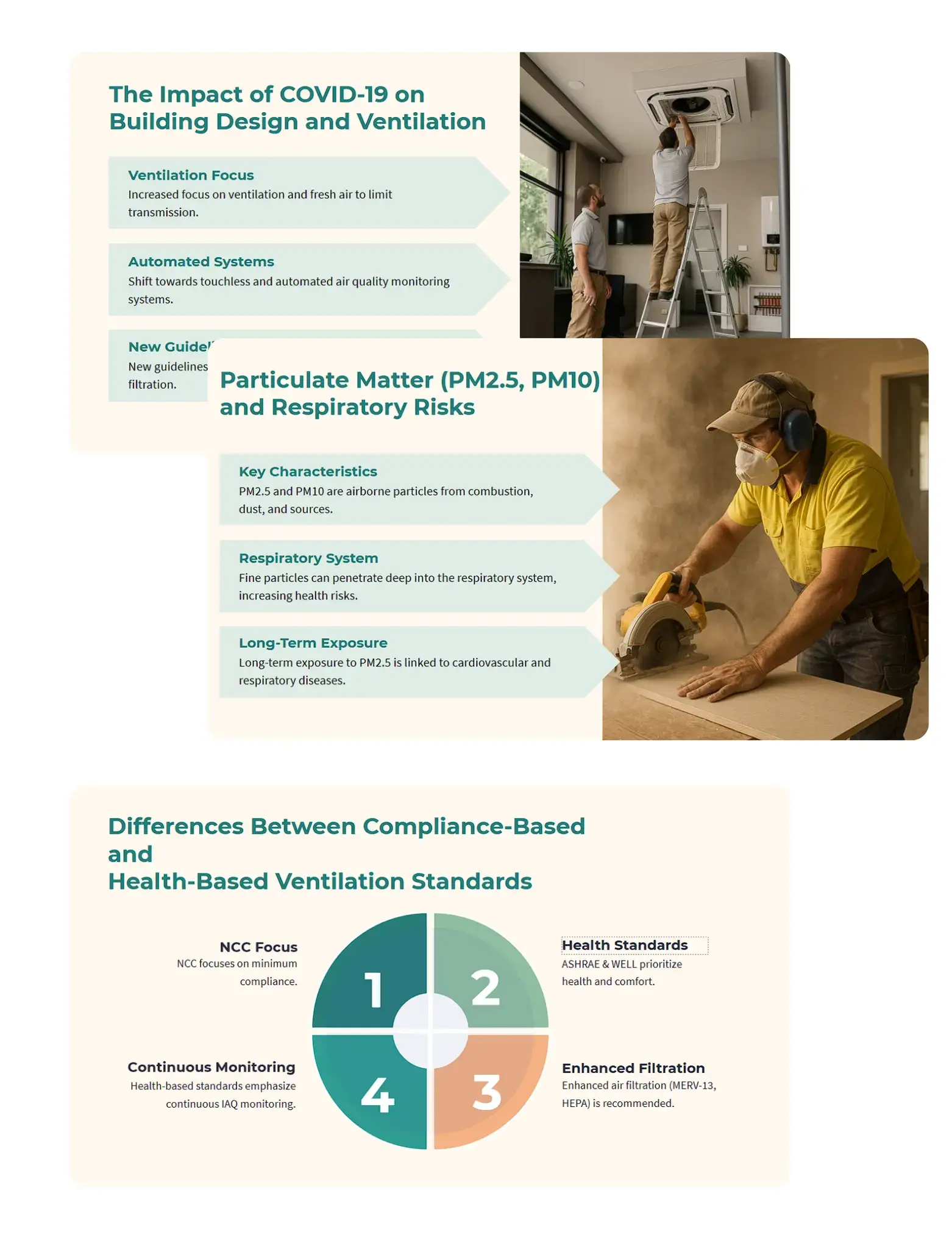
The session will also compare Australian ventilation standards with international best practices, such as ASHRAE 62.1 and WELL Building certification, to highlight opportunities for enhanced occupant safety. By the end of this course, attendees will be equipped with actionable strategies to design, assess, and implement IAQ solutions that meet regulatory requirements and exceed baseline performance standards.
Why Take This CPD Session?

This CPD session provides essential knowledge on indoor air quality (IAQ) and ventilation strategies, ensuring compliance with NCC 2022, NatHERS, and ABCB guidelines while enhancing occupant health and building performance.
It equips professionals with practical solutions, including smart ventilation technologies, high-efficiency filtration, and real-time IAQ monitoring, to optimize air quality in commercial and residential buildings.
By attending, you will gain actionable insights and best practices to design, assess, and implement effective IAQ strategies that exceed regulatory standards and improve long-term sustainability.
Professional development is an investment in career growth and regulatory compliance. Take the next step today.