
Home Energy Rating Disclosure: What Assessors Need to Prepare For

Current Status

Not Enrolled

Price

A$99.00

Get Started

Course Content

I. Introduction (4 minutes)
II. Learning Objectives (3 minutes)
VII. Case Studies (6 minutes)
VIII. Summary and Key Takeaways (3 minutes)

This course explains the national Home Energy Rating Disclosure Framework and how it is shifting energy rating certificates from compliance documents into tools used in property transactions. It focuses on the expanding role of energy assessors as their certificates are increasingly relied upon in property sales, tenancy agreements, and lending decisions. The course highlights the professional risks involved, particularly where certificates are used beyond their original purpose or become outdated. It provides practical guidance on documentation standards such as scope limitation statements, currency statements, and file retention to protect assessors from liability. It also reviews the current state of disclosure across Australia, including the ACT mandatory scheme and the NSW pilot, and outlines the expected path toward national implementation.

This CPD provides general guidance on professional responsibilities and documentation practices. It does not constitute legal advice or replace project-specific contractual or statutory obligations.

  • CPD Points: 1 Formal CPD Point
  • Duration: 1 hour
  • Certificate Upon Completion
  • Difficulty Level: Intermediate

This session is designed for

Energy Assessors
Building Designers
Architects
Sustainability Consultants
Licensed Builders


By the end of this course, participants will be able to explain the national Home Energy Rating Disclosure Framework, including its scope, purpose, and current implementation status. They will be able to analyse how energy rating certificates are used in property sales, tenancy agreements, and lending, and identify where professional liability risks arise. Participants will be able to apply clear documentation standards, including scope limitation and currency statements, to protect their certificates in transactional contexts. They will be able to evaluate the differences in disclosure requirements across jurisdictions and understand the pathway toward mandatory implementation. They will also be able to manage their assessment records and documentation in a way that supports and defends their work if it is later relied upon or challenged.

  • Explain the scope, intent, and current status of the national Home Energy Rating Disclosure Framework.
  • Evaluate the differences in disclosure requirements across jurisdictions and their progression toward mandatory adoption.
  • Analyse how energy rating certificates are used in property transactions and where liability risks arise.
  • Identify and manage key risk factors such as outdated assessments and changes to dwelling conditions.
  • Apply appropriate documentation standards, including scope limitation and currency statements, to protect certificates.
  • Maintain complete and accessible assessment records to support certificates in the event of review or dispute.

This ensures that CPD efforts align with professional regulatory requirements.

Framework/Body

Relevant Sections

Focus Areas

National Construction Code (NCC 2022)

Energy efficiency provisions (Volume Two), compliance pathways, performance-based assessment context

Relationship between NatHERS ratings and NCC compliance; distinction between new homes regulatory compliance vs existing homes; application of disclosure obligations within the NCC framework

NatHERS Protocols

NatHERS Administrative Protocols; Existing Homes Expansion Framework; AccuRate Enterprise methodology

Parallel assessment streams (new vs existing homes); site-based data collection; observational inputs; use of defaults; accreditation obligations; certificate production standards under disclosure conditions

ABSA CPD Competency Area

Energy assessment practice; professional conduct; data collection and modelling

Transition from plan-based to site-based assessment; competency in observational data collection; risk management through assumptions and defaults; scope limitation and currency statement practice

Building Designers

Performance-based design considerations; energy efficiency integration

Understanding how disclosure certificates influence property transaction value; design documentation accuracy and its impact on assessor certificates; implications of construction variations on NatHERS outputs

NSCA 2021 (Architects)

PC1, PC12, PC16, PC55

Environmental performance assessment of existing buildings; integration of sustainability knowledge; application of professional judgment in documentation scenarios; liability exposure in design-stage certificate use

Engineers Australia (Stage 2)

Competency areas related to sustainability, data analysis, and professional judgement

Building performance evaluation; interpreting incomplete data sets; applying engineering judgement in real-world conditions; professional liability and indemnity exposure in transactional certificate use

Licensed Builders (State CPD)

Building performance, retrofit implications, regulatory awareness

Understanding how ratings influence renovation decisions; interaction between existing conditions and upgrade pathways; site-based documentation obligations when construction varies from modelled specification

Building Surveyors

Compliance assessment frameworks; performance solutions; existing building evaluation

Distinction between regulatory compliance (new homes) and advisory ratings (existing homes); documentation limitations; evidence-based compliance assessment; currency and scope obligations for disclosure instruments

Urban Planners & Landscape Architects

Policy context; sustainability frameworks; built environment performance

Link between disclosure policy and planning outcomes; role of energy ratings in property transactions; broader sustainability policy trajectory from voluntary to mandatory disclosure; ACT and NSW scheme context

What’s Included

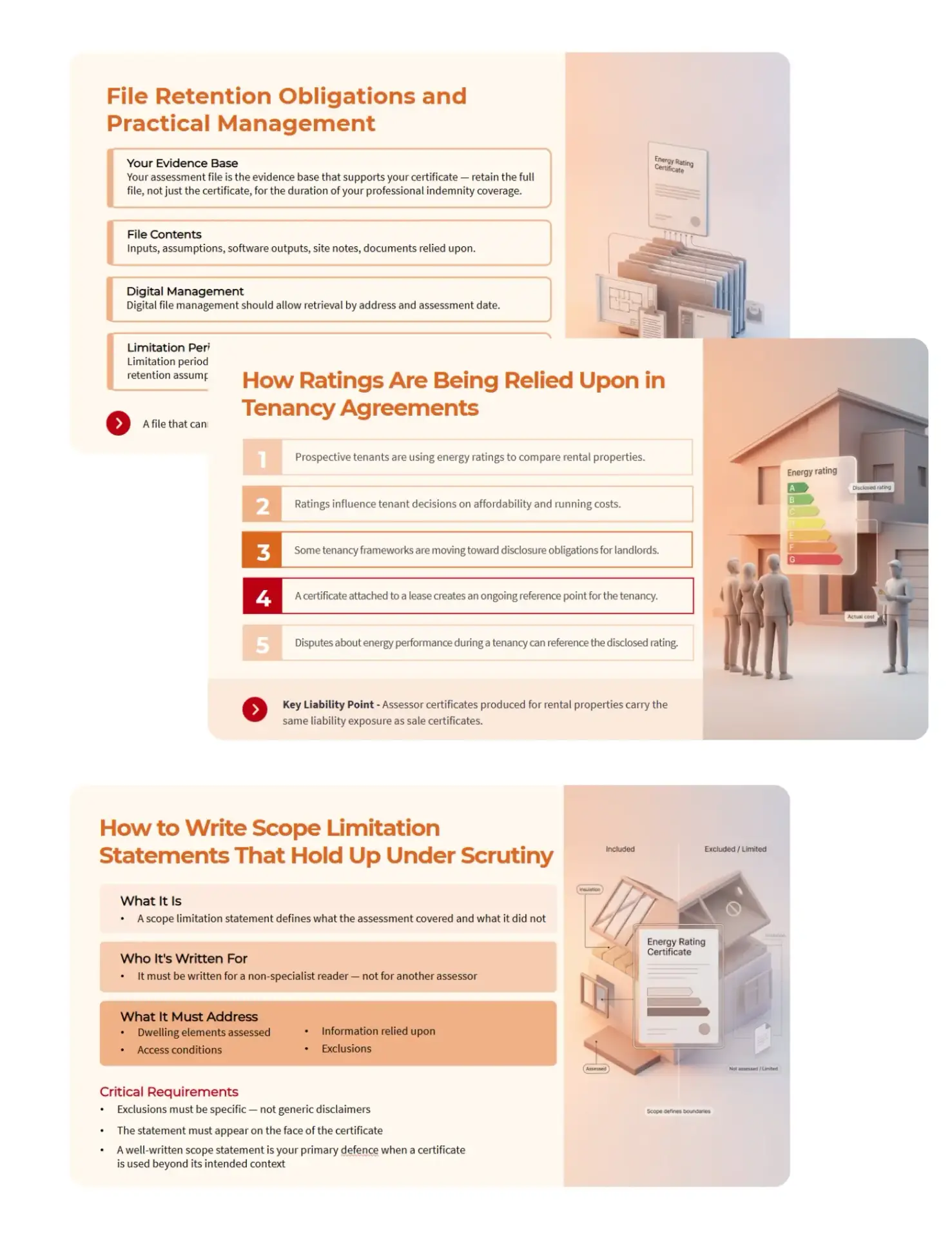
This course examines the national Home Energy Rating Disclosure Framework and what it means for accredited energy assessors working under NatHERS, NABERS, and Section J. It covers how the mandatory disclosure landscape is evolving across Australia, with the ACT scheme already operational, a NSW pilot underway, and a national rollout in development. The course analyses how assessor certificates are increasingly used as transactional documents in property sales, tenancy agreements, and lending assessments, and the professional liability this creates. It also details the documentation standards assessors must apply to protect themselves, including scope limitation statements, currency declarations, and file retention practices. Finally, it evaluates the jurisdictional picture across all states and territories and maps the realistic pathway from voluntary to mandatory disclosure nationwide.
  • A 1-hour video session covering NCC-aligned strategies and real-world case studies.
  • An interactive quiz to test and reinforce knowledge.
  • An audio summary version via NotebookLM for flexible, on-the-go learning.
  • A downloadable certificate of completion for CPD compliance reporting.
  • Centralised CPD tracking dashboard to support audits and personal recordkeeping.

Why Take This CPD Session?

Understand how your certificates are already being used in property transactions, tenancy agreements, and lending assessments beyond their original compliance purpose.

Improve your ability to document assessments in ways that protect your professional position when ratings are relied upon in sales, leasing, or lending contexts.

Strengthen your confidence in navigating the jurisdictional disclosure landscape, from the operational ACT scheme through to the pathway toward national mandatory rollout.

Professional development is an investment in career growth and regulatory compliance. Take the next step today.