

Course Content
By the end of this course, participants will be able to distinguish between net-zero and net-positive design strategies and apply this understanding in their projects. They will be able to integrate renewable energy and water reuse systems effectively into building designs. Participants will also be capable of designing buildings that generate surplus energy for community benefit. In addition, they will understand how to navigate and apply relevant regulatory and financial frameworks. Overall, they will be equipped to deliver compliant, high-performance buildings that go beyond standard sustainability outcomes.
Learning Outcomes
This ensures that CPD efforts align with professional regulatory requirements.
This CPD provides general guidance on professional responsibilities and documentation practices. It does not constitute legal advice or replace project-specific contractual or statutory obligations.
Compliance and Accreditation
|
Framework/Body |
Relevant Sections |
Focus Areas |
|
National Construction Code (NCC 2022) |
Volumes 1 & 3; Section J9, J3D14; Part A5G2–A5G4 |
On-site energy systems, solar PV sizing, energy surplus design, and water reuse system compliance. |
|
NatHERS Protocols |
Whole-of-Home Rating; Technical Notes |
Energy performance of domestic services; alignment with surplus energy contribution and performance modelling. |
|
ABSA CPD Competency Area |
Modules on Whole-of-Home and energy system integration |
Designing for operational and surplus performance; incorporating water reuse strategies into thermal assessments. |
|
Building Designers |
BDAA CPD Areas – Energy and Sustainability |
Compliant system integration; renewable strategies; water reuse; precinct-level contributions. |
|
NSCA 2021 (Architects) |
PC10, PC20, PC31, PC33, PC45 |
Whole-of-life carbon, energy systems design, sustainability alignment, compliance documentation, and project feasibility. |
|
Engineers Australia (Stage 2) |
2.2, 3.1, 3.5 |
Energy modelling, life-cycle analysis, integrated system design for net-positive outcomes. |
|
Licensed Builders (State CPD) |
NSW: NCC 2022 and PCA Vol 3 updates |
Renewable systems, water reuse, compliance-ready construction practices for net-positive homes. |
|
Building Surveyors |
NCC 2022 Part A5; Evidence of Suitability pathways |
Assessment of Performance Solutions, documentation review, and grid/export compliance. |
|
Urban Planners & Landscape Architects |
Sustainability in Precinct Planning; Local Government Incentives |
Design for shared infrastructure, community energy systems, and resilient water strategies in precinct design. |
This session is designed for

Architects

Building Designers

Energy Assessors

Engineers

Urban Planners
What’s Included
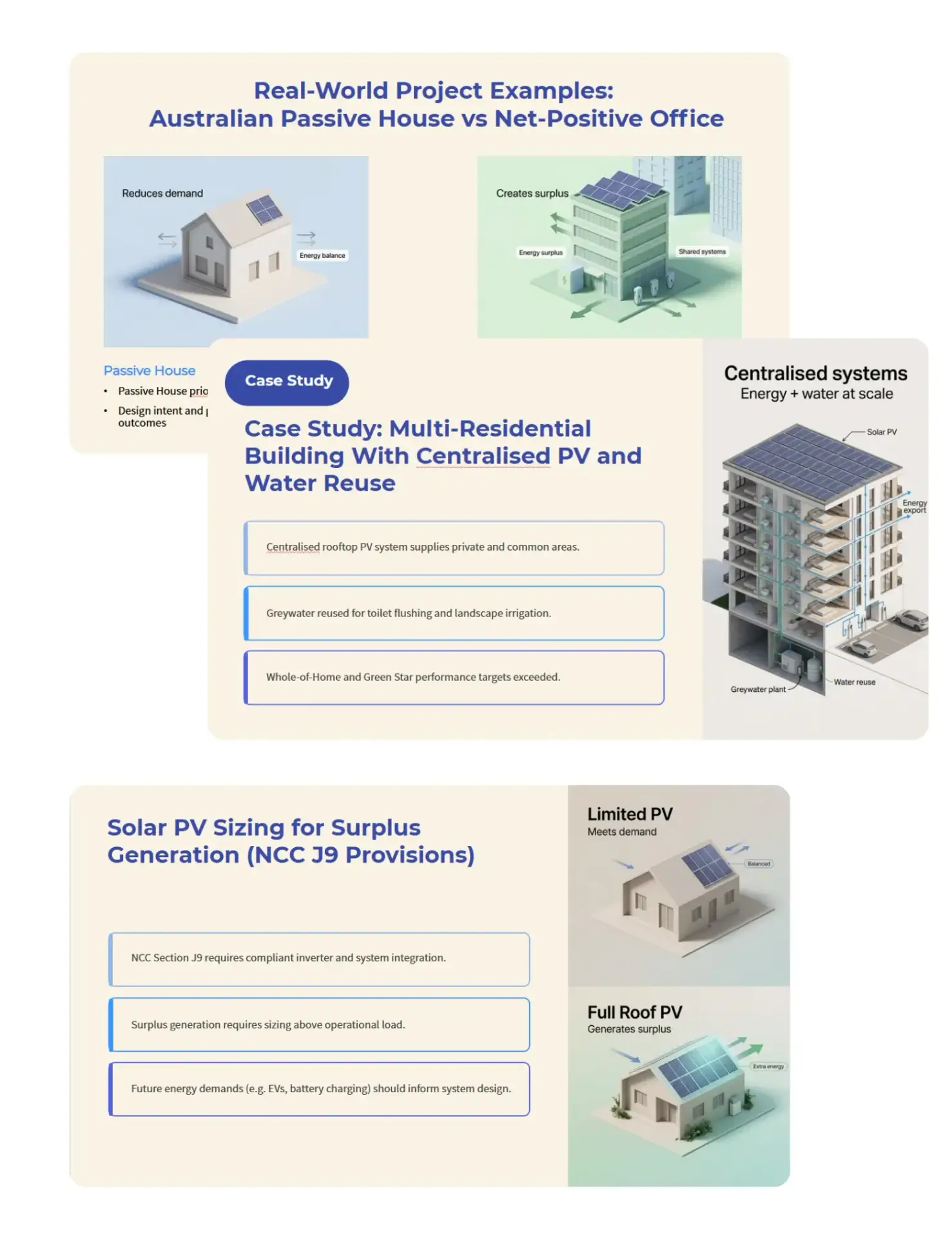
This course examines the transition from conventional sustainability approaches to regenerative design within the built environment. It explores how building systems can be planned and coordinated to deliver long term environmental and operational benefits. The content looks at the relationship between design decisions, building performance, and broader urban infrastructure. It also reviews how policy, compliance frameworks, and industry standards influence high performance outcomes. In addition, the course investigates real world applications and system integration across residential and mixed use projects.
Why Take This CPD Session?

Build the skills needed to design buildings that deliver measurable environmental and community benefits beyond standard compliance.
Stay aligned with current NCC requirements and evolving sustainability expectations in the Australian construction industry.
Gain practical knowledge that can improve project performance, client outcomes, and long-term building value.
Professional development is an investment in career growth and regulatory compliance. Take the next step today.