

Course Content
By the end of this course, you will understand the regulatory requirements, compliance pathways, and design principles that underpin all-electric Class 1a homes. You will be able to confidently specify and document all-electric systems, avoid common compliance and coordination pitfalls, and guide clients through informed decisions that support high-performing, future-ready residential projects. You will also learn how to coordinate effectively with energy assessors, electricians, and certifiers while maintaining clear professional boundaries. In addition, you will develop practical workflows and client communication strategies that help protect all-electric specifications from redesign, substitution, and compliance risks throughout the project lifecycle.
Learning Outcomes
This ensures that CPD efforts align with professional regulatory requirements.
This CPD provides general guidance on professional responsibilities and documentation practices. It does not constitute legal advice or replace project-specific contractual or statutory obligations.
Compliance and Accreditation
|
Framework/Body |
Relevant Sections |
Focus Areas |
|
National Construction Code (NCC 2022 / NCC 2025 transition) |
Volume Two Energy Efficiency provisions; Whole-of-Home pathway; Class 1a compliance; documentation and coordination requirements |
Whole-of-home compliance; energy efficiency; all-electric residential design; documentation; compliance workflow; consultant coordination |
|
NatHERS Protocols |
Thermal performance; Whole-of-Home assessment inputs; appliance selection; energy modelling |
7-Star thermal performance; Whole-of-Home pathway; heat pumps; induction; reverse-cycle; PV integration |
|
ABSA CPD Competency Area |
Residential energy efficiency; NatHERS assessment coordination; compliance documentation |
Building fabric performance; energy assessment inputs; documentation quality; interdisciplinary coordination |
|
Building Designers |
Residential design; documentation; specification writing; consultant coordination; client communication |
All-electric design strategy; construction documentation; compliance; workflow development; risk reduction |
|
NSCA 2021 (Architects) |
PC12, PC20, PC31, PC33, PC46 |
PC12 is directly applicable because the course focuses on interpreting and applying the NCC 2025, state gas-connection regulations, and compliance pathways for Class 1a homes. PC20 is relevant as participants must assess compliance requirements, project constraints and statutory obligations when specifying all-electric systems. PC31 is a core competency because the course centres on environmental sustainability, whole-of-home energy performance, electrification, operational carbon reduction and integrating energy-efficient systems over the building lifecycle. PC33 aligns with the integration of sustainable environmental systems—including heat-pump hot water, reverse-cycle HVAC, solar PV, batteries and EV infrastructure—into residential design. PC46 is highly relevant because a significant portion of the course is devoted to embedding all-electric decisions into construction documentation, specifications and coordinated drawing sets to avoid certification issues and protect design intent. |
|
Engineers Australia (Stage 2) |
Multidisciplinary coordination with electrical, mechanical and energy consultants |
Building services integration; systems coordination; electrical provisioning; sustainable building performance |
|
Licensed Builders (State CPD) |
Residential construction practices; documentation interpretation; installation sequencing |
Construction coordination; buildability; all-electric system implementation; specification compliance |
|
Building Surveyors |
Building approval documentation; NCC compliance verification; RFIs |
Compliance assessment; documentation review; certification requirements; regulatory interpretation |
This session is designed for

Building Designers

Architects

NatHERS Energy Assessors

Licensed Builders

Building Surveyors
What’s Included
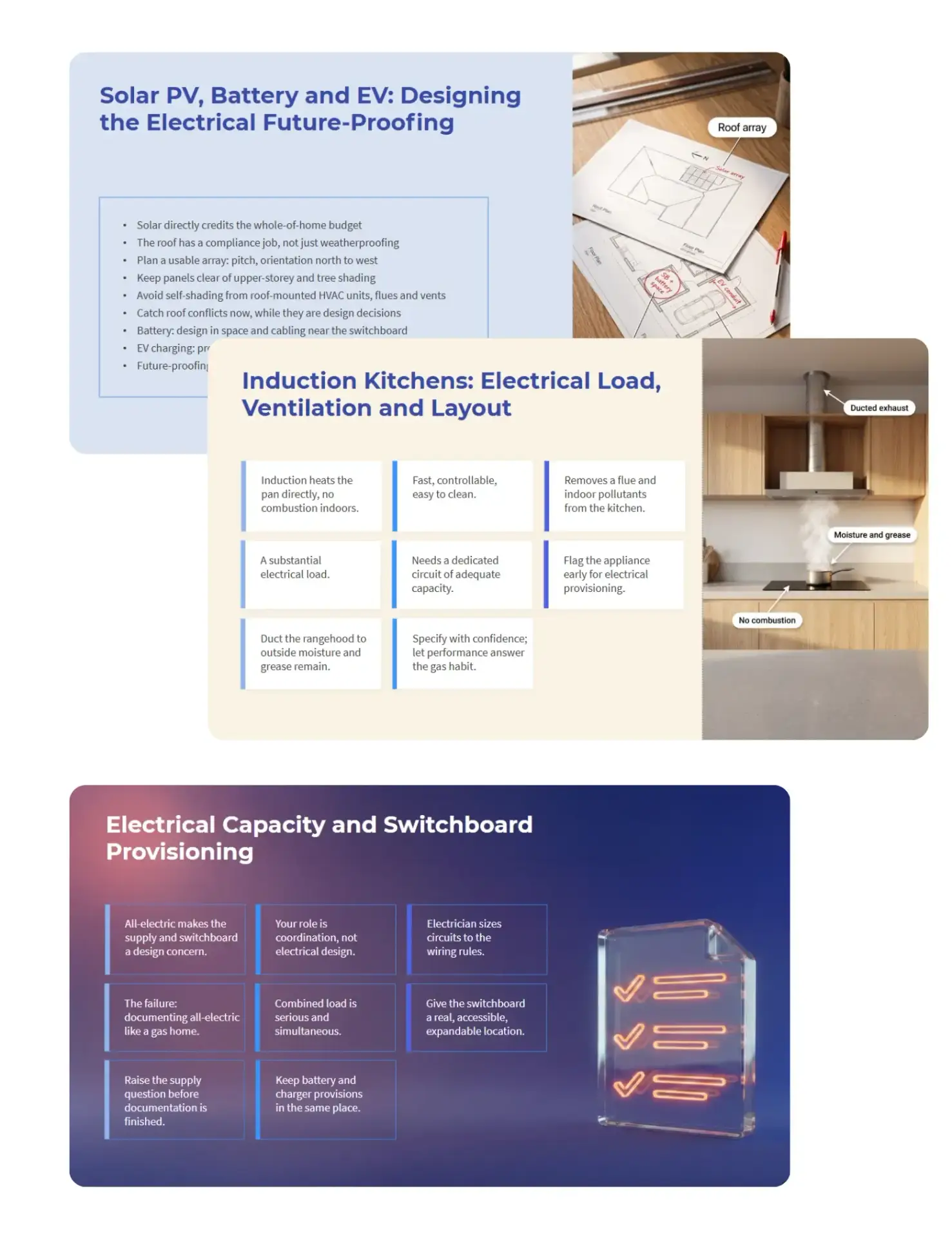
This course examines the practical challenges building designers face as all-electric residential construction becomes the norm across Australia. It covers the regulatory and policy landscape driving gas out of new homes, including how the NCC whole-of-home energy and emissions budget works and how state-by-state gas connection rules vary. The course then moves through the four core electric systems a Class 1a dwelling requires, namely heat-pump hot water, induction cooking, reverse-cycle heating and cooling, and solar with battery and EV provisioning, and how to specify and place them within the compliance pathway. It addresses the documentation and coordination failures most likely to draw certifier questions, from switchboard capacity to hot-water unit siting to the risks of removing gas late in the design process. Finally, it develops a repeatable workflow for embedding all-electric decisions into the drawing set and specification, alongside a client-facing case for upfront cost, running costs, and comfort that protects the specification from value-engineering pressure.
Why Take This CPD Session?

Understand why all-electric design is now landing on your projects and what actually binds each job, so you can read any residential project’s compliance baseline with confidence before you document anything.
Learn to specify and place the four core all-electric systems within the NatHERS and whole-of-home pathway, and avoid the documentation and coordination failures that draw certifier RFIs and force costly redesigns.
Develop a repeatable all-electric documentation workflow and a client conversation that holds your specification together from concept to handover, even under value-engineering pressure.
Professional development is an investment in career growth and regulatory compliance. Take the next step today.