

Course Content
By the end of this course, participants will be able to explain how the Great Design Fast Track Pathway operates within the Victorian planning system and how the Seven Principles function as a design and planning framework. They will be able to interpret how each principle influences design quality, NCC compliance, and planning approval outcomes. Participants will also be able to apply the principles to real residential projects, strengthening their design documentation and submission quality. They will be able to develop evidence-based planning arguments that support variations such as height, setbacks, and site coverage. Finally, they will be able to identify common documentation and design issues that lead to failed planning outcomes and avoid them in practice.
Learning Outcomes
This ensures that CPD efforts align with professional regulatory requirements.
This CPD provides general guidance on professional responsibilities and documentation practices. It does not constitute legal advice or replace project-specific contractual or statutory obligations.
Compliance and Accreditation
|
Framework/Body |
Relevant Sections |
Focus Areas |
|
National Construction Code (NCC 2022) |
Volume One: Parts D, F; Volume Two: Part H4, Part H8; Energy Efficiency (7-Star NatHERS + Whole-of-Home) |
Access and egress, health and amenity, daylight and ventilation, livable housing design, energy efficiency, performance solutions, compliance documentation |
|
NatHERS Protocols |
NatHERS 7-Star requirements; Heating & Cooling Load Limits; Whole-of-Home Energy Assessment |
Thermal performance modelling, passive design optimisation, energy load compliance, system selection and verification |
|
ABSA CPD Competency Area |
Thermal Performance; Building Science; Energy Efficiency |
NatHERS application, passive solar design, building envelope performance, whole-of-home energy integration |
|
Building Designers |
Design documentation; NCC compliance; Planning integration |
Concept-to-documentation workflow, integrating planning policy with built form, compliance-led design decisions |
|
NSCA 2021 (Architects) |
PC20, PC28, PC31, PC32, PC34 |
PC20 (project requirements, codes, and planning constraints): The course focuses on aligning design quality with planning approvals, including navigating the Victorian planning system and justifying variations (e.g. height, setbacks), which directly relates to assessing projects against statutory requirements. |
|
Engineers Australia (Stage 2) |
Environmental & Sustainability; Risk & Compliance; Systems Integration |
Building performance systems, energy modelling inputs, construction systems (CLT/MMC), compliance evidence pathways |
|
Licensed Builders (State CPD) |
NCC compliance; Construction methods; Materials and systems |
Buildability, MMC/offsite construction, compliance with documentation, construction sequencing and risk |
|
Building Surveyors |
NCC assessment; Performance Solutions; Evidence of Suitability (A5.2) |
Compliance verification, certification pathways, documentation review, performance-based assessment |
|
Urban Planners & Landscape Architects |
Planning & Environment Act; Plan Melbourne; Urban design policy |
Planning submissions, design quality as evidence, canopy cover metrics, public realm integration, landscape performance |
This session is designed for

Architects

Building Designers

Urban Planners

Energy Assessors

Building Surveyors
What’s Included
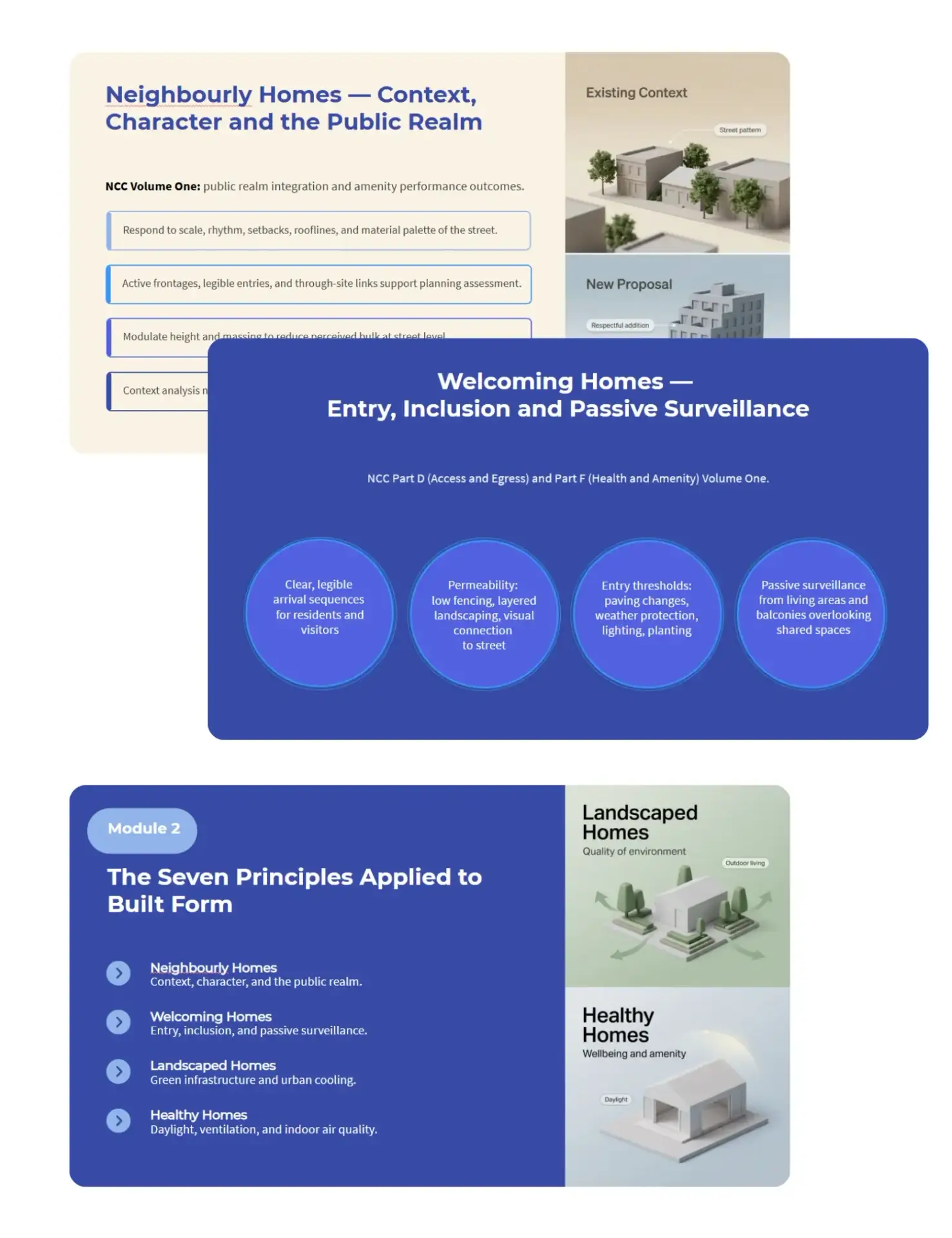
This course examines how design excellence can be used as a practical tool to influence planning outcomes in residential development. It explores the relationship between architectural decisions, regulatory compliance, and planning policy within a structured approval pathway. The content looks at how the Seven Principles shape building form, environmental performance, accessibility, and long term value. It also investigates how design intent is translated into measurable evidence through documentation, analysis, and technical reporting. In addition, the course reviews real project scenarios to demonstrate how integrated design thinking can strengthen approval outcomes and reduce risk.
Why Take This CPD Session?

Gain practical strategies to reduce planning risk and improve approval outcomes through evidence-based design.
Strengthen your ability to align design decisions with NCC compliance and planning policy requirements.
Learn how to present high-quality documentation that supports variations and demonstrates measurable design value.
Professional development is an investment in career growth and regulatory compliance. Take the next step today.