

Course Content
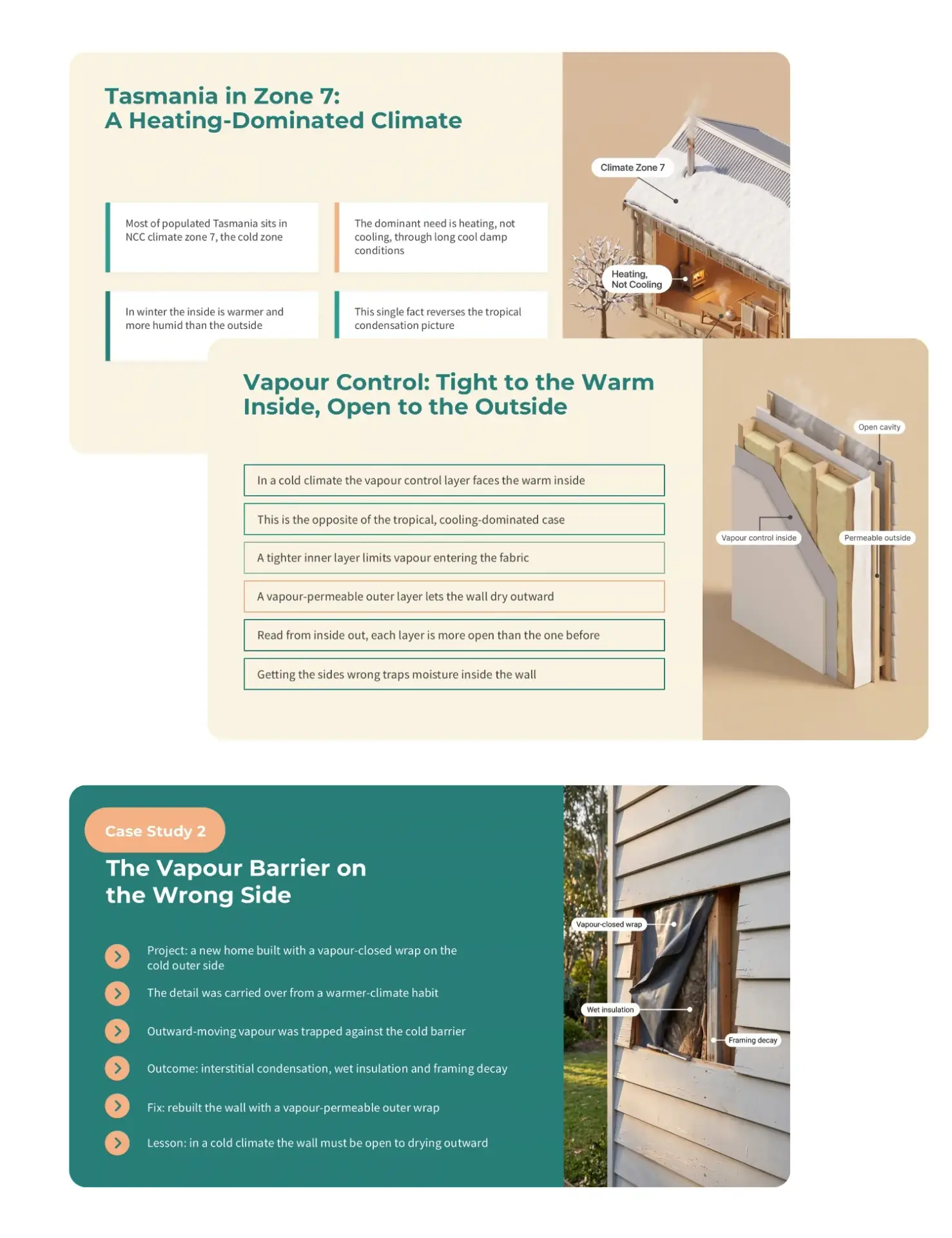
By the end of this course, you will be able to design a Tasmanian envelope that manages the moisture a cold, heating-dominated climate drives through it. Warm humid indoor air, the dew point and the cold surfaces and hidden layers where vapour condenses are worked through first, so every later decision reads as a consequence of the physics rather than a rule. The NCC 2022 condensation management provisions are then applied to wall and roof construction, with the vapour-permeable wall wrap, roof space ventilation and exhaust to outside treated as a floor to build above. Vapour control tight to the warm inside and open to the outside, continuous insulation, air tightness paired with deliberate ventilation and cold-climate glazing are assembled into one drying envelope. Buildability, heat recovery ventilation and the documentation that protects both the building and the architect close the hour, with two Tasmanian case studies showing where cold-climate condensation actually starts.
Learning Outcomes
This ensures that CPD efforts align with professional regulatory requirements.
This CPD provides general guidance on professional responsibilities and documentation practices. It does not constitute legal advice or replace project-specific contractual or statutory obligations.
Compliance and Accreditation
|
Framework/Body |
Relevant Sections |
Focus Areas |
|
National Construction Code (NCC 2022) as applied in Tasmania |
NCC 2022 Volume One (Class 2 to 9) and Volume Two (Class 1 and 10); condensation management provisions (Volume One Part F8, Volume Two Part H4 and ABCB Housing Provisions Part 10.8); pliable building membranes (AS 4200.1 and 4200.2); roof space ventilation; exhaust discharged to outside; Tasmanian adoption position (NCC 2022 applies until the next adoption window) |
Primary statutory framework. Vapour permeable membranes on external walls in climate zone 7; roof space ventilation; wet area exhaust to outside; deemed to satisfy as a floor; performance solutions on difficult sites |
|
Tasmanian building regulation |
Building Act 2016 (Tas) and Building Regulations 2016; Director of Building Control determinations; building surveyor certification of documentation |
Confirming the current NCC edition and Tasmanian position with the building surveyor before documentation is finalised |
|
NSCA 2021 (Architects) |
PC12, PC28, PC33, PC37, PC39, PC45 |
LO1 to PC28: drawing on building and environmental sciences in preliminary design research and concept design. LO2 to PC12: applying relevant building codes and standards, including climate change implications, across practice. LO3 to PC33 and PC39: integrating thermal environmental systems into the concept and carrying material, structural and construction systems into detailed design. LO4 to PC37 and PC45: producing complete, comprehensible documentation and nominating quality and performance standards for materials, components and systems |
|
Building Designers (Building Designers Australia CPD) |
Building science; condensation management; NCC 2022 compliance in climate zone 7; energy efficiency and moisture |
Vapour control; membrane selection; air tightness paired with ventilation; wet area and roof detailing |
|
Building Surveyors (AIBS CPD) |
NCC 2022 condensation management assessment; membrane and ventilation evidence; building envelope compliance in Tasmania |
Assessing whether architectural documentation demonstrates the NCC 2022 condensation management provisions as applied in Tasmania |
This session is designed for

Architects

Building Designers

NatHERS Energy Assessors

Building Surveyors

Sustainability Consultants
What’s Included
This course examines why a heated Tasmanian building in climate zone 7 drives moisture outward through its fabric, and where that vapour condenses on cold surfaces and inside walls and roofs. Surface and interstitial condensation are separated, with the tighter, better-insulated home shown to trap the moisture that draughty older housing used to leak away. The NCC 2022 condensation management provisions are read as design decisions, covering the vapour-permeable wall wrap, ventilated roof spaces, exhaust discharged outside and the limits of the deemed-to-satisfy floor. Vapour control on the warm side, continuous insulation, air tightness with controlled ventilation, glazing, wet areas and low-profile roofs are then assembled into an envelope that keeps surfaces warm and can dry. Two case studies, a sealed Hobart renovation and a new home wrapped in a vapour-closed membrane on the cold side, apply the same principles to the failures that most often reach a Tasmanian architect.
Why Take This CPD Session?

Understand why the vapour control layer sits toward the warm inside in a Tasmanian wall, the reverse of the tropical habit, and read every membrane, insulation and ventilation decision as a consequence of the dew point.
Apply the NCC 2022 condensation management provisions as a floor, then decide when a heavily occupied home, a sheltered damp site or a skillion roof needs a performance solution above it.
Build the documentation and site verification habits that keep a membrane on the right side and an exhaust duct out of the roof space, tested on a sealed Hobart renovation and a wall wrapped the wrong way round.
Professional development is an investment in career growth and regulatory compliance. Take the next step today.