
Bio-Based Building Materials: Risks, Benefits & Compliance

Current Status

Not Enrolled

Price

A$99.00

Get Started

Course Content

I. Introduction (4 min)
II. Learning Objectives (3 min)
V. Module 3: Compliance Pathways and Certification Options (15 min)
VII. Case Studies (5 min)
VIII. Summary & Key Takeaways (3 min)

This course provides an intermediate-level overview of bio-based building materials, focusing on their risks, benefits, and compliance requirements within the Australian construction context. It explores key material types such as timber, hempcrete, and emerging products, alongside their lifecycle performance and embodied carbon characteristics. The course examines critical performance requirements including fire safety, moisture management, thermal performance, and structural adequacy under NCC 2022. It also explains compliance pathways, particularly the Evidence of Suitability framework and the role of Performance Solutions, certification, and testing. Finally, it translates this knowledge into practical specification, documentation, and risk management strategies to support real-world project delivery.

This CPD provides general guidance on professional responsibilities and documentation practices. It does not constitute legal advice or replace project-specific contractual or statutory obligations.

  • CPD Points: 1 Formal CPD Point
  • Duration: 1 hour
  • Certificate Upon Completion
  • Difficulty Level: Intermediate

This session is designed for

Sustainability Consultants
Architects
Building Designers
Energy Assessors
Building Surveyors


By the end of this course, participants will be able to analyse the properties, embodied carbon, and lifecycle performance of key bio-based building materials. They will be able to assess fire safety, moisture, thermal, and structural requirements under NCC 2022 for these materials. Participants will understand how to select and apply appropriate compliance pathways using the Evidence of Suitability framework, including certification and testing options. They will also be able to develop clear, project-specific specifications supported by proper documentation and verification processes. In addition, they will be equipped to identify risks and manage compliance and liability when using bio-based materials in real projects.

  • Analyse the material properties, embodied carbon, and lifecycle performance of key bio-based building materials used in construction.
  • Interpret certification, testing data, and engineering assessments to support compliant material selection.
  • Evaluate fire safety, moisture resistance, thermal performance, and structural requirements under NCC 2022.
  • Develop clear, performance-based specifications and documentation for bio-based material applications.
  • Identify appropriate compliance pathways using the NCC Evidence of Suitability framework for bio-based materials.
  • Assess project risks and implement strategies to manage compliance, substitution, and professional liability.

This ensures that CPD efforts align with professional regulatory requirements.

Framework/Body

Relevant Sections

Focus Areas

National Construction Code (NCC 2022)

Volume One Section C, Section F, Section J; Volume Two Part 3.7; Performance Requirements FP1.2, EP2.1, BP1.1; Evidence of Suitability

Fire performance, moisture and durability, thermal performance, structural adequacy, DTS vs Performance Solutions, compliance pathways

NatHERS Protocols

NatHERS Technical Note; Software Modelling Requirements

Thermal modelling inputs, insulation performance, climate zone sensitivity, verified product data

ABSA CPD Competency Area

Thermal Performance; Building Fabric; Compliance & Regulations

Energy efficiency, material performance assessment, compliance with NCC energy provisions

Building Designers

NCC application; Material Selection; Performance Solutions

Specification of non-DTS materials, detailing for moisture, fire and thermal compliance

NSCA 2021 (Architects)

PC10, PC31, PC33, PC45, PC16

PC10 (whole life carbon): The course strongly focuses on embodied carbon, biogenic carbon, and lifecycle assessment of bio-based materials, aligning directly with whole-of-life carbon evaluation.
PC31 (environmental sustainability): Analysis of lifecycle performance, sustainability credentials, and environmental impacts of materials clearly addresses integration of sustainability across the project lifecycle.
PC33 (environmental systems): The course evaluates thermal performance, moisture behaviour, and acoustic considerations, requiring understanding and integration of building systems into design.
PC45 (quality and performance standards): Detailed assessment of fire safety, NCC compliance, and material performance aligns with ensuring materials meet required technical and regulatory standards.
PC16 (risk management): Emphasis on compliance pathways, supplier verification, and specification risk management directly relates to identifying and mitigating risks in material selection and documentation.

Engineers Australia (Stage 2)

Elements 1–3

Structural adequacy, fire engineering, material validation, engineering judgement

Licensed Builders (State CPD)

Construction Practice; NCC compliance

Installation risks, substitution risk, durability and compliance

Building Surveyors

Compliance assessment; Evidence of Suitability

Verification of test data, certification pathways, approval risk management

Urban Planners & Landscape Architects

Sustainability frameworks; Planning considerations

Embodied carbon, lifecycle impacts, integration into planning outcomes

What’s Included

This course examines the use of bio-based building materials in the Australian construction industry, focusing on their performance, risks, and compliance requirements. It explores how these materials behave in relation to fire safety, moisture, thermal performance, and structural standards under NCC 2022. The course also looks at compliance pathways, including certification, testing, and Performance Solutions for materials outside standard provisions. In addition, it reviews practical challenges such as supplier verification, documentation, and approval processes. Overall, it provides a structured approach to confidently specifying and managing bio-based materials in real projects.
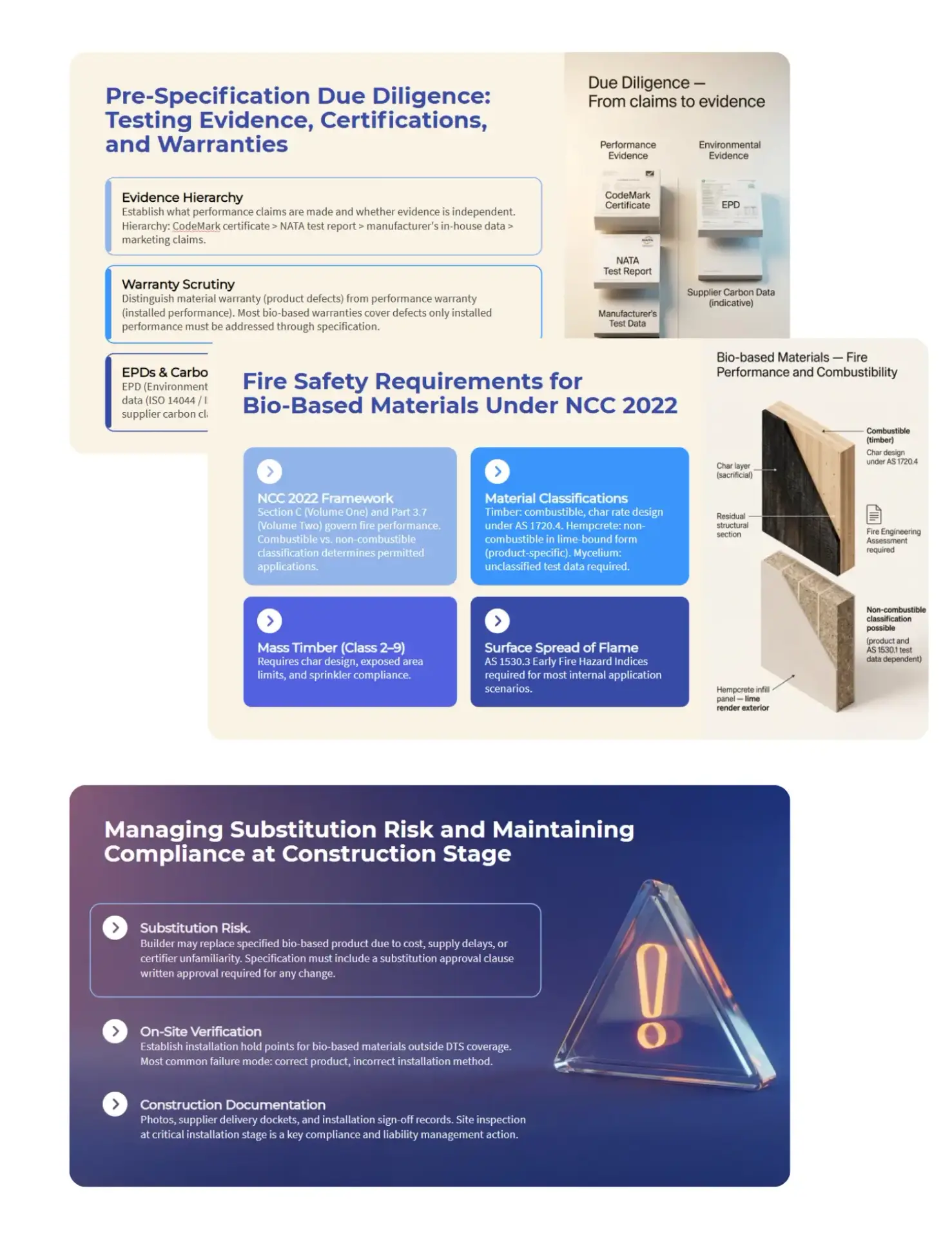
  • A 1-hour video session covering NCC-aligned strategies and real-world case studies.
  • An interactive quiz to test and reinforce knowledge.
  • An audio summary version via NotebookLM for flexible, on-the-go learning.
  • A downloadable certificate of completion for CPD compliance reporting.
  • Centralised CPD tracking dashboard to support audits and personal recordkeeping.

Why Take This CPD Session?

Gain practical knowledge to confidently specify bio-based materials while meeting NCC 2022 compliance requirements.

Understand how to manage risks, documentation, and approval processes when working with non-standard materials.

Strengthen your ability to deliver sustainable, low embodied carbon outcomes backed by credible evidence and compliance pathways.

Professional development is an investment in career growth and regulatory compliance. Take the next step today.