

Course Content
By the end of this course, you will be able to separate what the National Construction Code asks of a material from what its sustainability claim asserts, and answer only the question that decides approval. The evidence of suitability provisions in NCC 2025 are worked through form by form, so you can name which of the six forms of documentary evidence suits a product and what a complete package looks like before you ask a supplier for it. Combustibility is taught as a test result rather than a description, with the assembly rule and the minor degree provisions applied to grown materials that resemble tested ones. NCC 2025 also rewrote the external wall condensation provisions, and the course traces them onto monolithic bio-based walls, where a required drained and ventilated cavity changes wall thickness and every opening in the building. Two case studies, a hempcrete wall that lost its non-combustible claim and a straw bale house in climate zone seven, show where these specifications fail and what the record should have held.
Learning Outcomes
This ensures that CPD efforts align with professional regulatory requirements.
This CPD provides general guidance on professional responsibilities and documentation practices. It does not constitute legal advice or replace project-specific contractual or statutory obligations.
Compliance and Accreditation
|
Framework/Body |
Relevant Sections |
Focus Areas |
|
National Construction Code (NCC 2025 & NCC 2022) |
NCC 2025 Volume Two Part A5 Documentation of design and construction (A5G1, A5G2, A5G3, A5G6); Volume Two Part H3 clause H3D2; Volume One clause C2D10; Volume One Part F8 Condensation management (F8D2, F8D3, F8D5, F8D6, Table F8D3); ABCB Housing Provisions Standard 2025 clauses 10.8.1, 10.8.3, 10.8.4 and 13.2.2 with Table 10.8.1; corresponding NCC 2022 and Housing Provisions 2022 provisions where transitional arrangements apply |
Evidence of suitability and fitness for purpose (two limbs: documentary evidence and appropriate installation), the six forms of documentary evidence, validity of evidence citing earlier editions, combustibility and the deemed non-combustible lists, the minor degree provisions, the four fire hazard properties and their test Standards, external wall vapour permeance by climate zone, drained and ventilated cavities, roof space ventilation, insulation installation, staged adoption of NCC 2025 by jurisdiction. |
|
NatHERS Protocols |
NatHERS Technical Notes on insulation and construction inputs; verified product data requirements |
Insulation assessed against AS/NZS 4859.1; use of verified, product-specific performance data rather than generic values for bio-based insulation in thermal modelling; recognising that no R-Value or conductivity figure should be taken from a CPD or supplier marketing without documentation. |
|
ABSA CPD Competency Areas |
Building fabric and materials; compliance and regulations; moisture and condensation management |
Material performance assessment, condensation risk in bio-based wall systems, compliance with NCC energy and condensation provisions, verification of supplier claims. |
|
Building Designers |
NCC Volume Two and Housing Provisions application; material selection and specification; Performance Solutions where no Deemed-to-Satisfy route exists; Volume One only where licence class and jurisdiction permit Class 2 work |
Specifying non-Deemed-to-Satisfy materials, choosing the form of evidence before the product, assembly-level combustibility, wall build-up decisions at concept in climate zones 6 to 8, documenting the evidence path and record for certification, managing substitution requests. |
|
NSCA 2021 (Architects) |
PC12, PC35, PC39, PC45, PC46 |
The course is built around how NCC 2025 provisions apply to a material class – Part A5 evidence of suitability, C2D10/H3D2 deemed non-combustible lists, Part F8 and the Housing Provisions. PC12 covers understanding how building codes and standards apply across practice, expressly including the principles of fire safety, which Module 3 addresses through combustibility testing (AS 1530.1) and the four fire hazard properties. LO1 turns on separating a biogenic carbon claim from what the Code actually requires of a material, and Module 1 works through the carbon storage arguments made for bio-based products. PC35 concerns understanding the embodied carbon implications of chosen materials, components and systems, including the technical data and provenance needed to substantiate those claims. Module 4 resolves the bio-based wall as a construction system – vapour permeance, drained ventilated cavity, and the interaction of membrane, cladding and structural fabric in climate zones 6-8. PC39 covers the integration of material selection with structural and construction systems, which is precisely the hempcrete and straw bale assembly analysis in the case studies. LO2 and LO3 require the designer to select materials against documented quality and performance standards – the six forms of evidence under A5G3, certificate scope, and the AS 1530 / AS 5637.1 / AS 4200 / AS 1720.1 test regimes. PC45 is the criterion for selecting materials and systems on the basis of performance standards and their whole life carbon impact. LO4 produces the specification and the compliance record that carries a novel material through certification. PC46 covers producing documentation that complies with regulatory controls, building standards and codes – the exact deliverable when a material has no Deemed-to-Satisfy route and the evidence trail must stand on its own. |
|
Licensed Builders (State CPD) |
Construction practice; NCC compliance; installation in accordance with evidence of suitability |
Installing bio-based systems to the conditions stated in the evidence (render, fixing, curing, cavity formation and ventilation openings), substitution risk at tender, durability and moisture management, record keeping. |
|
Building Surveyors |
Assessment of evidence of suitability under Part A5; fire hazard property and combustibility verification; condensation provisions |
Reviewing certificates against their scope, checking test reports for laboratory accreditation and sample description, applying the minor degree provisions and their stated limitations, verifying cavity and vapour permeance compliance on drawings. |
This session is designed for

Building Designers

Architects

Building Surveyors

Licensed Builders

Sustainability Consultants
What’s Included
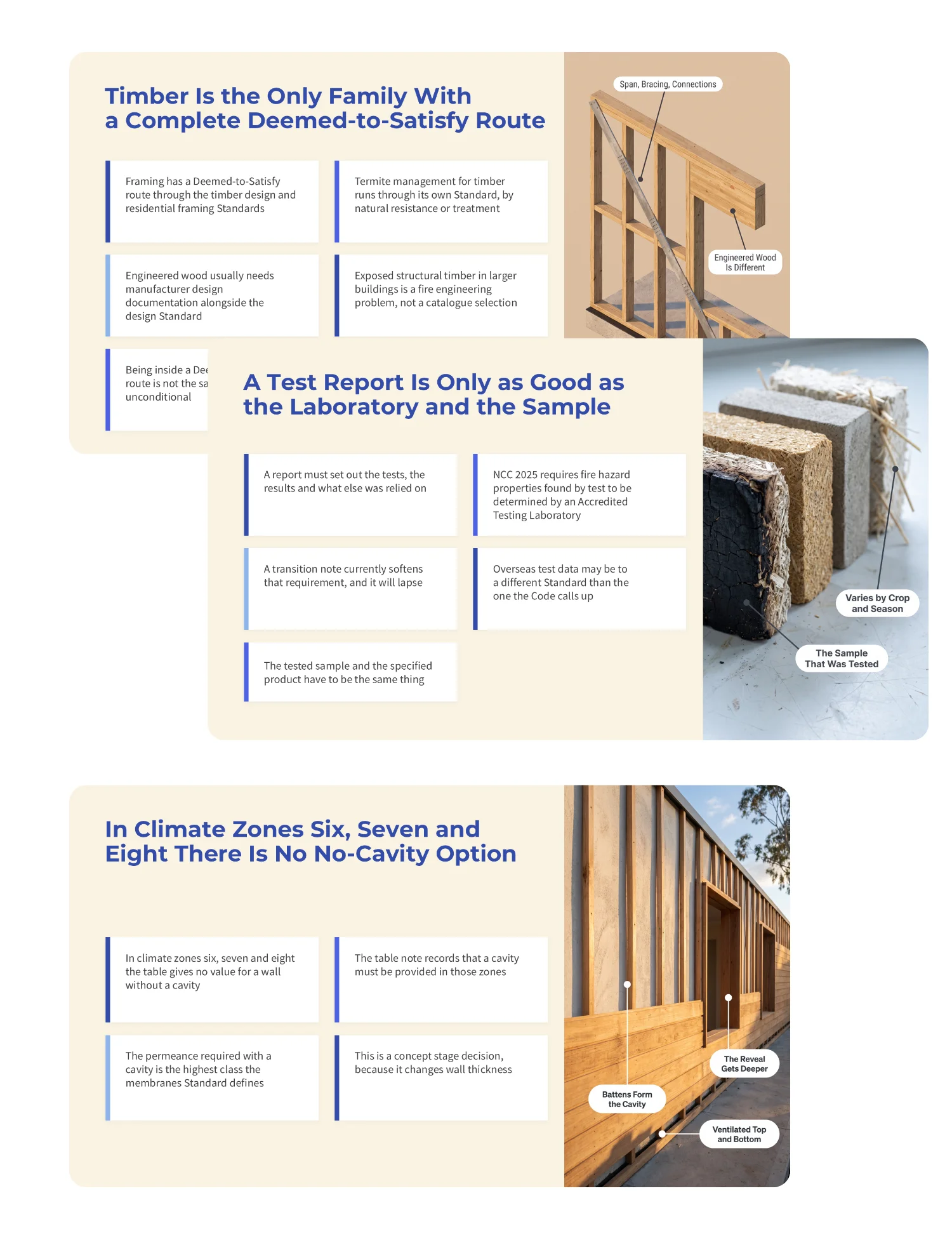
This course examines what the National Construction Code asks of a bio-based material, as distinct from the sustainability claim that brought it into the project. It takes apart the evidence of suitability provisions of NCC 2025, including the six forms of documentary evidence and the scope a certificate actually covers. Combustibility is treated as a test result rather than a description, with the deemed non-combustible lists, the minor degree provisions and the four fire hazard properties. The rewritten external wall condensation provisions are traced onto monolithic bio-based walls, where climate zones six, seven and eight leave no option without a drained and ventilated cavity. Two case studies, a hempcrete wall and a straw bale house, apply those provisions to real project decisions.
Why Take This CPD Session?

Learn to ask a supplier the right evidence question before a bio-based material reaches your drawings, and to recognise a complete answer when it arrives.
Understand why non-combustible is a test result and not a description, so you can settle a fire claim on a rendered composite or a timber framed assembly before a certifier does.
Build a specification and project record that survive a certifier, a builder and a substitution request, tested against a hempcrete wall and a straw bale house in climate zone seven.
Professional development is an investment in career growth and regulatory compliance. Take the next step today.