

Course Content
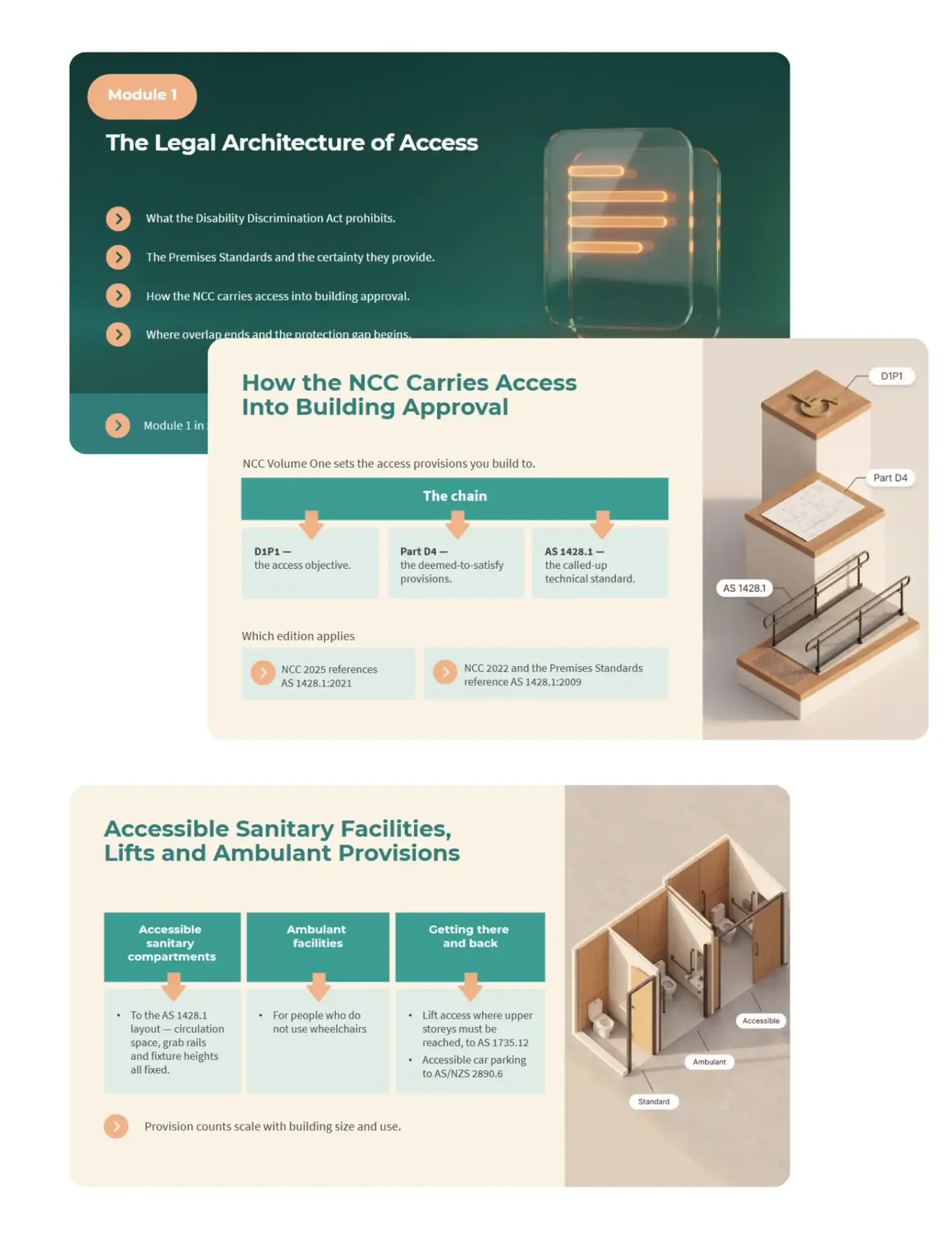
Throughout this course, you will explore the legal and regulatory framework that governs accessibility in Australian buildings, including the Disability Discrimination Act, the Premises Standards, and the National Construction Code. You will gain an understanding of how accessible design requirements are applied in practice and how AS 1428 provisions influence architectural documentation. The course will examine concessions, performance solutions, and common compliance challenges that arise on both new and existing projects. You will also learn how effective documentation and coordination can help manage risk, support compliance, and create more inclusive built environments. By the end of the course, you will be better equipped to integrate accessibility considerations into every stage of the design process.
Learning Outcomes
This ensures that CPD efforts align with professional regulatory requirements.
This CPD provides general guidance on professional responsibilities and documentation practices. It does not constitute legal advice or replace project-specific contractual or statutory obligations.
Compliance and Accreditation
|
Framework/Body |
Relevant Sections |
Focus Areas |
|
National Construction Code (NCC 2025 & NCC 2022) |
Volume One – Accessibility provisions; Performance Requirements; DTS access provisions; Performance Solutions |
Application of access requirements, accessible paths of travel, sanitary facilities, lifts, circulation spaces, documentation, Performance Solutions, compliance with jurisdictional NCC adoption. |
|
National Standard of Competency for Architects (NSCA 2021) |
PC1, PC32, PC41, PC46, PC47 |
PC1 – Regulatory Requirements and Obligations The course is fundamentally centred on architects’ legal and professional obligations under the Disability Discrimination Act (DDA), the Premises Standards, AS 1428 and the NCC. It develops competency in understanding and applying statutory requirements, professional responsibilities and risk management throughout architectural practice. |
|
Building Designers |
Regulatory compliance; Building Code application; Inclusive design; Documentation and specification |
Designing compliant accessible buildings, interpreting NCC access requirements, coordinating documentation, integrating accessibility from concept through construction documentation. |
|
Licensed Builders (State CPD) |
Building code compliance; Construction quality; Accessibility implementation |
Constructing accessible features in accordance with approved documentation, interpreting access details on site, quality assurance, managing compliance during construction. |
|
Building Surveyors |
Building approval; NCC compliance assessment; Performance Solutions; Certification |
Assessing compliance with NCC access provisions, reviewing Performance Solutions, interpreting Premises Standards interface with building approvals, certification and statutory compliance. |
This session is designed for

Architects

Building Designers

Building Surveyors

Access Consultants

Licensed Builders
What’s Included
This course explores the practical realities of designing accessible buildings within Australia’s evolving regulatory environment. It examines the relationship between legal obligations, building approval requirements, and architectural decision-making, highlighting how accessibility considerations influence projects from concept design through to handover. You will explore common design challenges, including existing buildings, heritage constraints, and complex site conditions, and consider the pathways available when standard compliance solutions are not achievable. The course also investigates the role of documentation, consultant coordination, and risk management in creating accessible, functional, and legally defensible design outcomes. Throughout the course, real-world scenarios are used to demonstrate how accessibility principles can be successfully integrated into everyday architectural practice.
Why Take This CPD Session?

Understand how the Disability Discrimination Act, Premises Standards, AS 1428 and the NCC interact so you can confidently manage accessibility compliance throughout the design process.
Learn practical strategies for designing accessible buildings, applying performance solutions, and navigating concessions without increasing project risk.
Strengthen your documentation and risk management practices to help reduce the likelihood of complaints and support more defensible design decisions.
Professional development is an investment in career growth and regulatory compliance. Take the next step today.