Fire Separation and Fire-Resisting Construction for Townhouses and Units
$99.00 GST
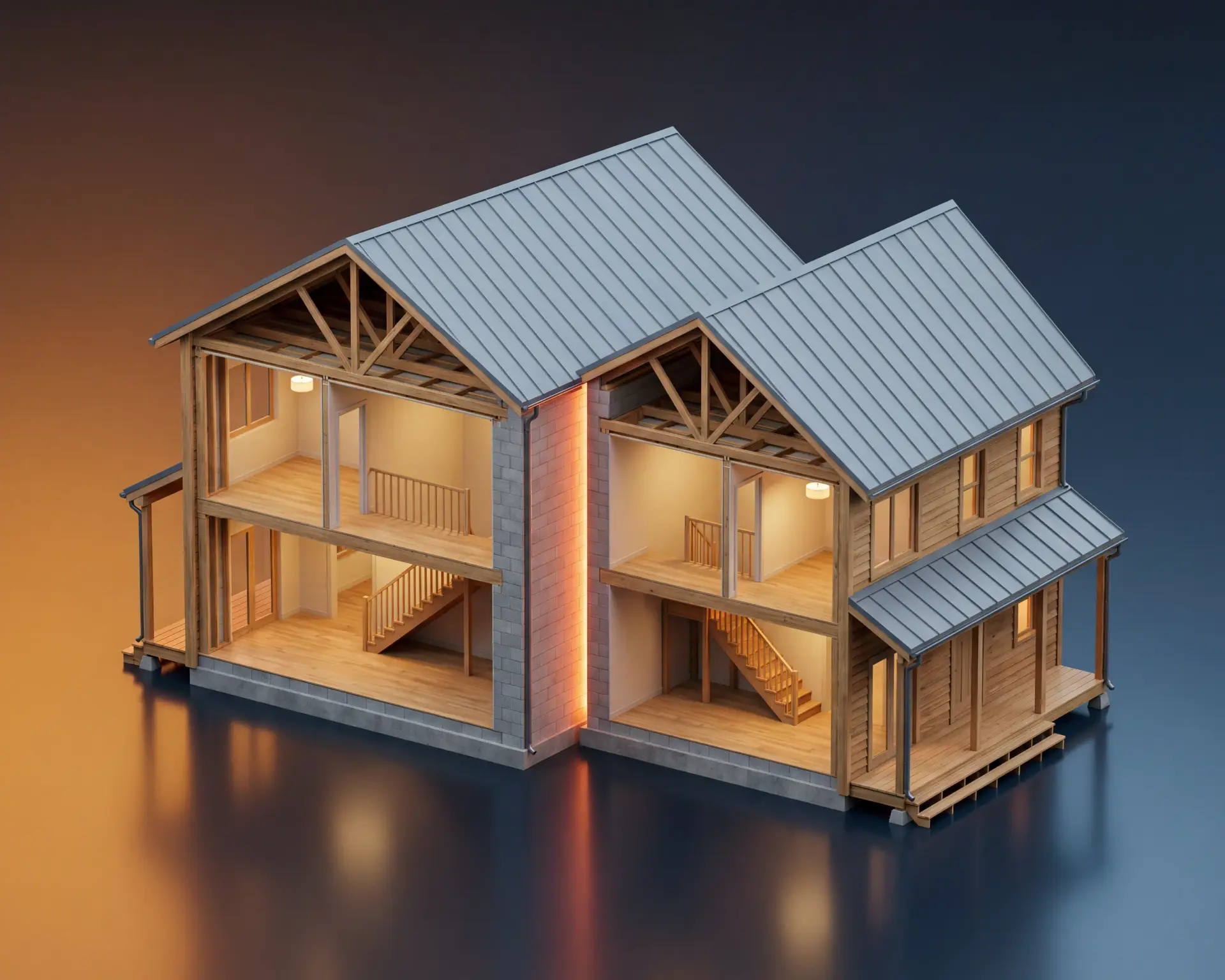
Most fire separation faults in attached housing are not in the wall. They sit at its edges: a truss running over the top plate, a shared verandah soffit, power points cut back to back, or a shared stair that turns a small unit building from Type C into Type B.
This one hour CPD course is for building designers, architects, building surveyors, licensed builders and fire safety engineers. Four short modules, two case studies and a ten question quiz, with your certificate saved to your dashboard.
Description
Fire separation for townhouses and units starts with classification: a dwelling beside a dwelling is Class 1a under Volume Two, while a dwelling over another dwelling or a shared space is a Class 2 unit under Volume One. By the end of this course, you will be able to differentiate a Class 1a townhouse from a Class 2 unit and confirm the edition, apply the separating wall, garage and roof provisions to attached dwellings, evaluate external walls, openings and encroachments near boundaries, and analyse the Type of construction and fire-resistance levels for a small Class 2 building.
The organising idea is that a separating wall is judged as one unbroken plane. The course follows it from the footings to the roofing, through the roof line, the veneer gap, shared eaves, services, horizontal projections and dwellings over a neighbour’s garage, then measures the 900 mm and 1.8 m boundary triggers and works through openings, garages, carports and eaves. For unit buildings it sets the Type of construction from the exits, tests the two storey concession and carries the Type C ratings through walls, floors, unit entry doors and penetrations.
Two case studies put that into practice: a Launceston terrace with continuous trusses, and a Hobart fourplex with a shared stair.
This CPD reflects NCC 2022 Amendment 2, NCC 2025, the ABCB Housing Provisions and the Tasmanian Building Act 2016 and Building Regulations 2016 as published in November 2026. Confirm the edition, any state variation and your licence scope for each project with your building surveyor and your regulator. It is general professional education, not legal advice.