
Time Management & Resource Planning for Design Projects

Current Status

Not Enrolled

Price

A$99.00

Get Started

Course Content

I. Introduction (5 minutes)
II. Learning Objectives (2 minutes)
III. Module 1: Project Phases & Resource Allocation (12 minutes)
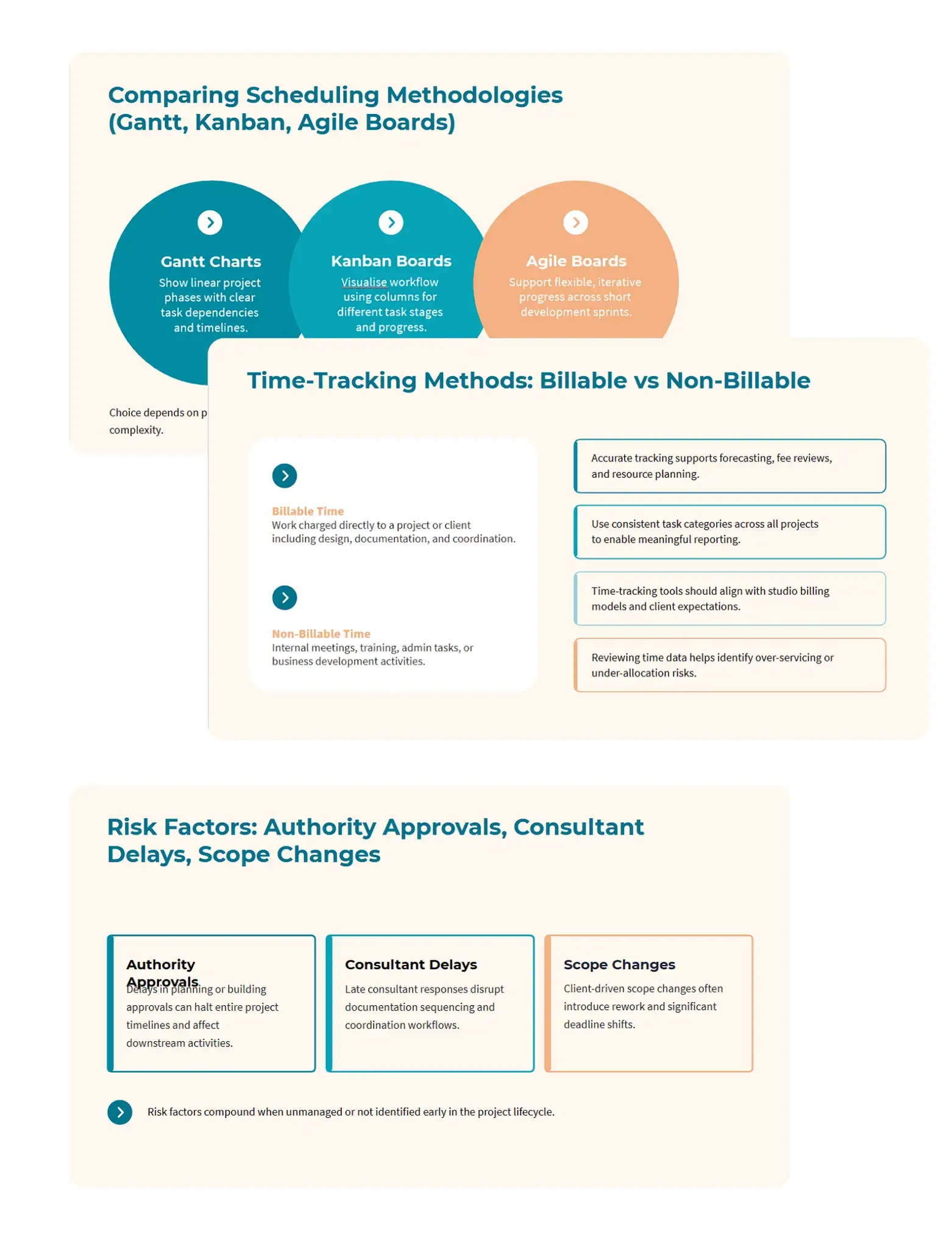
IV. Module 2: Scheduling & Time Tracking Tools (12 minutes)
V. Module 3: Managing Critical Path & Design Risks (12 minutes)
VI. Module 4: Integrated Project Management Systems (12 minutes)
VII. Summary & Key Takeaways (5 minutes)
Final Quiz – Time Management & Resource Planning for Design Projects

This course provides architects and design professionals with practical strategies to improve efficiency, consistency, and compliance across all project phases. Participants will learn how to structure their time and resources effectively using proven scheduling, tracking, and project management tools tailored to studio environments. The program covers identifying critical paths, managing risks, and integrating management systems to support seamless coordination and delivery. Real-world examples demonstrate how structured planning reduces delays, prevents burnout, and enhances project outcomes. By the end of the session, attendees will have the confidence and tools to manage design workflows in alignment with NCC documentation and industry standards.

  • CPD Points: 1 Formal CPD Point
  • Duration: 1 hour
  • Certificate Upon Completion
  • Difficulty Level: Intermediate

This session is designed for

Architects
Project Managers
Design Technologists
Studio Leads
Graduate Architects

By the end of this course, participants will understand how to effectively allocate resources and schedule project phases for consistent, on-time delivery. They will be able to identify and manage critical path risks that impact design outcomes and compliance timelines. Participants will also gain practical knowledge of industry tools for time tracking, scheduling, and integrated project management. They will learn to connect project milestones with documentation workflows to meet NCC and ABCB expectations. Ultimately, they will be equipped to lead more efficient, transparent, and compliant design projects within studio environments.

  • Identify and allocate studio resources effectively across each phase of the architectural design process.
  • Develop and maintain risk registers tailored to architectural workflows for proactive project control.
  • Apply scheduling and time-tracking tools to optimise productivity and delivery timelines.
  • Integrate project management systems to streamline forecasting, documentation, and approvals.
  • Recognise and manage critical path risks that can impact project milestones and compliance outcomes.
  • Align deliverables and documentation with NCC requirements to ensure regulatory compliance and quality assurance.

This ensures that CPD efforts align with professional regulatory requirements.

Framework/Body

Relevant Sections

Focus Areas

National Construction Code (NCC 2022)

Section C – Fire Safety; Part A5 – Evidence of Suitability; Volume 2 – Whole-of-Home

Addresses fire compliance (FRL), DTS vs. Performance Solutions, and Whole-of-Home energy efficiency for hempcrete and mycelium

NatHERS Protocols

Whole-of-Home Heating/Cooling Load Compliance

Applies to hempcrete and mycelium for natural insulation values in energy modelling and compliance ratings

ABSA CPD Competency Area

Section 3.2 – Construction Materials; Section 3.5 – Energy Performance

Supports thermal performance evaluation and low-carbon material integration in residential rating assessments

Building Designers

BDAA CPD – Sustainable Materials & Innovation

Relevant to specifying and documenting compliant use of hempcrete, timber, and mycelium under NCC and bushfire performance conditions

NSCA 2021 (Architects)

PC4, PC16, PC26, PC31, PC45

Aligns with sustainable material selection, fire testing interpretation, circular economy practices, and lifecycle design

Engineers Australia (Stage 2)

Systems Integration; Technical Proficiency; Risk Management

Applies to compliance pathways, material suitability, and fire/thermal testing data for new systems integration

Licensed Builders (State CPD)

Construction Detailing; Alternative Solutions

Covers site installation, durability of unconventional materials, and managing performance documentation

Building Surveyors

Evidence of Suitability; NCC Vol 1 & 2 – Fire Performance; BAL

Applies to assessment of documentation for non-standard materials, FRL ratings, and bushfire zoning decisions

Urban Planners & Landscape Architects

Low-Carbon Material Use in Site Planning; Circular Economy

Relevance in precinct-scale planning, green infrastructure strategy, and public realm material sustainability

What’s Included

This course covers practical strategies for managing time and resources throughout the architectural design process. It explores how to structure project phases, assign staff effectively, and implement scheduling and tracking tools suited to studio workflows. Participants will learn to identify and manage critical path risks, ensuring smoother coordination and reduced delays. The course also examines integrated project management systems that combine forecasting, approvals, and documentation control. Through real-world examples, it demonstrates how effective planning supports compliance with NCC requirements and improves overall project performance.
  • A 1-hour video session covering NCC-aligned strategies and real-world case studies.
  • An interactive quiz to test and reinforce knowledge.
  • An audio summary version via NotebookLM for flexible, on-the-go learning.
  • A downloadable certificate of completion for CPD compliance reporting.
  • Centralised CPD tracking dashboard to support audits and personal recordkeeping.

Why Take This CPD Session?

Enhance your ability to plan, schedule, and deliver design projects efficiently while meeting compliance standards.

Gain practical tools and workflows that improve team coordination, resource management, and project visibility.

Strengthen your professional capability to manage complex architectural projects with confidence and consistency.

Professional development is an investment in career growth and regulatory compliance. Take the next step today.