
Non-Conforming Building Products: Specification Risk, Evidence of Suitability, and Documentation Defence for Building Designers

Current Status

Not Enrolled

Price

A$99.00

Get Started

Course Content

I. Introduction (3 minutes)
II. Learning Objectives (5 minutes)
VII. Case Studies (4 minutes)
VIII. Summary & Key Takeaways(2 minutes)

This is an intermediate-level CPD course designed for architects and building designers working in Australia’s post-cladding-crisis regulatory environment. It focuses on the professional risks that arise when non-conforming building products enter a project through substitution, misrepresentation, or weak specification language, and how designers can protect themselves through better documentation practices. The course walks through the National Construction Code’s evidence of suitability pathways under NCC 2022, including CodeMark, WaterMark, and Certificates of Conformity, while also previewing the tightened compliance expectations signalled by the NCC 2025 preview. Across four modules, participants learn to identify where their specification language creates unintended liability, how to assess product selection decisions against the appropriate NCC pathway, and how to draw clear written boundaries between their responsibilities and those of the supplier, builder, and certifier. The course culminates in practical documentation strategies and real-world case studies that help designers build a defensible paper trail capable of withstanding scrutiny when a product is later found to be non-conforming.

This CPD provides general guidance on professional responsibilities and documentation practices. It does not constitute legal advice or replace project-specific contractual or statutory obligations.

  • CPD Points: 1 Formal CPD Point
  • Duration: 1 hour
  • Certificate Upon Completion
  • Difficulty Level: Intermediate

This session is designed for

Building Designers
Architects
Contract Administrators
Building Surveyors and Certifiers
Project Managers


By the end of this course, participants will be able to understand what constitutes a non-conforming building product, how it differs from non-compliant and counterfeit products, and the pathways through which these products enter projects through substitution, misrepresentation, and inadequate specification. They will be able to identify where they carry documentation and specification risk, particularly the gap between specifying and verifying a product, and how generic language and equivalence clauses create professional liability exposure. Participants will be able to apply NCC evidence of suitability pathways to assess and document product selection decisions, including CodeMark, WaterMark, JAS-ANZ, Certificates of Conformity, and expert judgement under NCC Part A5, while understanding what the NCC 2025 preview is changing. Finally, they will be able to implement documentation and coordination strategies that reduce professional exposure when products are later found to be non-conforming, including what to record, when to escalate, and how to delineate responsibility across the project team.

  • Understand what constitutes a non-conforming building product and how it differs from non-compliant and counterfeit products using ABCB definitions.
  • Apply NCC 2022 evidence of suitability pathways, including CodeMark, WaterMark, JAS-ANZ, and Certificates of Conformity, to product selection decisions.
  • Identify the key pathways through which non-conforming products enter projects, including substitution, misrepresentation, and inadequate specification language.
  • Interpret the confirmed changes in the NCC 2025 preview and understand how they are raising the bar for compliance documentation and evidence requirements.
  • Recognise where building designers carry professional liability risk in the gap between specifying a product and verifying its compliance on site.
  • Implement defensible documentation strategies that clearly delineate responsibility between the designer, supplier, builder, and certifier when products are later found to be non-conforming.

This ensures that CPD efforts align with professional regulatory requirements.

Framework/Body

Relevant Sections

Focus Areas

National Construction Code (NCC 2022)

Part A5 — Evidence of Suitability (A5G1, A5G2, A5G3); Part A2 — Compliance Pathways; Performance Solution requirements

Evidence of suitability obligations for product selection; CodeMark, WaterMark, and JAS-ANZ certification pathways; Certificates of Conformity; distinction between Deemed-to-Satisfy and Performance Solution compliance; designer documentation obligations under A5

NCC 2025 Preview

Strengthened A5G1, A5G2, A5G3; narrowing of Expert Judgement under A2G2; proposed Building Product Assurance Framework; risk-based Building Product Registration Scheme

Raising the bar for standardised compliance information; risk-proportionate evidence requirements; traceable documentation obligations; narrowing of Expert Judgement for Performance Solutions; emerging product registration and assurance framework — confirmed changes vs proposals still under development

ABSA CPD Competency Area

Professional conduct; documentation and specification practice; risk management

Documentation discipline in product selection workflows; scope limitation and responsibility delineation; evidence-based decision recording; professional exposure management in post-cladding-crisis regulatory environment

NSCA 2021 (Architects)

PC1, PC12, PC16, PC39, PC45

PC1 — Professional conduct obligation to understand non-conforming product risks and the post-cladding-crisis regulatory landscape; directly supports LO1.
PC12 — NCC evidence of suitability pathways (A5G1–A5G4, A2G2) are central to LO3; includes NCC 2025 preview strengthening of product assurance requirements.
PC16 — Professional liability: LO2 addresses the gap between specifying and verifying, and how generic specification language creates liability exposure.
PC39 — Material specification: product selection, CodeMark, WaterMark, and JAS-ANZ certification assessment for evidence of suitability.
PC45 — Coordination: LO4 covers delineation of responsibility between designer, supplier, builder, and certifier when products are found non-conforming.

Building Designers Association (BDA) CPD

Specification documentation; product selection; compliance obligations; professional practice

Identifying where specification language creates unintended liability; managing the gap between specifying and verifying; applying NCC evidence of suitability pathways to product selection decisions; recording substitution requests and product changes in real time

Engineers Australia (Stage 2)

Competency areas related to risk analysis, compliance assessment, and professional judgement

Risk assessment in building product selection; applying engineering judgement to evidence of suitability decisions; professional liability exposure when products are substituted without designer knowledge; documentation standards that support defensible professional positions

Australian Institute of Building Surveyors (AIBS) CPD

Product compliance assessment; certification pathways; NCC evidence of suitability

Understanding how designers document product suitability for certifier review; CodeMark and WaterMark certification as compliance evidence; chain of responsibility between designer, supplier, builder, and certifier; what constitutes adequate documentation when non-conforming products are discovered post-construction

Licensed Builders (State CPD)

Building product compliance; substitution obligations; regulatory awareness

Understanding the regulatory consequences of product substitution without designer approval; chain of responsibility for non-conforming product installation; documentation obligations when substitution is requested or occurs; post-cladding-crisis regulatory environment and heightened product compliance expectations

Building Products Innovation Council (BPIC) / Industry Frameworks

Non-conforming product identification; supply chain integrity; product assurance

How non-conforming products enter supply chains through substitution, misrepresentation, and inadequate specification; ABCB definitions — non-conforming vs non-compliant vs counterfeit; supply chain opacity and cost-pressure substitution dynamics; proposed Building Product Registration Scheme context

Professional Indemnity / Risk Management (CPD)

Documentation defence; professional liability; specification risk management

Recording product selection decisions in real time; documenting substitution requests and product changes during construction; clarifying responsibility boundaries in writing; what to record, when to escalate, and how to delineate responsibility between designer, supplier, builder, and certifier; documentation as the primary professional defence when products fail

What’s Included

This course examines the professional risks that building designers and architects face when non-conforming products enter a project, the specification language and documentation habits that either create or reduce liability exposure, the NCC evidence of suitability framework under NCC 2022 and the changes signalled by the NCC 2025 preview, and the practical strategies designers can use to build a defensible documentation record in a post-cladding-crisis regulatory environment.
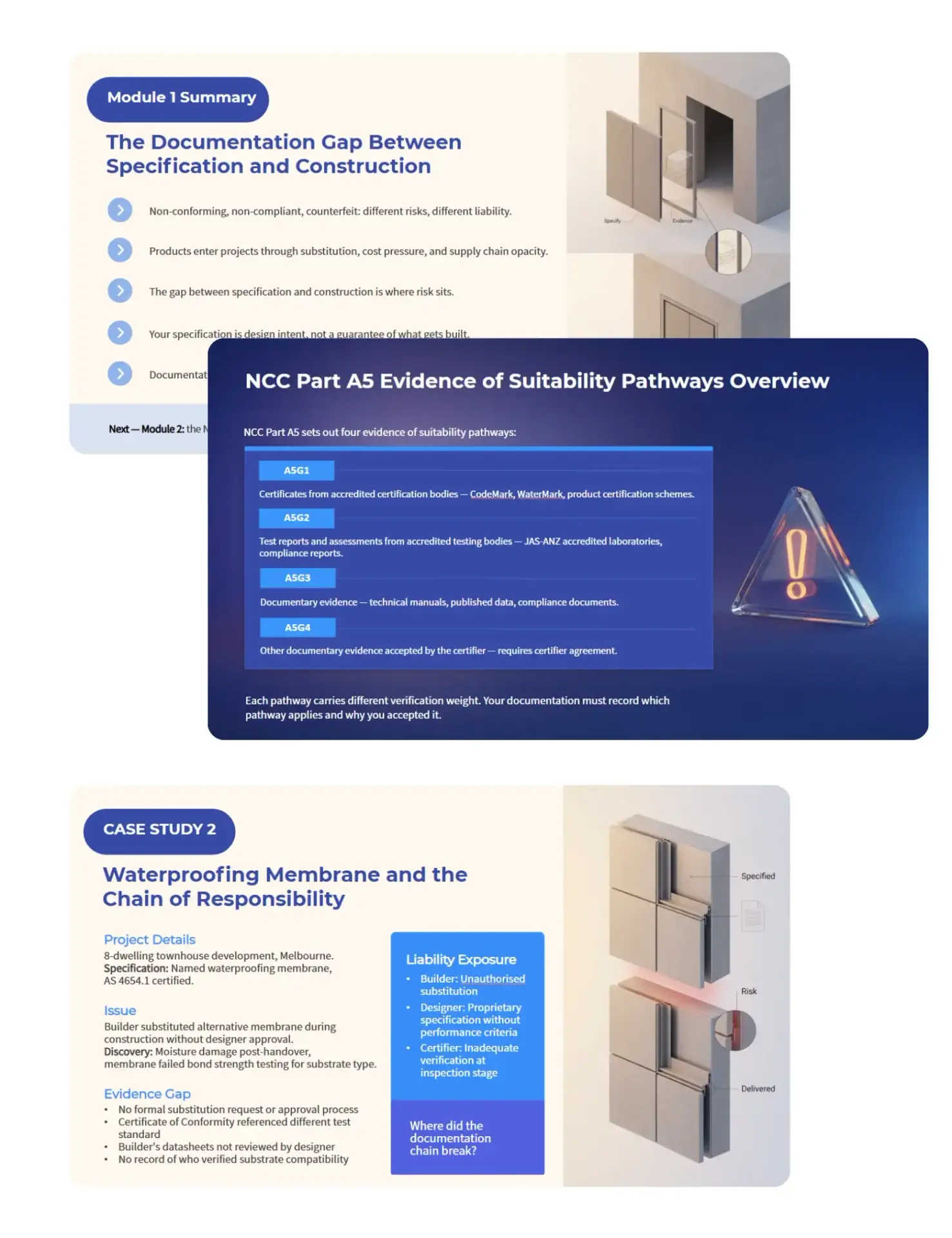
  • A 1-hour video session covering NCC-aligned strategies and real-world case studies.
  • An interactive quiz to test and reinforce knowledge.
  • An audio summary version via NotebookLM for flexible, on-the-go learning.
  • A downloadable certificate of completion for CPD compliance reporting.
  • Centralised CPD tracking dashboard to support audits and personal recordkeeping.

Why Take This CPD Session?

Understand how non-conforming products enter your projects and where your professional liability sits in the specification process.

Navigate the NCC evidence of suitability pathways with confidence and prepare your practice for the stronger compliance expectations signalled by the NCC 2025 preview.

Strengthen your documentation habits to record your product selection decisions, manage substitution requests, and clearly delineate your responsibilities from others on the project team.

Professional development is an investment in career growth and regulatory compliance. Take the next step today.