Livable Housing Design: NCC Mandatory Provisions (NCC 2022) with NCC 2025 Preview Context

Current Status

Not Enrolled

Price

A$99.00

Get Started

Course Content

I. Introduction (5 minutes)
II. Learning Objectives (2 minutes)
III. Module 1: Regulatory Framework and NCC Context (10 minutes)
V. Module 3: Mandatory Livable Housing Design Elements (20 minutes)
VII. Module 5: Practical Application and Case Examples (6 minutes)
VIII. Summary and Key Takeaways (4 minutes)

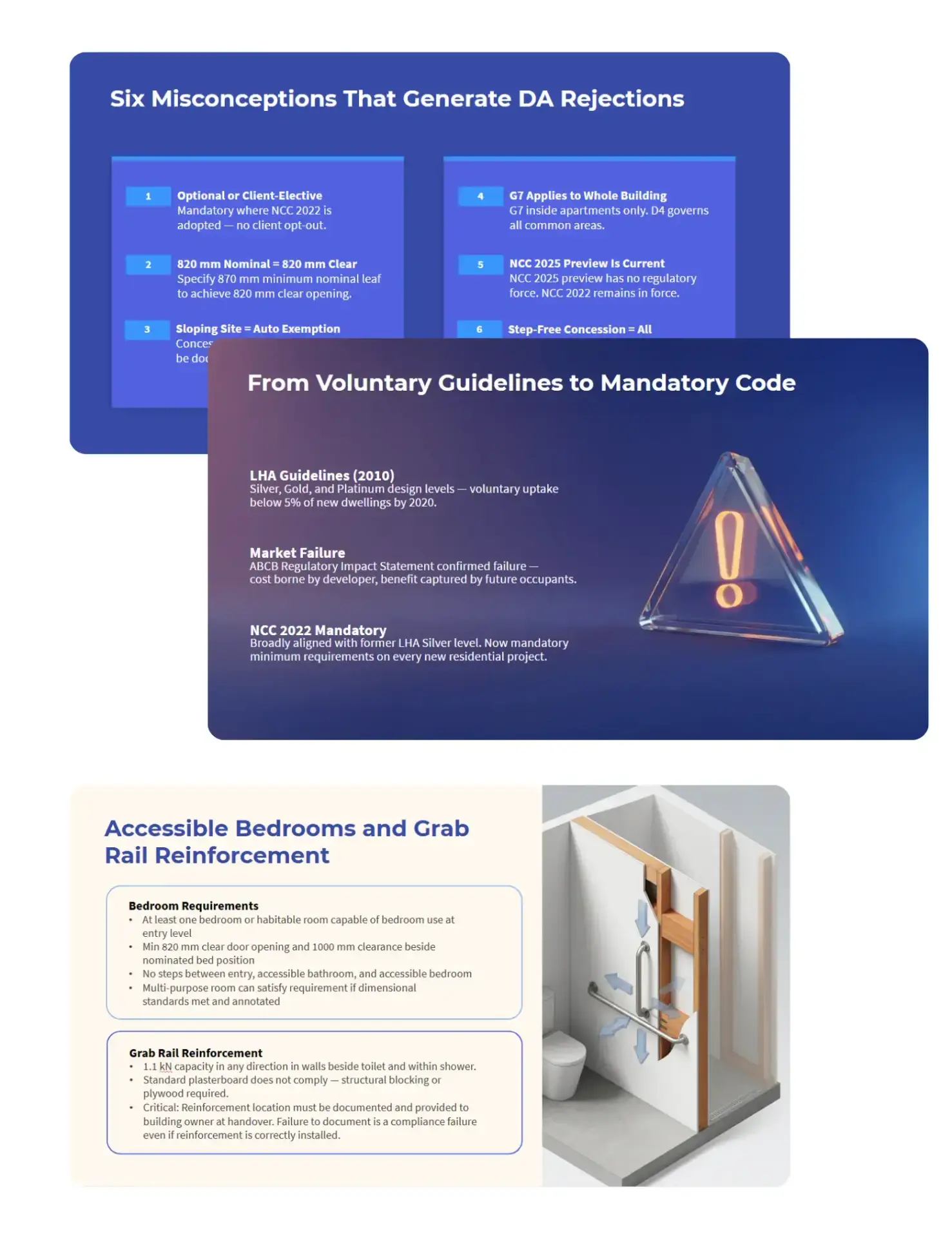
This CPD course explains how livable housing design has shifted from a voluntary guideline to a mandatory compliance requirement under NCC 2022, depending on state and territory adoption. It provides clear guidance on where the livable housing provisions sit within the NCC framework, including Volume Two Part H8, Volume One Part G7, and the ABCB Standard for Livable Housing Design. The course breaks down the key mandatory design requirements, covering step-free access, internal circulation, bathrooms, and adaptable habitable spaces. It also highlights common misconceptions and compliance risks, including misunderstandings about slope concessions and the limited scope for Class 2 buildings. Overall, the course is designed to help designers, builders, and certifiers confidently apply livable housing provisions and reduce approval and audit risk.

This CPD provides general guidance on professional responsibilities and documentation practices. It does not constitute legal advice or replace project-specific contractual or statutory obligations.

  • CPD Points: 1 Formal CPD Point
  • Duration: 1 hour
  • Certificate Upon Completion
  • Difficulty Level: Intermediate

This session is designed for

Architects
Building Designers
Building Surveyors
Licensed Builders
Residential Project Managers

By the end of the session, participants will understand how mandatory livable housing provisions are established under NCC 2022 and how the NCC 2025 preview reinforces their ongoing role within the regulatory framework. They will be able to identify which building classifications are captured, including Class 1 dwellings and Class 2 sole occupancy units, subject to jurisdictional adoption. Participants will recognise common misconceptions, scope limitations, and when concessions or Performance Solutions may be appropriately applied. They will understand the key technical requirements relating to step-free access, circulation, sanitary facilities, reinforcement, and adaptable layouts. Most importantly, they will be equipped to apply compliant design and documentation strategies that reduce approval delays, redesign risk, and professional liability.

  • Understand how livable housing provisions became mandatory under NCC 2022 and how the NCC 2025 preview confirms their ongoing direction.
  • Interpret mandatory technical requirements relating to step free access, internal circulation, sanitary facilities, and reinforcement for future adaptability.
  • Identify which building classifications are captured, including Class 1 dwellings and Class 2 sole occupancy units, subject to jurisdictional adoption.
  • Distinguish between Deemed to Satisfy pathways and Performance Solutions when demonstrating compliance with livable housing requirements.
  • Locate the relevant livable housing provisions within NCC Volume Two Part H8, NCC Volume One Part G7, and the ABCB Standard for Livable Housing Design.
  • Recognise common misconceptions, jurisdictional adoption considerations, and compliance risks associated with misinterpreting livable housing provisions.

This ensures that CPD efforts align with professional regulatory requirements.

Framework/Body

Relevant Sections

Focus Areas

National Construction Code (NCC 2022)

Volume Two Part H8; Volume One Part G7; Disability Access (Part D4 reference for Class 2 common areas); Performance Requirements; Deemed-to-Satisfy provisions; NCC 2025 Preview context

Mandatory livable housing provisions; step-free access; internal circulation widths; ground-level sanitary facilities; spatial allowances and reinforcement; Class 1 and Class 2 SOU scope; concessions for slope; Performance Solutions; jurisdictional adoption

ABSA CPD Competency Area

Regulatory knowledge; NCC compliance; Assessment pathways

Mandatory livable housing interpretation; compliance pathways; jurisdictional application; risk management

Building Designers

NCC Volume Two Part H8; ABCB Standard for Livable Housing Design

Design integration of step-free access; compliant circulation and bathroom layouts; reinforcement detailing; documentation coordination

NSCA 2021 (Architects)

PC1, PC12, PC20, PC32, PC46

Application of statutory requirements; regulatory interpretation; accessibility integration at concept stage; compliant documentation; risk management; CPD alignment with NCC topic

Engineers Australia (Stage 2)

Element 2: Engineering Application Ability; Element 3: Professional and Personal Attributes

Integration of access requirements with structural and civil design; grading and ramp feasibility; interdisciplinary coordination

Licensed Builders (State CPD)

NCC compliance obligations; construction execution requirements

Constructing step-free entrances; compliant gradients and thresholds; bathroom allowances; reinforcement installation; site constraint management

Building Surveyors

NCC assessment obligations; Performance Solution evaluation; jurisdictional legislation

Determining applicability; assessing Class 1 and Class 2 SOU compliance; evaluating Performance Solutions; transitional arrangements

Urban Planners & Landscape Architects

Site planning interfaces; statutory planning coordination; access pathways

Boundary access gradients; planning and NCC coordination; external pathway design supporting step-free access

What’s Included

This course examines the regulatory evolution that led to the inclusion of livable housing requirements within the National Construction Code. It explores how these provisions operate across different building classifications and how jurisdictional adoption affects their application. The session unpacks the practical design implications of access, circulation, sanitary facilities, and adaptable spatial planning. It also analyses how concessions and alternative compliance pathways can be applied in real project scenarios. Throughout the course, emphasis is placed on reducing compliance risk through accurate interpretation, coordinated documentation, and early design integration.

  • A 1-hour video session covering NCC-aligned strategies and real-world case studies.
  • An interactive quiz to test and reinforce knowledge.
  • An audio summary version via NotebookLM for flexible, on-the-go learning.
  • A downloadable certificate of completion for CPD compliance reporting.
  • Centralised CPD tracking dashboard to support audits and personal recordkeeping.

Why Take This CPD Session?

Gain clear, practical understanding of mandatory livable housing requirements to ensure compliant residential design and documentation.

Reduce approval delays, redesign costs, and professional liability by correctly interpreting scope, concessions, and jurisdictional adoption.

Strengthen your ability to confidently coordinate with builders, certifiers, and regulators on livable housing compliance.

Professional development is an investment in career growth and regulatory compliance. Take the next step today.