
Interpreting NatHERS Reports for Renovation Projects

Current Status

Not Enrolled

Price

A$99.00

Get Started

Course Content

I. Introduction (5 minutes)
II. Learning Objectives (3 minutes)
V. Module 3: Evaluating Existing Building Limitations (10 minutes)
VII. Summary & Key Takeaways (3 minutes)
Final Quiz – Interpreting NatHERS Reports for Renovation Projects

This CPD session teaches architects, building designers, and energy assessors how to interpret NatHERS reports specifically for renovation projects and use the results to guide practical upgrade decisions. It explains how to read key NatHERS outputs such as star ratings, heating and cooling loads, zone breakdowns, glazing schedules, and modelling assumptions. Participants learn how to identify thermal weak spots in existing homes and translate performance data into realistic design recommendations. The course also covers how NatHERS aligns with NCC 2022 requirements, including heating and cooling load limits and Whole-of-Home considerations. It finishes by showing how to develop retrofit strategies that balance compliance, comfort improvements, and condensation risk management.

This CPD provides general guidance on professional responsibilities and documentation practices. It does not constitute legal advice or replace project-specific contractual or statutory obligations.

  • CPD Points: 1 Formal CPD Point
  • Duration: 1 hour
  • Certificate Upon Completion
  • Difficulty Level: Intermediate

This session is designed for

Architects
Building Designers
Energy Assessors
Builders
Building Surveyors

By the end of this session, participants will understand how to confidently read and interpret NatHERS certificates and reports for renovation projects, including key tables, graphs, zoning outputs, and load profiles. They will be able to identify which parts of an existing dwelling are driving poor thermal performance and pinpoint practical opportunities for improvement. Participants will understand how to translate heating and cooling load data into clear, renovation-ready design advice involving insulation, glazing, shading, ventilation, sealing, and layout adjustments. They will also understand how NatHERS modelling connects to NCC 2022 compliance requirements, including heating and cooling load limits and Whole-of-Home factors. Finally, they will understand how to develop retrofit strategies that account for real-world constraints in older homes while managing condensation and moisture risks.

  • Interpret NatHERS certificates and report outputs to assess thermal performance in renovation projects.
  • Evaluate the limitations and assumptions involved in modelling older buildings and adjust retrofit advice accordingly.
  • Analyse heating and cooling load profiles to identify priority zones and thermal weak points in existing dwellings.
  • Apply NCC 2022 energy efficiency requirements, including heating and cooling load limits and Whole-of-Home considerations, to renovation compliance pathways.
  • Translate NatHERS modelling results into practical renovation design recommendations for insulation, glazing, shading, and sealing upgrades.
  • Develop evidence-based retrofit strategies that improve comfort and efficiency while managing condensation and moisture risk.

This ensures that CPD efforts align with professional regulatory requirements.

Framework/Body

Relevant Sections

Focus Areas

National Construction Code (NCC 2022)

Volume Two, Part H6; Whole-of-Home compliance; Star rating pathways

Heating and cooling load limits; energy efficiency compliance via NatHERS; integration of retrofit design strategies into NCC-aligned renovation work

NatHERS Protocols

Technical Note; Software Accreditation Protocol; Assessor Conduct Requirements

Interpretation of heating and cooling loads, use of climate files, zone configurations, and Whole-of-Home factors

ABSA CPD Competency Area

Section 2 – Thermal Modelling; Section 3 – Construction Detailing

Report reading, thermal bridging, glazing specification, envelope improvement, retrofit assessment based on modelling outcomes

Building Designers

BDAA Guidelines – Sustainable Design; Performance-based renovation practices

Renovation design aligned to NatHERS modelling; glazing upgrades, orientation-driven interventions, and Whole-of-Home performance implications

NSCA 2021 (Architects)

PC20, PC28, PC31, PC33, PC45

Understanding thermal load data, Whole-of-Home sustainability factors, and translating performance into practical design in renovations

Engineers Australia (Stage 2)

Competency 2.3, 3.2, 3.6

Technical analysis and application of NatHERS outputs in system upgrades and passive performance strategies

Licensed Builders (State CPD)

NSW: BASIX/Whole-of-Home Requirements; VIC: Section 3.12 (via NCC)

Construction implications of renovation design decisions; managing compliance via performance pathways

Building Surveyors

NCC Part H6 Assessment; Verification Method pathways

Verification of NatHERS-based solutions in Class 1 and 2 dwellings under renovation

What’s Included

This course explores how thermal modelling data can be used to uncover performance gaps in existing homes undergoing renovation. It examines how different building elements such as roofs, walls, glazing, and zoning arrangements influence overall heating and cooling demand. The content investigates how regulatory requirements shape renovation decisions when using the NatHERS compliance pathway. It also considers the practical constraints of older dwellings, including unknown construction details and site-specific limitations. Throughout the session, participants explore how to turn technical modelling outputs into clear, defensible upgrade strategies that improve comfort and energy efficiency.
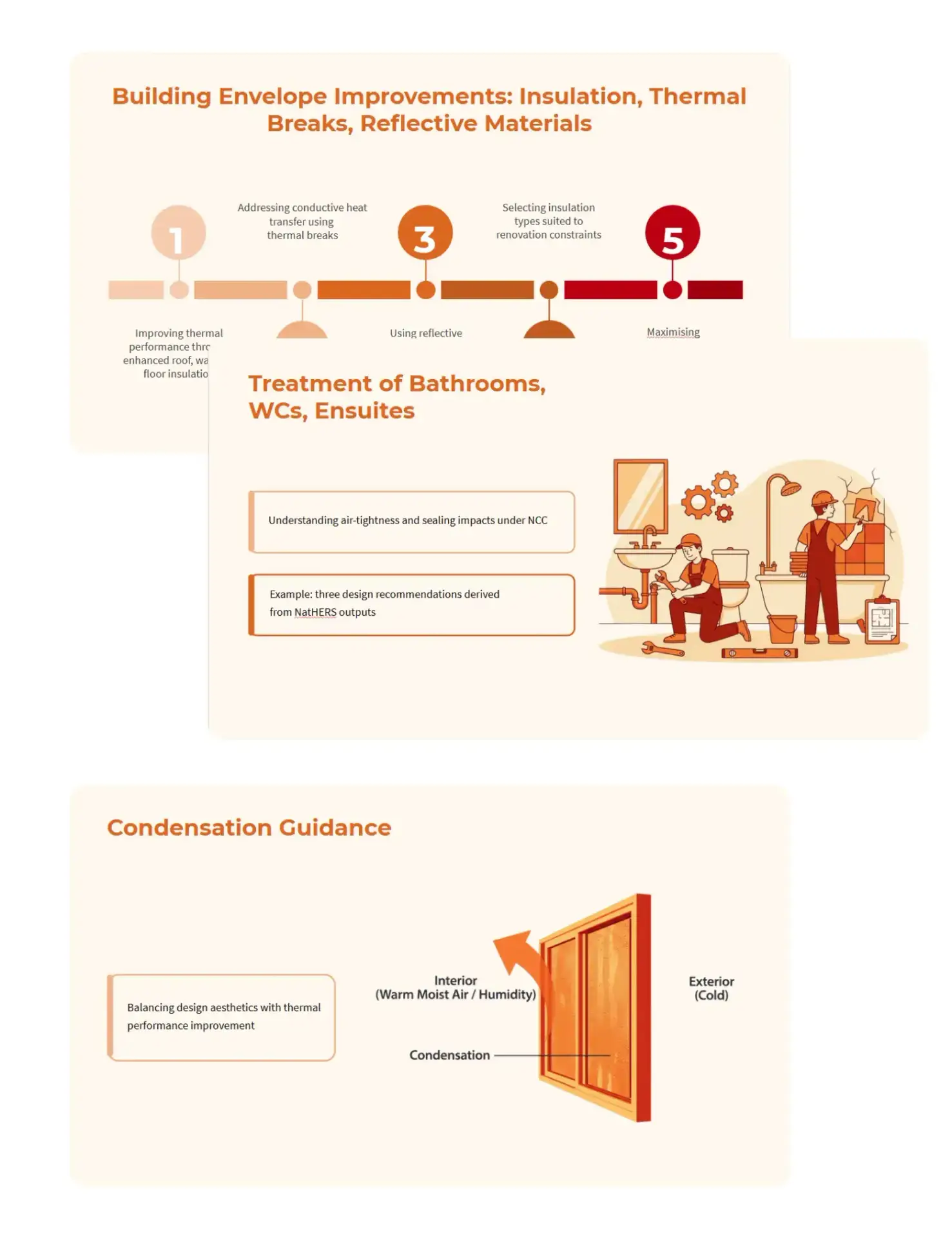
  • A 1-hour video session covering NCC-aligned strategies and real-world case studies.
  • An interactive quiz to test and reinforce knowledge.
  • An audio summary version via NotebookLM for flexible, on-the-go learning.
  • A downloadable certificate of completion for CPD compliance reporting.
  • Centralised CPD tracking dashboard to support audits and personal recordkeeping.

Why Take This CPD Session?

Gain practical skills to interpret NatHERS reports and apply the findings directly to renovation design decisions.

Strengthen your ability to deliver NCC-compliant, energy-efficient upgrades with confidence and clarity.

Improve client communication by translating technical modelling data into clear, evidence-based recommendations.

Professional development is an investment in career growth and regulatory compliance. Take the next step today.