
Garage Door Safety, Compliance & Installer Liability

Current Status

Not Enrolled

Price

A$99.00

Get Started

Course Content

I. Introduction (5 min)
II. Learning Objectives (3 min)
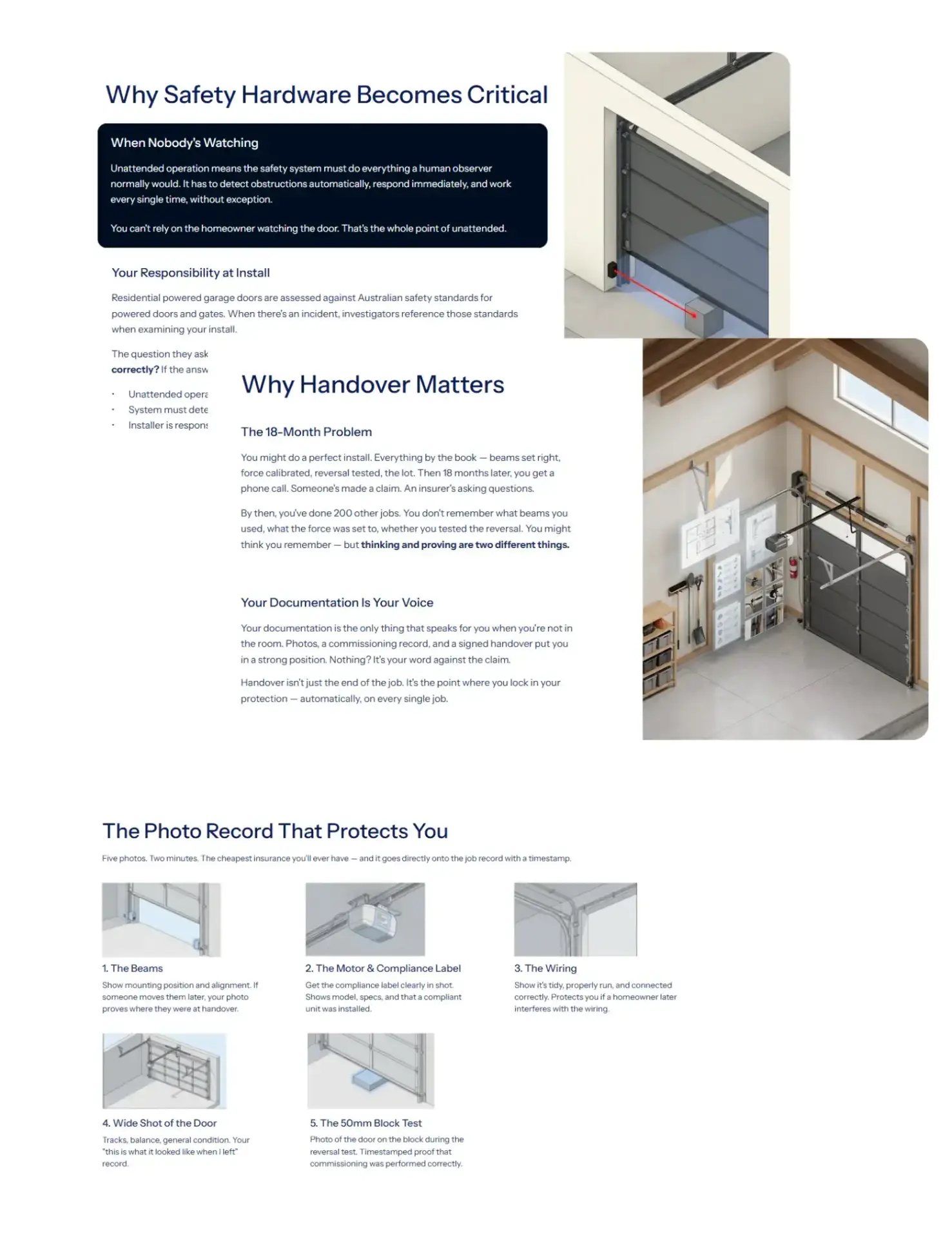
VI. Module 4: Safe Handover & Documentation Practices (13 min)
VII. Summary & Key Takeaways (5 min)
Final Quiz – Garage Door Safety, Compliance & Installer Liability

This CPD course is designed for garage door installers, technicians, and tradespeople who install, service, or upgrade residential automated garage door systems. It explains the safety, compliance, and liability risks involved when working with modern garage door motors and automation features. The course shows how technologies such as Wi-Fi modules, smartphone apps, and smart-home integrations can turn a standard door into an unattended system, which changes the safety requirements for installers. Participants learn about the correct safety hardware, commissioning procedures, and installation practices required to reduce the risk of injury and legal exposure. It also teaches installers how proper documentation, testing, and handover procedures can protect their business if an incident or insurance investigation occurs later.

This CPD provides general guidance on professional responsibilities and documentation practices. It does not constitute legal advice or replace project-specific contractual or statutory obligations.

  • CPD Points: 1 Formal CPD Point
  • Duration: 1 hour
  • Certificate Upon Completion
  • Difficulty Level: Intermediate

This session is designed for

Garage Door Installers
Door Automation Technicians
Residential Builders
Building Surveyors
Facility Maintenance Contractors


By the end of this course, participants will be able to identify when a residential garage door system is considered unattended and understand why this changes the safety requirements of the installation. They will understand what safety hardware is required for unattended operation, including the difference between standard and monitored safety beams. Participants will also be able to recognise installation scenarios that can shift legal or insurance liability onto the installer, such as Wi-Fi upgrades, retrofit automation, or missing safety devices. In addition, they will learn how to apply proper commissioning practices, including force calibration and obstruction reversal testing. Finally, they will be able to implement documentation and handover procedures that help demonstrate compliance and protect their business if an incident occurs later.

  • Identify when a residential garage door system is considered unattended and explain why this affects safety requirements.
  • Recognise installation scenarios that may transfer legal or insurance liability to the installer.
  • Describe the safety hardware required for unattended residential garage door operation.
  • Apply correct commissioning practices, including force calibration and obstruction reversal testing.
  • Distinguish between standard photoelectric beams and monitored safety beams and explain their role in system safety.
  • Implement documentation and handover procedures that demonstrate compliance and protect installer responsibility.

This ensures that CPD efforts align with professional regulatory requirements.

Framework/Body

Relevant Sections

Focus Areas

National Construction Code (NCC 2022)

NCC Volume Two – Safety of building elements; performance requirements relating to powered building components and building services; interaction with referenced Australian Standards for powered doors and gates

Compliance obligations for powered residential garage doors; safety systems required where automated doors operate without supervision; installer responsibility for compliant installation, commissioning and handover

ABSA CPD Competency Area

Risk management; compliance with building regulations; installation verification and documentation practices

Understanding safety systems for automated building components; identifying risks in retrofit installations; documentation and commissioning processes that support compliance and professional responsibility

Building Designers

Professional practice responsibilities; compliance with NCC and Australian Standards; coordination with trades and installers

Awareness of safety requirements for automated garage door systems; coordination of compliant building components; understanding installer liability and safety hardware requirements in residential projects

NSCA 2021 (Architects)

PC1, PC12, PC16, PC54, PC56

Professional responsibility for compliance with building codes and safety systems; risk management when specifying automated building elements; documentation and verification of installation compliance during construction

Engineers Australia (Stage 2)

Risk management and safety in engineering practice; systems engineering; professional accountability in design and installation

Evaluation of automated mechanical systems; safety system redundancy; identifying hazards in powered door operation; verification and commissioning of automated systems

Licensed Builders (State CPD)

Building safety compliance; coordination of subcontractors; responsibility for compliant installation of building components

Builder responsibility for ensuring installed garage doors meet applicable safety standards; recognising unsafe retrofit scenarios; managing trade interfaces and compliance verification

Building Surveyors

NCC compliance assessment; verification of building elements and building services

Regulatory compliance review of powered garage doors and safety devices; verifying installation aligns with NCC and referenced standards

Urban Planners & Landscape Architects

General built environment risk awareness; coordination of built infrastructure elements in residential development

Awareness of safety considerations for automated building infrastructure within residential developments

What’s Included

This course examines the practical risks that arise when residential garage doors are automated or upgraded with new technology. It explores how modern connectivity features and automation can alter the way a door system operates and the safety expectations that apply to installers. The course also reviews common on-site situations that can create compliance issues, particularly during retrofits, upgrades, or when working with older doors. In addition, it looks at the relationship between installers, homeowners, electricians, and manufacturers, clarifying where responsibilities begin and end. Finally, the course examines how proper testing, handover procedures, and record keeping help installers demonstrate professional practice and reduce exposure to claims or disputes.
  • A 1-hour video session covering NCC-aligned strategies and real-world case studies.
  • An interactive quiz to test and reinforce knowledge.
  • An audio summary version via NotebookLM for flexible, on-the-go learning.
  • A downloadable certificate of completion for CPD compliance reporting.
  • Centralised CPD tracking dashboard to support audits and personal recordkeeping.

Why Take This CPD Session?

Learn how modern automation features can change the safety expectations for residential garage door systems.

Understand common installation situations that can create compliance issues or increase installer liability.

Gain practical steps for testing, documentation, and handover that help protect your business and professional responsibility.

Professional development is an investment in career growth and regulatory compliance. Take the next step today.