
Balcony Waterproofing Under NCC 2025: What Has Actually Changed (and What Hasn’t)

Current Status

Not Enrolled

Price

A$99.00

Get Started

Course Content

I. Introduction (5 minutes)
II. Learning Objectives (2 minutes)
III. Module 1: Regulatory Framework and NCC Context (15 minutes)
IV. Module 2: Structural Falls and Drainage Logic (15 minutes)
V. Module 3: Thresholds, Hobs and High-Risk Interfaces (15 minutes)
VII. Summary and Key Takeaways (5 minutes)

This course examines balcony waterproofing requirements under NCC 2022 and the NCC 2025 preview, focusing on what has materially changed and what remains consistent. It explains the increased emphasis on structural substrate falls, threshold step downs, perimeter hobs, and clearly defined drainage connections. Participants learn why finish dependent approaches such as screed to fall only detailing now carry greater compliance and defect risk. The session also clarifies the legal status of NCC 2025 and outlines transition considerations ahead of potential jurisdictional adoption from May 2026. Practical documentation strategies are provided to help designers reduce redesign, certification delays, and long term liability exposure.

This CPD provides general guidance on professional responsibilities and documentation practices. It does not constitute legal advice or replace project-specific contractual or statutory obligations.

  • CPD Points: 1 Formal CPD Point
  • Duration: 1 hour
  • Certificate Upon Completion
  • Difficulty Level: Intermediate

This session is designed for

Architects
Building Designers
Structural Engineers
Building Surveyors
Licensed Builders

By the end of this course, participants will be able to interpret balcony waterproofing provisions within Volume One Section F with greater technical confidence. They will recognise how slab set downs, fall direction, and outlet positioning influence real world drainage performance. Attendees will be able to assess whether their standard details rely too heavily on finishes rather than permanent structural geometry. They will also understand how threshold levels, door systems, and balustrade penetrations interact with membrane design and water containment. In addition, they will leave with practical insight into producing clearer drawings that support smoother certification and reduce post construction defect exposure.

  • Interpret balcony waterproofing obligations under NCC Volume One Section F in practical design terms.
  • Identify detailing conditions that increase the likelihood of water ingress and long term defects.
  • Evaluate structural slab geometry to ensure adequate falls toward compliant drainage outlets.
  • Coordinate structural, architectural, and hydraulic elements to support effective balcony drainage.
  • Analyse threshold levels and perimeter upstands to improve water containment performance.
  • Produce clear, dimensioned documentation that strengthens compliance outcomes and reduces liability risk.

This ensures that CPD efforts align with professional regulatory requirements.

Framework/Body

Relevant Sections

Focus Areas

National Construction Code (NCC 2022)

Volume One – Section F; Performance Requirements (moisture management); Deemed-to-Satisfy pathways; Evidence of Suitability

Balcony waterproofing compliance intent; prevention of water ingress; structural substrate falls (1:80); threshold step-down logic (70 mm); drainage connection to compliant stormwater; membrane termination detailing; DTS vs Performance Solutions

ABSA CPD Competency Area

Building Physics; Moisture Management; NCC Compliance; Building Fabric

Water ingress prevention in Class 2–9 buildings; structural fall formation vs screed-only falls; drainage clarity; balcony detailing risk mitigation; certification defensibility

Building Designers

NCC compliance obligations; Construction detailing; Documentation standards

Translating Performance Requirements into measurable geometry; slab set-down coordination; threshold detailing; membrane termination heights; structure/façade/hydraulic integration; defect risk reduction

NSCA 2021 (Architects)

PC12, PC32, PC39, PC45, PC46

Application of building codes; statutory compliance; risk management; documentation accuracy; quality assurance; defect identification; construction phase inspection

Engineers Australia (Stage 2)

Stage 2 Competency – Element 1 (Knowledge); Element 2 (Engineering Application); Element 3 (Professional Attributes)

Structural grading for falls; durability and serviceability of balcony slabs; structural and hydraulic coordination; water ingress risk assessment; compliance documentation

Licensed Builders (State CPD)

Waterproofing; Structural Compliance; NCC Updates

Construction implementation of structural falls; sequencing; threshold and hob construction; membrane termination compliance; regulatory awareness; defect prevention

Building Surveyors

NCC Volume One compliance assessment; Performance Solution assessment; Evidence of Suitability review

Assessment of balcony drainage compliance; structural fall geometry review; documentation scrutiny; interpretation of NCC 2025 preview amendments; compliance risk identification

What’s Included

This course examines how balcony water management is assessed from both a regulatory and buildability perspective within multi residential and commercial buildings. It explores the technical relationship between slab design, drainage strategy, membrane continuity, and façade interfaces. The session reviews how evolving compliance expectations influence common detailing practices used in current projects. It also considers where misalignment between design documentation and on site construction typically creates exposure to defects and disputes. Overall, the course investigates how stronger geometric control and clearer coordination can improve long term performance outcomes.
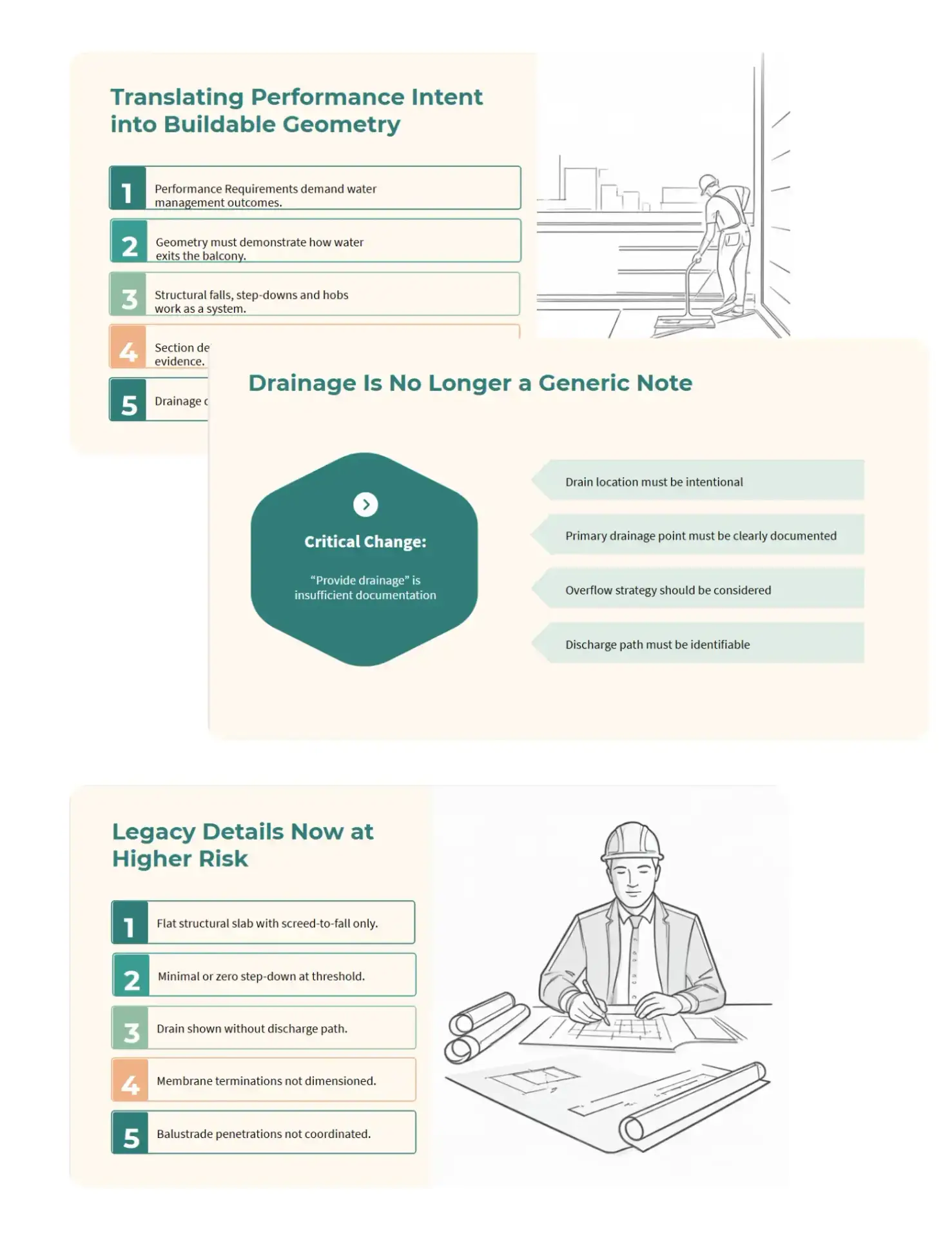
  • A 1-hour video session covering NCC-aligned strategies and real-world case studies.
  • An interactive quiz to test and reinforce knowledge.
  • An audio summary version via NotebookLM for flexible, on-the-go learning.
  • A downloadable certificate of completion for CPD compliance reporting.
  • Centralised CPD tracking dashboard to support audits and personal recordkeeping.

Why Take This CPD Session?

Gain practical insight into reducing balcony water ingress risk before it becomes a costly defect or dispute.

Strengthen your compliance knowledge to support smoother certification and approval processes.

Improve the clarity and defensibility of your documentation to minimise redesign and liability exposure.

Professional development is an investment in career growth and regulatory compliance. Take the next step today.