

Course Content
By the end of this session, you will understand what thermal bridging is, how it occurs in residential construction, and why it impacts energy performance and compliance with NCC 2022. You’ll be able to identify common thermal bridge locations and explore practical design strategies to mitigate them. The course also equips you to address thermal bridging effectively even without the use of advanced modelling tools like AccuRate. This knowledge supports better detailing, improved comfort, and stronger regulatory outcomes in your residential projects.
Learning Outcomes
This ensures that CPD efforts align with professional regulatory requirements.
The “Thermal Bridging in Residential Design: From Concept to Modelling” CPD course is an intermediate-level training designed for building designers, energy assessors, and engineers seeking practical and regulatory knowledge on thermal bridging in Australian homes. It explores how thermal bridging affects energy efficiency, comfort, and compliance with NCC 2022, and provides actionable design and detailing strategies even without advanced modelling tools. Through detailed modules, case studies, and visual aids, the course equips professionals to identify, assess, and mitigate thermal bridges for better real-world performance and regulatory outcomes.
This CPD provides general guidance on professional responsibilities and documentation practices. It does not constitute legal advice or replace project-specific contractual or statutory obligations.
Compliance and Accreditation
|
Framework/Body |
Relevant Sections |
Focus Areas |
|
National Construction Code (NCC 2022) |
Volume Two, Part H6P1; Whole-of-Home (WOH) Efficiency |
Thermal envelope performance, heat flow minimisation, compliance via DTS vs Performance Solutions, implications for Class 1 buildings |
|
NatHERS Protocols |
2024 Technical Note 20241023 |
Modelling limitations of thermal bridges in AccuRate/HERO, impacts on WOH ratings, assumptions in star ratings, slab edge inputs |
|
ABSA CPD Competency Area |
Thermal Envelope Modelling; Design Assessment |
Interpretation of simulation outputs, risk identification, “no-software” checklist development, reflective of practical assessment competencies |
|
Building Designers |
Performance Detailing; Materials Specification |
Continuity of insulation, junction design, thermal break integration, passive design techniques, buildability trade-offs |
|
NSCA 2021 (Architects) |
PC10, PC28, PC31, PC33, PC45 |
Whole life carbon, environmental systems integration, sustainable detailing, risk in envelope design, material conductivity in design decisions |
|
Engineers Australia (Stage 2) |
2.4 Addressing Sustainability; 2.5 Engage with Risk |
Heat transfer mechanisms, structural impacts of thermal breaks, integration of services in passive solutions |
|
Licensed Builders (State CPD) |
CPD Compliance linked to NCC 2022 and construction details |
Site-specific applications of thermal breaks, understanding common bridging areas in construction (slab edges, cantilevers) |
|
Building Surveyors |
NCC Interpretation; Performance Verification Pathways |
Judging DTS vs Performance path compliance, risk categorisation in thermal envelope design, plan reviews for bridging indicators |
This session is designed for

Energy Assessors

Engineers

Building Designers

Builders

Architects
What’s Included
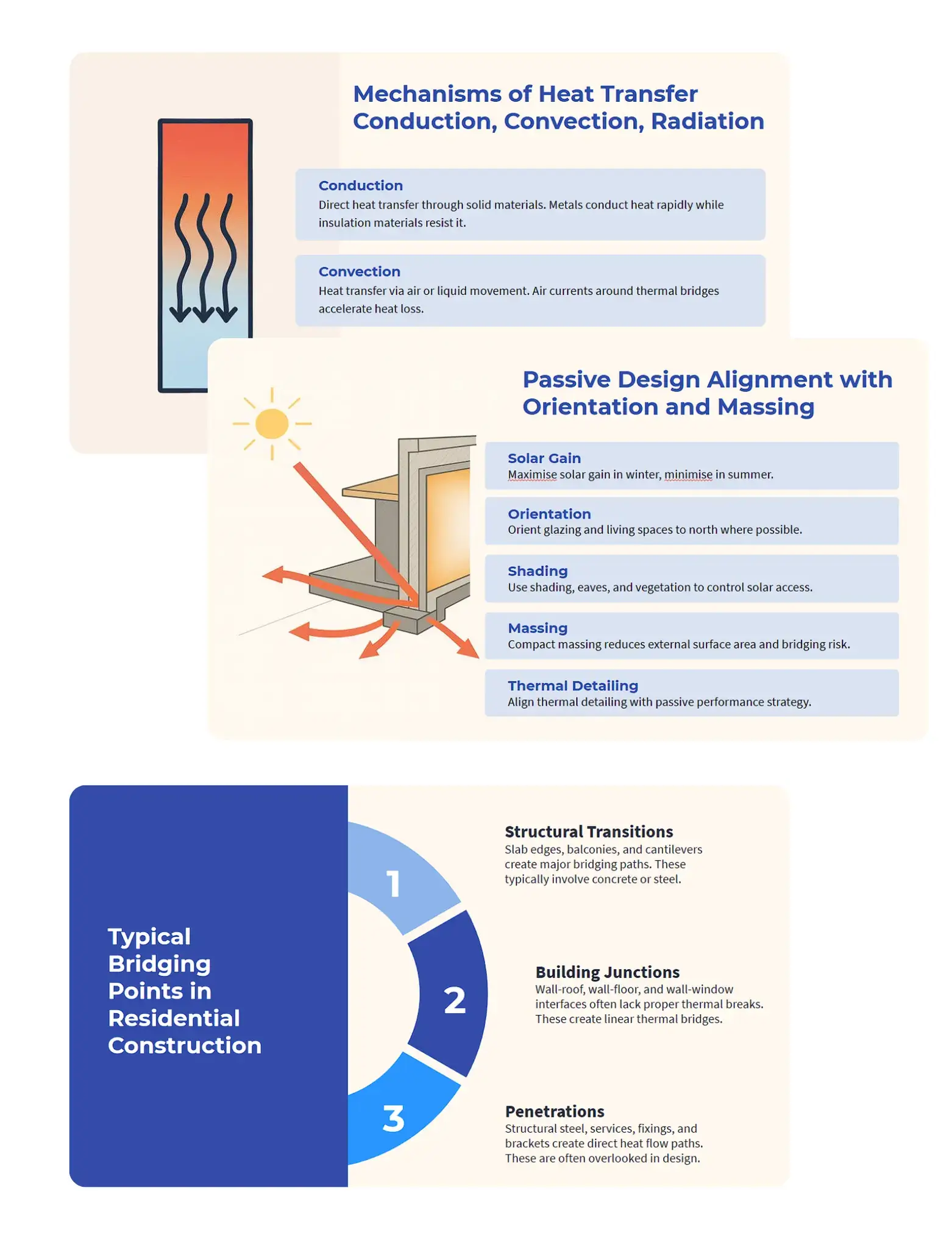
This course covers the fundamentals of thermal bridging in Australian residential design, including its causes, types, and real-world impacts on energy efficiency, occupant comfort, and building durability. It explores how thermal bridges compromise insulation performance and how to identify them at common locations such as slab edges, junctions, and penetrations. The course also examines the regulatory context, focusing on compliance with NCC 2022 and Whole-of-Home efficiency requirements, and highlights the limitations of NatHERS tools in modelling thermal bridging. Participants will learn practical strategies for mitigating thermal bridging through detailing, material choices, and “no-software” design approaches. Case studies, diagrams, and checklists support the application of best-practice solutions in both new builds and retrofits.
Why Take This CPD Session?

Enhance your compliance knowledge by understanding how thermal bridging affects NCC 2022 and Whole-of-Home energy efficiency requirements.
Gain practical design strategies to identify and mitigate thermal bridging using real-world examples, detail drawings, and passive design principles.
Improve project outcomes by delivering more comfortable, energy-efficient homes even without relying on advanced modelling tools.
Professional development is an investment in career growth and regulatory compliance. Take the next step today.