

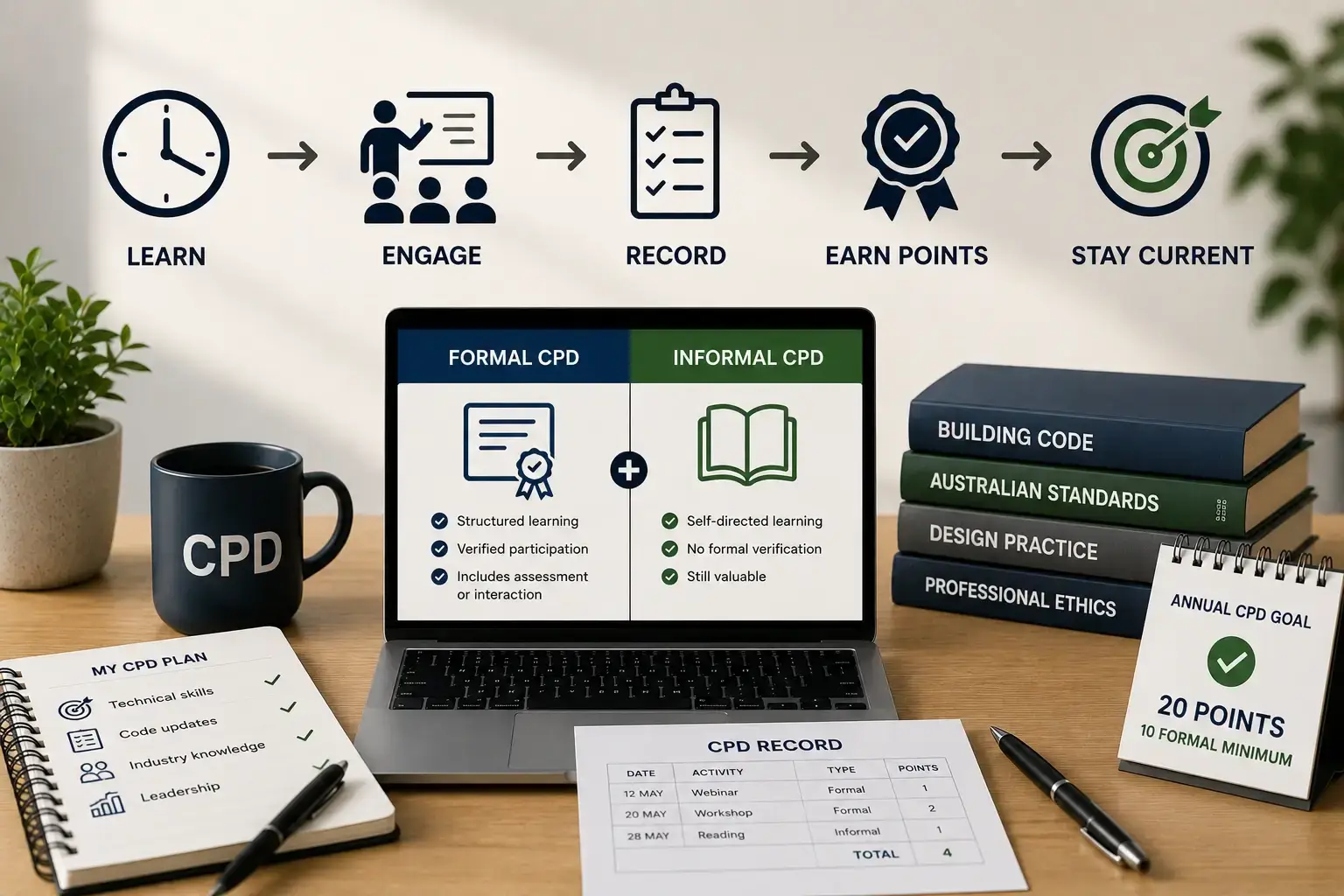
What Is a CPD Point? How the Australian System Actually Works
A CPD point is a unit of measurement used by Australian registration boards and professional associations to record how much structured learning you have completed in a year. In almost every Australian scheme, one CPD point equals one hour of relevant learning activity. Your annual CPD obligation is then expressed as a number of points or hours that you need to reach to keep your registration, accreditation, or membership current.
That is the whole concept. The rest of this article is the detail: what counts, what does not, how to earn points, and the common mistakes that catch out practitioners in their first CPD year.
Why CPD Exists in the First Place
Continuing Professional Development is the formal name for the lifelong learning expected of professionals to stay current in their field. In the Australian built environment, CPD is not optional. It is built into the regulations that govern registration as an architect, building designer, engineer, building surveyor, energy assessor, residential builder, or interior designer. The body that gives you the right to practise is the same body that sets the CPD bar you need to clear each year.
The purpose is straightforward. The National Construction Code changes. Australian Standards change. Practice expectations change. CPD is the mechanism that confirms practitioners are keeping up. Skip it, and the regulator has grounds to refuse your renewal.
For new practitioners coming out of a degree or trade qualification, CPD can feel like another piece of admin. After a year or two, most professionals discover the more useful framing: CPD is the budget you have to invest in your own competence, and the people who plan it deliberately are the people whose careers compound fastest.
The One-Hour Rule
Across nearly every Australian CPD scheme covered on this site, one point represents one hour of relevant learning. A 60-minute webinar earns you one point. A two-hour workshop earns you two. A half-day conference session earns you roughly four.
The exceptions are narrow but worth knowing. Authoring published technical content, peer-reviewing technical work, and teaching at a tertiary level often attract a higher points value per hour because of the depth of preparation involved. Some bodies cap how many of your annual points can come from those categories, which keeps the scheme honest. If you are pursuing those activities, check the specific scheme rules.
For ordinary structured learning (courses, webinars, workshops, technical seminars), one-to-one is the working rule.
Formal CPD versus Informal CPD
This is the distinction that catches the largest number of practitioners out at audit. Every Australian scheme that requires CPD distinguishes between formal and informal learning. The boundary between them is consistent enough to memorise once and apply everywhere.
Formal CPD is a structured educational activity with defined learning outcomes and either an assessment, a quiz, or significant interaction between the presenter and the participant. The defining test is whether your engagement was verified. If someone confirmed that you participated, paid attention, and demonstrated understanding, the activity counts as formal. Examples include online courses with a quiz, attended workshops with active facilitation, accredited webinars with verification of attendance, and tertiary-level courses.
Informal CPD is self-directed learning that is relevant to your practice but lacks the structured verification. Reading a technical paper, listening to an industry podcast, attending a non-assessed presentation, watching a recorded session without a quiz, or having a mentoring conversation with a senior practitioner. The learning is real. The verification is not.
Most schemes require a minimum portion of formal CPD each year. Building designers under BDAA need 10 of their 20 points to be formal. Architects under every state board need 10 of their 20 hours to be formal. NatHERS energy assessors need 6 of their 12 points to be formal technical. The formal minimum is the part you cannot skip by reading at home.
If you only do one thing differently in your next CPD year, plan your formal hours first. Top up with informal at the end. Most audit failures come from practitioners who racked up plenty of informal hours and assumed they would be enough.
How Different Schemes Apply the Same Concept
Australian CPD looks complicated because so many bodies have their own scheme. The point system itself is broadly consistent. What varies is the total number of points you need, the formal-to-informal split, the mandatory topics, and the reporting cycle.
A short summary by profession:
| Profession | Total annual CPD | Formal minimum |
| Architect (every state) | 20 hours | 10 hours formal |
| Building designer (BDAA) | 20 points | 10 formal, 10 informal |
| Chartered engineer (Engineers Australia) | 150 hours over 3 years | Subdivided by category |
| Energy assessor (NatHERS) | 12 points | 6 formal technical |
| NSW residential builder | 12 points | Across 8 approved learning areas |
| NSW building certifier | 25 points | Set components mandatory |
| Interior designer (DIA Accredited) | 50 points | Broad activity types eligible |
The full state-by-state breakdown is covered in How Many CPD Points Do I Need in 2026? A State-by-State Guide. For now, the takeaway is that the unit is the same across every scheme: one point, one hour, with a formal minimum baked in.
What Counts as a CPD Activity
A learning activity earns CPD when three conditions are met.
One. It is relevant to your professional practice. A bookkeeping seminar will not earn an architect formal CPD. A NCC 2025 commercial energy update will. The activity needs to fit inside the competency framework your registration body uses.
Two. It produces a learning outcome. Reading the agenda of a conference does not count. Sitting through the session, demonstrably engaging with the material, and being able to articulate what you learned does.
Three. You can prove you did it. Certificates, attendance records, assessment results, dated digital records in your platform dashboard. The standard of proof differs by scheme, but no scheme accepts an honour-system declaration without supporting evidence.
The activities that most commonly earn CPD points across Australian schemes:
- Online courses with verified completion and a quiz
- Technical webinars with attendance verification
- In-person workshops and seminars with facilitation
- Conferences with attended session records
- Tertiary courses at university or TAFE level
- Authoring published technical content
- Mentoring and peer-review activities (often informal)
- Reading technical publications and Australian Standards (informal)
- Site visits with documented learning outcomes (informal)
CPD On Demand courses sit firmly in the formal category. Each course is one hour, has defined learning outcomes, includes a quiz, and produces a dated certificate of completion stored in your dashboard. That structure is what your registration body is looking for when it audits.
How to Track and Record Your Points
This is the part most new practitioners underestimate. Earning the points is the easier half. Proving you earned them, two years later, when the audit notice arrives in your inbox, is where careers come unstuck.
The minimum you should hold for every CPD activity:
- A dated certificate of completion or attendance
- The title and learning outcomes of the activity
- The duration in hours
- The name of the provider or facilitator
- Whether the activity was formal or informal
Most registration bodies require you to retain this evidence for five to seven years. NSW ARB asks for five. Engineers Australia asks for the triennial cycle plus the audit window. NSW Fair Trading wants three years for builder CPD records. The right answer if you are unsure is to keep everything for seven years.
The simplest tracking system is the one you will actually maintain. Three options work well:
A platform dashboard. If most of your CPD comes through a single provider, their dashboard becomes your central record. CPD On Demand stores every certificate in your dashboard indefinitely, mapped to the relevant Performance Criteria codes.
A spreadsheet. One row per activity, columns for date, title, provider, duration, formal or informal, and a link or attachment for the certificate. Save it to cloud storage. Update it the day you complete each activity, not the week before your renewal.
A folder system. A dated folder per CPD year, containing PDFs of every certificate and a summary document. Effective for people who prefer files to spreadsheets.
What does not work is relying on the provider to keep the records for you indefinitely, especially if you change providers. Once the platform is gone or your account lapses, the evidence is gone. Download and store your certificates the day you earn them.
Common Beginner Mistakes
Five mistakes account for the vast majority of CPD problems in a practitioner’s first registration year.
Counting all attendance as formal. A conference is not automatically formal CPD. The sessions you attended with verification of engagement might be formal. The networking lunch was not. Apply the formal test to each activity individually, not to the whole conference badge.
Leaving CPD to the last quarter. Most schemes will accept the points you earn in the final month of your CPD year. The problem is that when something goes wrong, a website outage, a missed quiz, a course that did not provide a certificate, you have no recovery window. Spreading your CPD across the year is risk management as much as learning strategy.
Assuming product-sponsored CPD always counts. Supplier presentations are a legitimate CPD source if they meet the formal criteria: stated learning outcomes, verified engagement, and substantive technical content that is not just a product pitch. Many do not meet that bar. Check whether the session has been accredited by your registration body before counting it.
Skipping the mandatory topics. Most schemes mandate that part of your formal CPD addresses specific topics: NCC, sustainability, ethics, conduct. NSW architects must dedicate at least 3 hours of their 10 formal hours to mandatory topics. Energy assessors must include NCC energy provisions in their formal technical points. Topping up with random formal CPD that ignores the mandatory list is the most common audit-failure pattern.
Not knowing which body you report to. Plenty of practitioners hold both a state registration and a professional association membership. Many hold accreditation through more than one association. Each body has its own CPD requirements. The state regulator’s rules generally take precedence, but you still need to meet the others if you want to retain membership and the accreditation rights that go with it.
How CPD On Demand Fits
CPD On Demand is built for one thing: removing friction from formal CPD compliance for built environment practitioners across Australia.
Every course is one hour long, which equals one CPD point under almost every scheme. Every course has defined learning outcomes, a quiz, and produces an instant certificate of completion stored in your dashboard. The certificate records the title, the date, the learning outcomes covered, and the relevant Performance Criteria codes mapped to the activity. That is exactly the evidence structure your registration body is looking for at audit.
Pricing is flat. Each course is $79. There is no subscription, no upsell, no supplier sales pitch dressed up as education. The platform was built because the existing market was too expensive, too slow, and too dominated by product-funded sessions. The brief for every topic is straightforward: teach the thing the supplier-funded CPD market is structurally unwilling to teach, because the honest answer would not sell a specific product.
If you are early in your CPD journey, the easiest place to start is your discipline category. Architects. Building designers. Energy assessors. Trades. Pick the first course that addresses a mandatory topic for your scheme. Do it this week. The hardest part of CPD is finishing the first course. Everything after that is rhythm.
Frequently Asked Questions
What is a CPD point in simple terms?
A CPD point is a unit used by Australian registration boards and professional associations to measure structured learning. In nearly every Australian scheme, one CPD point equals one hour of relevant learning activity.
How many CPD points equal one hour?
One. In almost every Australian built environment CPD scheme, one point equals one hour of relevant structured learning. Exceptions exist for authoring, teaching, and peer review, which can attract higher per-hour values under specific scheme rules.
What is the difference between formal and informal CPD?
Formal CPD is structured learning with defined outcomes and either an assessment, a quiz, or significant interaction between presenter and participant. Informal CPD is self-directed learning that lacks the structured verification. Most Australian schemes require a minimum portion of formal CPD each year.
Do online courses count as CPD?
Yes. Online courses count as formal CPD when they have defined learning outcomes, include a quiz or assessment, and provide a certificate of completion. CPD On Demand courses meet all three criteria.
How long do I need to keep my CPD records?
Five to seven years depending on the scheme. NSW ARB requires five. Engineers Australia requires the triennial cycle plus audit window. The safe default is to keep all CPD evidence for seven years.
What happens if I do not meet my CPD requirement?
The consequences depend on the body. NSW Fair Trading can refuse a builder’s licence renewal if 12 points are not on file. State architect registration boards can suspend or downgrade registration. NatHERS Accredited Assessor Organisations can suspend or lapse an assessor’s accreditation. CPD is not optional once registration depends on it.
Can I count last year’s leftover CPD points?
It depends on the scheme. NSW builders can carry forward up to 11 surplus points for 12 months. NSW certifiers can carry up to 10. Most other schemes do not allow carryover. Check your specific scheme before relying on it.
Where can I find out exactly how many points I need?
The full breakdown by profession and state is covered in How Many CPD Points Do I Need in 2026? A State-by-State Guide. For NCC-specific CPD planning, see NCC 2025 vs NCC 2022: What Changed and What It Means for Your Practice.
What to Do Next
Three things move you from new-to-CPD to fully compliant in your first year.
One. Confirm which body or bodies set your CPD requirements. State regulator, professional association, or both. Write down the total annual points and the formal minimum.
Two. Pick one course that addresses a mandatory topic for your scheme and complete it this month. Starting clears the psychological barrier and gives you a working dashboard to build on.
Three. Set up your tracking system. Dashboard, spreadsheet, or folder. Update it the same day you complete each activity. Your future self, the one staring down an audit notice, will be grateful.
The Australian CPD system is not difficult once you understand the unit. One hour. One point. Verified learning. Recorded outcomes. Repeat until your number is met. The professionals who treat it as a quarterly habit rather than an annual emergency are the ones whose registration renewals are never in question.
The opposite of someday is today.